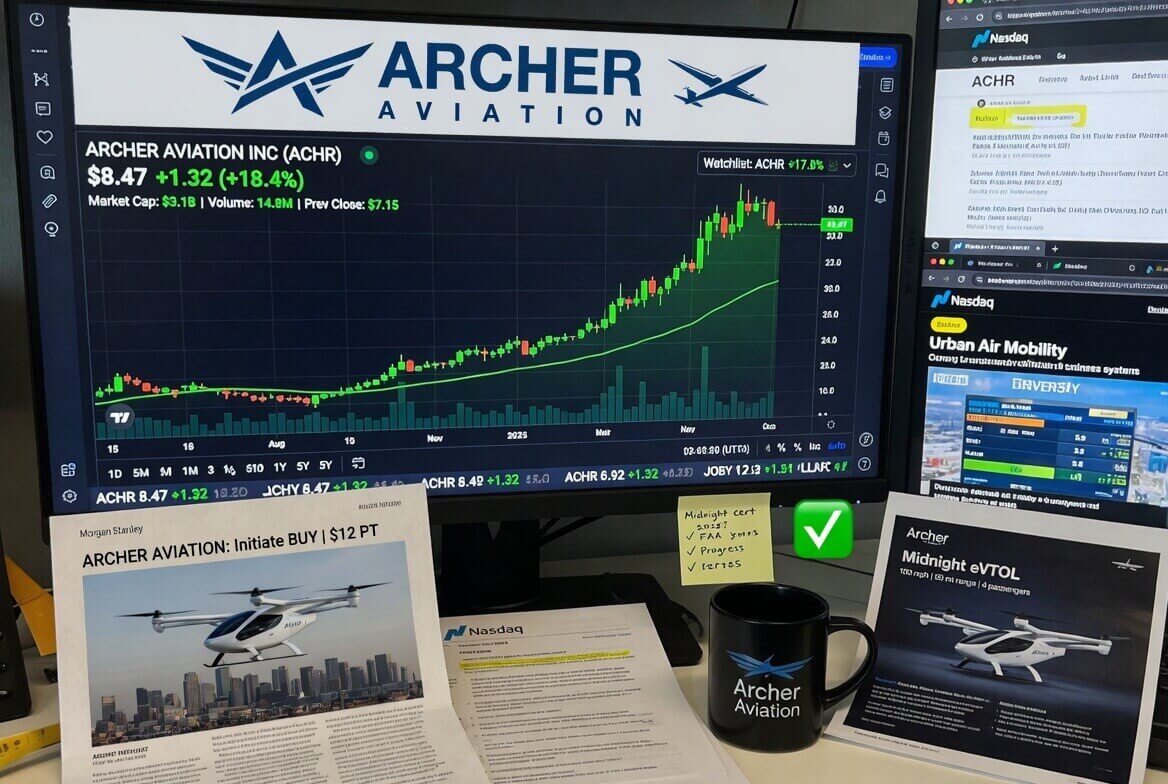
Archer Aviation is one of the most debated stocks in the US market right now. Supporters call it the future of urban transport. Critics call it a cash furnace with no revenue. Both sides have a point. This analysis gives you the real picture, with verified numbers, the latest developments as of May 26, 2026, and a clear view of what this investment actually requires to work.
One important note before we start: this is a pre-revenue company burning through roughly $700 million per year. The 2026 revenue forecast of $184 million that circulates on financial sites is a Wall Street estimate, not a result. Treat every forward number in this article as a projection, not a fact. We will flag every estimate clearly.
What Is Archer Aviation
Archer Aviation (NYSE: ACHR) is an electric air taxi company founded in San Jose, California in 2018. It builds eVTOL aircraft, meaning electric vertical takeoff and landing planes that lift off like a helicopter and fly like a small airplane.
Its flagship aircraft is called Midnight. It is designed to carry one pilot and four passengers on city routes of 20 to 60 miles at speeds up to 150 miles per hour. The target use case is simple: instead of sitting in 45 minutes of LA traffic to reach the airport, you take a 12-minute Midnight flight for roughly $60 to $100.
The company went public via SPAC in October 2021 at a reference price of $9.99. As of today, May 26, 2026, it trades near $6.35, meaning anyone who bought at the SPAC price is down roughly 37%.
The Snapshot: Key Data
| Metric | Data |
|---|---|
| Ticker | NYSE: ACHR |
| Price (May 26, 2026) | ~$6.35 |
| 52-Week Range | $4.80 to $14.62 |
| Market Capitalization | ~$4.8 billion |
| Shares Outstanding | 759.6 million |
| YTD Performance 2026 | approximately -25% |
| Beta | 3.13 (extremely high volatility vs market) |
| FY2025 Revenue (Actual) | $300,000 |
| Q1 2026 Revenue (Actual) | $1.6 million |
| Q1 2026 Net Loss (Actual) | $217.7 million |
| Cash and Short-Term Investments (March 31, 2026) | $1.78 billion |
| Quarterly Cash Burn | approximately $170 to $200 million |
| Debt | approximately $81 million |
| Employees | approximately 1,660 |
| Dividend | None |
| Next Earnings Date | August 10, 2026 (estimated) |
Figures come from CNBC, SEC filings and TipRanks as of May 26, 2026.
The Financials: What the Numbers Actually Say
Revenue Reality Check
In all of 2025, Archer generated $300,000 in revenue. That is not a misprint. Three hundred thousand dollars from a company with a $4.8 billion market cap. The entire revenue line came from early UAE program payments and minor defense work.
In Q1 2026, revenue came in at $1.6 million, which actually beat the analyst estimate of $900,000. That beat does not change the picture materially. The company is spending $256 million per quarter and collecting $1.6 million. The ratio is striking.
The Cash Burn Problem
Q1 2026 operating cash use was $149.1 million. Free cash flow was approximately negative $181.7 million. Management guided Q2 2026 adjusted EBITDA loss of $170 to $200 million, similar to Q1. The annualized burn rate is therefore somewhere between $680 million and $800 million per year.
With $1.78 billion in liquidity as of March 31, 2026, simple math gives Archer roughly 9 to 10 quarters of runway at current burn before it needs more capital. That is approximately two to two and a half years, assuming spending does not accelerate further.
Management has stated that additional financing may be needed if business plans expand. That is corporate language for: we will probably raise more money. Every raise dilutes existing shareholders. At 759.6 million shares outstanding, that dilution pool is already large.
| Financial Metric | Q1 2025 | Q1 2026 |
|---|---|---|
| Revenue | Not material | $1.6 million |
| Net Loss | $93.4 million | $217.7 million |
| R&D Spending | N/A | $171.7 million |
| Total Operating Expenses | N/A | $256.2 million |
| Adjusted EBITDA Loss | N/A | $172.5 million |
| Operating Cash Use | N/A | $149.1 million |
| EPS (GAAP) | -$0.17 | -$0.28 (beat estimate of -$0.32) |
| Cash + Short-Term Investments | N/A | $1.78 billion |
Source: Archer Aviation Q1 2026 8-K, StockTitan, Benzinga. As of May 11, 2026.
Forward Revenue Estimates: Use With Caution
The table below shows what Wall Street expects. These are analyst estimates, not guidance from Archer. The jump from $300,000 in 2025 to $184.7 million in 2026 requires UAE commercial operations and US eIPP program revenue to begin flowing this year. If either timeline slips, these numbers get revised sharply downward.
| Year | Revenue Estimate | Net Loss Estimate | EPS Estimate |
|---|---|---|---|
| FY 2025 (Confirmed Actual) | $300,000 | $618 million | -$0.99 |
| FY 2026 (Analyst Consensus) | ~$184.7 million | ~$167 million | -$0.75 |
| FY 2027 (Analyst Consensus) | ~$577.7 million | N/A | -$0.58 |
| FY 2028 (Analyst Consensus) | ~$1.27 billion | N/A | -$0.28 |
Source: TickerGate, TipRanks, StockAnalysis. Analyst consensus as of May 2026. These are estimates, not guaranteed outcomes.
The FAA Certification Timeline: The Only Metric That Really Matters
Everything in this story depends on one outcome: FAA Type Certification for the Midnight aircraft. No certification, no US commercial operations. It is that simple.
Where Archer Stands Today
As of May 2026, Archer has completed Phase 3 of 4 in the FAA Type Certification process. More importantly, it became the first eVTOL manufacturer in the world to achieve 100% FAA acceptance of its Means of Compliance. This is the technical document that establishes exactly how Archer will prove Midnight meets airworthiness standards. The FAA has signed off on the methodology. Testing under that methodology is now underway.
The next step is Type Inspection Authorization (TIA), the final major phase before full certification. Archer says TIA activities could begin in 2026. Management has not walked back its 2026 US operations target, which includes the White House-backed eVTOL Integration Pilot Program (eIPP) across eight states including Florida, Texas, and New York.
My assessment: the FAA progress is real and verified. However, aviation certification timelines have a long history of slipping. The FAA is writing new rules for an entirely new category of aircraft. One unexpected test result, one policy clarification needed, and the timeline moves. Investors should price in a 6 to 12 month delay as the base case, not the exception.
The UAE Route: Potentially Faster Revenue
In May 2026, Archer became the first eVTOL manufacturer to enter the UAE’s Restricted Type Certificate (RTC) track with the General Civil Aviation Authority (GCAA). The RTC program allows limited commercial passenger operations before full type certification. This is Archer’s fastest path to meaningful revenue in 2026.
Abu Dhabi Aviation is the operating partner. The Abu Dhabi Investment Office is backing the program as part of its Smart Vehicle Industries cluster. Multiple GCAA on-site inspections of Archer’s US facilities have already been completed. This is not a memorandum of intent. It is an active regulatory and commercial process.
What Is Actually New in 2026: Important Updates
Hawthorne Airport Acquisition
Archer has agreed to acquire Hawthorne Municipal Airport in Los Angeles in a transaction reported to exceed $100 million. This is a significant strategic move. Hawthorne sits close to key LA urban corridors and is directly relevant to the 2028 Los Angeles Olympics, which management has described as an “unslippable” commercialization deadline. Owning the airport rather than leasing it gives Archer control over its primary US operational hub and removes a dependency on third-party landlords for its most important market.
Nvidia and Starlink Partnerships
Archer has partnered with Nvidia to integrate the NVIDIA IGX Thor platform into Midnight aircraft. This advances onboard AI capabilities, flight safety systems, and autonomous flight control technology. Separately, Archer is integrating Starlink’s satellite internet system into the aircraft for stable in-flight connectivity. Both partnerships were announced in 2026 and reflect the AI and connectivity infrastructure layer that Archer is building around its aircraft.
The Joby Lawsuit
This is a risk that is not getting enough attention. Joby Aviation has filed a lawsuit against Archer in a California Superior Court, alleging corporate espionage. Joby claims that a former employee, George Kivork, downloaded confidential files before leaving Joby to join Archer, and that Archer used this information to interfere with one of Joby’s exclusive real estate partnerships for vertiport sites. Archer CEO Adam Goldstein has denied any wrongdoing, calling Joby’s accusations “fantasy.”
The legal dispute is ongoing. Even if Archer ultimately prevails, the lawsuit creates distraction for management, legal costs, and negative headlines at a time when the company needs to execute flawlessly. If Joby wins and courts find that Archer improperly obtained confidential information, it could result in damages, injunctions on certain business activities, or delays in vertiport site development. This risk is real and should not be dismissed.
Insider Selling and Institutional Buying
In May 2026, Archer insiders sold shares, prompting investor concern and coverage on major financial outlets. Insider selling at a pre-revenue company with a still-significant certification risk is always worth noting. However, on the other side of that trade: Cathie Wood’s ARK Invest purchased 281,199 ACHR shares on May 18 for approximately $1.7 million at $5.92, adding to ARK’s existing 37.5 million share position. Billionaire hedge fund manager Ken Griffin of Citadel also added ACHR to his portfolio recently. Neither of these institutional buyers is known for buying without doing the work. Their continued accumulation at these levels is a meaningful counterpoint to insider selling.
The Partnership Network
| Partner | Role | Why It Matters |
|---|---|---|
| Stellantis | Manufacturing partner and investor | Automotive scale production expertise, reduces capex burden |
| United Airlines | Pre-order customer (part of $6B backlog) | Route design, vertiport infrastructure, regulatory credibility |
| Anduril Industries | Defense co-development partner | Hybrid VTOL military program, powertrain sales, defense revenue bridge |
| Palantir Technologies | Aviation AI software partner | Next-generation flight management systems |
| Nvidia | AI platform integration | IGX Thor onboard AI, autonomous flight capability |
| Starlink | Connectivity partner | In-flight satellite internet system integration |
| Abu Dhabi Aviation | UAE commercial operator | First revenue-generating commercial partner, RTC program |
The $6 billion order backlog cited by Archer includes pre-orders from United Airlines and other partners. Backlog at a pre-certification company is not the same as confirmed revenue. These are conditional commitments that can be revised, cancelled, or deferred if the aircraft does not receive certification. Treat the $6 billion figure as an indicator of demand intent, not a revenue guarantee.
Competitive Landscape: Archer vs. Joby vs. The Rest
The eVTOL sector has already seen one major casualty. Lilium, the German manufacturer, filed for insolvency in 2024. Archer purchased approximately 300 of Lilium’s patents for $21 million, bringing its total IP portfolio to over 1,000 assets. That acquisition also narrows the competitive field.
The real race is between Archer and Joby Aviation (NYSE: JOBY).
| Factor | Archer Aviation (ACHR) | Joby Aviation (JOBY) |
|---|---|---|
| Market Cap (May 2026) | ~$4.8 billion | ~$6.5 billion |
| Key Industrial Partner | Stellantis | Toyota |
| Key Airline Partner | United Airlines | Delta Airlines |
| Cash Position | ~$1.78 billion | ~$2.5 billion (stronger) |
| FAA Certification Phase | Phase 3 complete, 100% MOC accepted | Phase 4, first FAA-ready aircraft flew Q1 2026 |
| Legal Issues | Defendant in Joby lawsuit | Plaintiff in lawsuit vs Archer |
| Goldman Sachs Rating | N/A | Sell, target $9 (May 2026) |
Joby has a stronger cash position and is arguably slightly ahead on the FAA timeline. Goldman Sachs has a Sell rating on Joby with a $9 target, citing near-term launch costs and execution risk. The fact that Goldman is bearish on Joby while most analysts are bullish on Archer shows how divided the Street is on this entire sector.
My view: being second to certify does not automatically mean losing. The eVTOL market, if it develops, will not be a winner-takes-all outcome like a software platform. Multiple aircraft operators can coexist across different cities, routes, and price points. Archer does not need to beat Joby to be a good investment. It needs to certify and operate.
Wall Street Coverage
| Analyst Firm | Rating | Price Target | Notes |
|---|---|---|---|
| H.C. Wainwright | Buy | $18.00 | Highest target; cites AI, defense, and certification de-risking |
| Needham | Buy | $13.00 | Reiterated after Q1 2026 results |
| Canaccord Genuity | Buy | $12.00 | Trimmed from $13 after Q1 2026 |
| Cantor Fitzgerald | Buy | $11.00 | Lowered from $13 after Q1 2026 |
| Consensus (9 analysts) | Buy | ~$12.33 | 7 Buy, 2 Hold, 0 Sell |
| Bear Case (1 analyst) | Hold | $4.50 | Reflects material certification delay scenario |
Source: TipRanks, S&P Global Market Intelligence. As of May 2026.
Zero Sell ratings from nine covering analysts. That sounds bullish until you remember that analyst coverage on pre-revenue high-risk names is structurally biased toward Buy ratings. The more meaningful signal is where individual targets have moved: Canaccord and Cantor both trimmed after Q1. The consensus is intact but gradually compressing.
Risk Factors: What Can Go Wrong
FAA Certification Delay
This is the single largest risk. The FAA is setting precedent with eVTOL certification. Any unexpected finding during TIA testing, any regulatory policy change, or any request for additional test cycles pushes the commercial timeline and burns more cash. A 12-month delay does not kill Archer, but it changes the financial math significantly.
Dilution Risk
At 759.6 million shares and a quarterly burn of $170 to $200 million, further share issuances are probable. Raising capital at $6 per share is painful for existing holders. Every new share reduces the value of the shares already outstanding.
The Joby Lawsuit
The corporate espionage allegations have not been resolved. An adverse judgment could mean financial penalties, injunctions, or restrictions on Archer’s vertiport development strategy. Management denies the allegations, but active litigation of this nature is a material risk in the current environment.
Insider Selling
Recent insider sales are a yellow flag. They do not confirm that insiders believe the stock is overvalued, since executives sell shares for many reasons including tax planning. But selling at $6 per share after the stock is down 55% from its high sends a signal that should not be completely ignored.
Cash Burn Escalation
Q1 2026 R&D spending of $171.7 million was significantly higher than the year-ago period. If the Hawthorne Airport acquisition exceeds $100 million and defense program investment accelerates, the quarterly burn could move above $200 million, shortening the runway further.
Safety and Technology Risk
No eVTOL aircraft has ever operated commercially under FAA oversight. The real-world reliability of electric aircraft batteries in high-cycle urban operations has not been proven at scale. A single public safety incident during test flights or early operations would have severe consequences for the entire sector.
Infrastructure Bottleneck
Even with FAA certification in hand, Archer cannot fly commercially without vertiports. Building urban landing infrastructure requires city permits, zoning changes, utility connections, and community approval. The Hawthorne acquisition helps for LA, but every new city is a separate multi-year process.
The 2028 Olympics: The Clearest Near-Term Catalyst
Management has explicitly described the 2028 Los Angeles Olympics as an “unslippable” deadline for commercial operations. This creates a hard public commitment. The global visibility of air taxi operations at the LA28 games would validate the product, generate earned media worth hundreds of millions of dollars, and demonstrate the technology to regulators, airlines, and cities worldwide.
The Hawthorne Airport acquisition, which sits in the heart of the LA metro area, is directly connected to this Olympic strategy. If Archer is operating air taxis to and from Olympic venues in 2028, the certification and infrastructure work done in 2026 and 2027 becomes the foundation for a global commercial rollout.
The risk: Olympic timelines are fixed. If Archer is not certified by mid-2027 at the latest, it will not have enough time to build out the operational infrastructure for the games. Missing the Olympics would not end the company, but it would remove the single most powerful marketing moment available to eVTOL.
Three Scenarios
Bull Case: FAA Certifies in 2026 to Early 2027
UAE RTC operations begin generating revenue in H2 2026. US eIPP flights launch across Florida, Texas, and New York. The Anduril defense program produces a formal government contract. ACHR retrades toward $12 to $14 as the market reprices it from pre-revenue developer to commercial aerospace operator. This is what the analyst consensus is pricing in.
Base Case: Certification Slips by 6 to 12 Months
UAE revenue begins but slowly. US operations are limited to eIPP trial flights with minimal revenue. Archer raises capital in 2027 at a modest discount to market. ACHR trades in the $7 to $9 range. Investors who buy near current levels generate a modest positive return but well below the analyst consensus target.
Bear Case: Certification Pushed to 2028
The FAA requests additional test cycles. The Joby lawsuit causes operational disruption. A capital raise at depressed prices creates severe dilution. ACHR retests the $4.50 to $5.00 range. The investment thesis remains alive but requires another two years of patience and continued financing risk.
My View as an Analyst
The bull case for ACHR is real. The technology exists. The FAA progress is verified. The partners are credible. The $1.78 billion cash position is not a fabrication. Cathie Wood and Ken Griffin are not buying this stock on a whim.
But there are things that concern me that do not get discussed enough.
First, the revenue forecast problem we showed at the start. The table showing $300,000 in 2025 actual revenue next to a $184.7 million 2026 estimate is not a model. It is a hope. That 61,000% jump requires everything to go right, on time, in multiple jurisdictions simultaneously. That has never happened in early-stage aviation history.
Second, the insider selling while the stock is already down 55% from its high is something I take seriously. These are people with the most information about the certification timeline and the operational readiness. When they sell, I notice.
Third, the Joby lawsuit is a genuine wild card. Corporate espionage allegations in a sector where regulatory trust and government relationships are everything can cause damage well beyond the direct legal outcome.
Where I land: ACHR is a speculative position for investors with a genuine three to five year horizon, a tolerance for volatility in a stock with a beta of 3.13, and the ability to size the position as a small allocation within a diversified portfolio. It is not a high-conviction Buy at this price. It is a calculated bet that the technology certifies and the 2028 Olympics provides the commercial launch platform that management is building toward.
If you are buying, the $4.80 to $5.00 zone is the technical support level that has held. That is where the risk/reward improves meaningfully. At $6.35, you are paying for some of the good news already. The margin of safety is tighter than it looks.
Final Summary
| Factor | Assessment |
|---|---|
| Technology | Real and advancing. Phase 3 FAA complete, UAE RTC entered. |
| Financials | Pre-revenue. $300K in all of 2025. Burning $700M per year. |
| Cash Runway | Approximately 9 to 10 quarters at current burn. Not immediately critical. |
| Revenue Forecasts | Estimates only. Require 2026 commercial operations to materialise. |
| Partners | Strong. Stellantis, United Airlines, Anduril, Nvidia, Starlink. |
| Competition | Joby ahead on cash and possibly on FAA timeline. Lawsuit active. |
| Analyst Consensus | Buy. Average target $12.33. Zero Sell ratings. But coverage is thin. |
| Key Catalysts | TIA clearance, UAE commercial launch, Anduril defense contract, 2028 Olympics. |
| Key Risks | FAA delay, dilution, Joby lawsuit, insider selling, safety incident. |
| Verdict | Speculative. Real optionality. Not a safe investment. Know what you own. |
Disclaimer: This article is published by Investments Research for informational purposes only. It does not constitute investment advice or a recommendation to buy, sell, or hold any security. All financial data is sourced from publicly available information including Archer Aviation SEC filings, CNBC, TipRanks, S&P Global, Benzinga, Motley Fool, and StockTitan. All forward revenue and earnings figures are analyst consensus estimates and not guaranteed outcomes. Archer Aviation is a pre-revenue, high-risk speculative investment. Past performance is not indicative of future results. Conduct your own due diligence and consult a qualified financial advisor before making any investment decision.