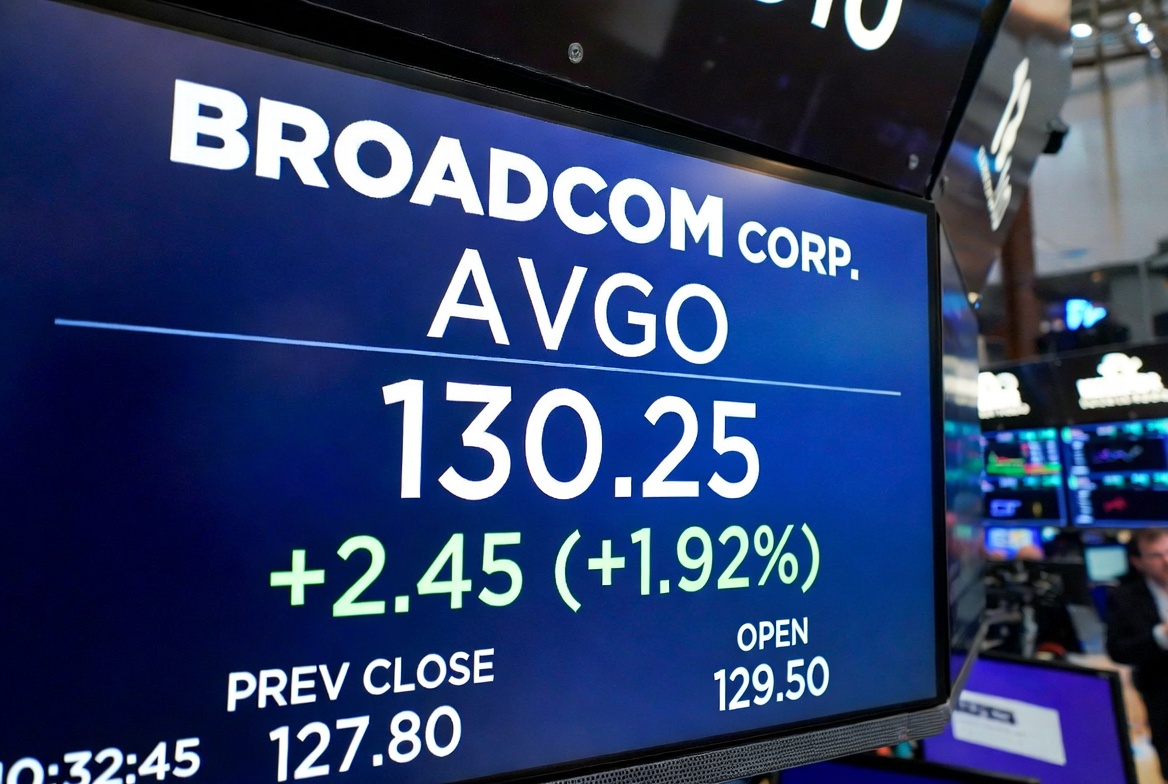
Investment Thesis
Broadcom Inc. (NASDAQ: AVGO) is one of the most compelling risk/reward propositions in global technology today. While the broader market debate about AI hardware spending centres on Nvidia’s GPU dominance, Broadcom has been methodically building an indispensable, complementary position in the AI infrastructure stack one that is harder to replicate, less cyclical than GPU commodity plays, and increasingly recognised by hyperscalers as a strategic necessity rather than a vendor relationship.
The company operates across two high-quality, structurally growing segments: Semiconductor Solutions (~58% of revenue), anchored by custom AI accelerators (XPUs), Ethernet networking ASICs and storage semiconductors; and Infrastructure Software (~42% of revenue), dominated by the VMware platform acquired in 2023. Both segments are inflecting simultaneously, creating a rare dual-engine growth dynamic at a scale few technology companies can match.
“AI revenue growth is accelerating, and we expect AI semiconductor revenue to be $10.7 billion in Q2.”
Hock Tan, President & CEO, Broadcom Inc., Q1 FY2026 Earnings Call, March 2026
Key Financial Highlights
| Metric | FY2024A | FY2025A | Q1 FY26A | Q2 FY26E |
|---|---|---|---|---|
| Revenue ($B) | $51.6 | $63.9 | $19.3 | ~$22.0 |
| YoY Growth | n/a | +24% | +29% | +47% |
| AI Revenue ($B) | ~$12.2 | ~$20.0 | $8.4 | ~$10.7 |
| Adj. EBITDA ($B) | n/a | ~$43.5 | $13.1 | ~$15.0E |
| EBITDA Margin | n/a | 68% | 68% | ~68% |
| Non-GAAP EPS | n/a | $4.91 | $2.05 | ~$2.39E |
| Free Cash Flow ($B) | n/a | ~$26.0 | $8.0 | n/a |
| FCF Margin | n/a | ~41% | 41% | n/a |
E = consensus estimates.
FY ends late October.
Business Model: Two Moats, One Platform
Semiconductor Solutions
Broadcom’s semiconductor franchise is defined by the breadth and depth of its ASIC and networking portfolio. Unlike Nvidia’s general-purpose GPU approach, Broadcom designs custom silicon tailored to specific hyperscaler workloads a model that commands higher switching costs, longer design cycles, and more predictable revenue streams. The company’s XPU programmes span some of the most important AI compute projects in the world, with multi-generational relationships at Google (TPUs), Meta (MTIA chips), and ByteDance.
The Ethernet AI networking segment is equally formidable. Broadcom’s Tomahawk and Jericho switch families form the backbone of large-scale AI training clusters at virtually every major hyperscaler. Networking revenues grew approximately 170% year-over-year in Q2 FY2025 and accounted for roughly 40% of total AI revenue.
Infrastructure Software (VMware)
The $69 billion acquisition of VMware in November 2023 has been one of the most transformative moves in enterprise software history. Under Broadcom’s ownership, VMware has been aggressively repositioned as a subscription-first, private cloud platform. Infrastructure software revenues have grown from $4.6 billion per quarter pre-acquisition to $6.9 billion in Q4 FY2025, a 19% year-over-year increase. That has created a recurring, high-margin revenue base that buffers Broadcom against semiconductor cyclicality.
The AI Opportunity: The Custom Silicon Supercycle
The fundamental debate about Broadcom’s AI opportunity centres on one question: how large can the custom silicon market become relative to merchant GPU alternatives? Hyperscalers Google, Meta, ByteDance, Apple and others have a strategic and economic incentive to reduce dependence on Nvidia’s GPU ecosystem. Custom ASICs and XPUs offer superior performance-per-watt for specific inference workloads, lower total cost of ownership at scale, and tighter vertical integration with proprietary software stacks.
CEO Hock Tan’s compensation structure for performance share units is tied to achieving $90 billion in aggregate AI revenue over any rolling four-quarter period at the “target” level, with maximum payout triggered at $120 billion a board-sanctioned commitment to an AI revenue trajectory implying quarterly AI revenues of $22 to 30 billion, roughly two to three times current levels.
Q1 FY2026 AI revenue reached $8.4 billion, up 106% year-over-year, surpassing management’s own forecast. Q2 FY2026 AI guidance of $10.7 billion implies a further 27% sequential increase. The company also disclosed a $73 billion AI backlog scheduled to be recognised over the following 18 months a figure that provides rare visibility in a sector typically characterised by short lead times and volatile demand signals.
Valuation
Wall Street’s consensus reflects broad optimism: 26 buy ratings, 4 hold ratings, and zero sells across covering analysts. The average 12-month price target stands at approximately $478, with the most bullish targets from Evercore ISI ($582), Wells Fargo ($545), and TD Cowen ($500). UBS raised its target to $490 in May 2026 ahead of Q2 earnings.
Our $540 target is anchored by three methodologies. On a forward non-GAAP P/E basis, Broadcom currently trades at approximately 30x FY2026 earnings a meaningful discount to its intrinsic growth rate, given Q2 FY2026 guidance implies 47% year-over-year growth. On an FCF yield basis, the stock offers approximately 4.7% on FY2026 estimates. On EV/EBITDA, applying a 25x multiple to our FY2027 EBITDA estimate yields a $540 equity value per share.
Broadcom returns capital generously: a quarterly dividend of $0.65 per share (31% CAGR over the past decade) and a new $10 billion share repurchase programme announced in March 2026.
Bull & Bear Factors
Bull Factors
- AI backlog of $73B provides 18-month revenue visibility rare in semiconductors
- Hyperscaler XPU programmes are multi-generational; switching costs are enormous
- VMware subscription transition approaching full maturity, driving durable 40%+ software margins
- Q2 FY26 revenue guide of $22B (+47% YoY) suggests AI acceleration, not deceleration
- FCF growth expected to accelerate to 60%+ in FY2026; buyback adds further upside
- Gigawatt-scale AI clusters will structurally require Ethernet networking Broadcom owns this market
Bear Factors
- Geopolitical risk: export restrictions could impair China-linked revenue (ByteDance)
- VMware enterprise pushback some large customers publicly resistant to pricing changes
- Hyperscaler capex cuts (if AI ROI debate intensifies) would disproportionately impact custom silicon
- Nvidia may develop custom ASIC capabilities, encroaching on Broadcom’s positioning
- Premium valuation leaves limited margin of safety if AI revenue growth disappoints
Near-Term Catalysts
Q2 FY2026 Earnings June 3, 2026
The most significant near-term event. Consensus expects revenue of approximately $22.0 billion and non-GAAP EPS of $2.39. Any upside surprise in AI revenue (guided at $10.7 billion) or incremental disclosure on new XPU customer wins would be meaningfully positive for the stock. Watch also for any update on the $73 billion AI backlog figure.
2nm Custom SoC Ramp
Broadcom recently announced it has begun shipping the industry’s first 2nm custom compute SoC built on its 3.5D eXtreme Dimension System in Package (XDSiP) platform. Volume ramp of next-generation 2nm designs (likely at TSMC) would materially expand the addressable revenue per customer, as each new chip generation commands significantly higher ASPs.
New XPU Customer Announcements
Broadcom currently serves a relatively small number of hyperscalers with custom XPU programmes. Any announcement of a new major customer Apple, OpenAI, Amazon, or a sovereign AI programme would significantly expand the total addressable market narrative and likely trigger a re-rating.
Conclusion: BUY Positioned for the Decade
Broadcom is not a trade on AI momentum. It is a long-duration investment in the two most defensible positions in the AI infrastructure stack: custom silicon that hyperscalers cannot easily replace, and enterprise cloud software that has become mission-critical for Fortune 500 operations.
At approximately 30x FY2026 non-GAAP earnings with an AI revenue trajectory that is genuinely accelerating Q2 FY2026 AI guidance of $10.7 billion represents a 27% sequential jump we believe the market continues to under-appreciate the earnings power embedded in Broadcom’s model as the AI capex cycle extends into FY2027 and beyond. Our $540 price target implies roughly 28% upside over the next 12 months. We rate AVGO a BUY.
Disclaimer: This report is published by Simo and is intended for informational purposes only. It does not constitute investment advice, an offer, or solicitation to buy or sell any securities. The views expressed are those of the author and are based on publicly available information including SEC filings, earnings releases, and third-party data. Past performance is not indicative of future results. All investments carry risk. Readers should consult a qualified financial advisor before making investment decisions. Price targets and financial estimates are forward-looking and subject to revision. Author may hold positions in AVGO. Published: 19 May 2026.