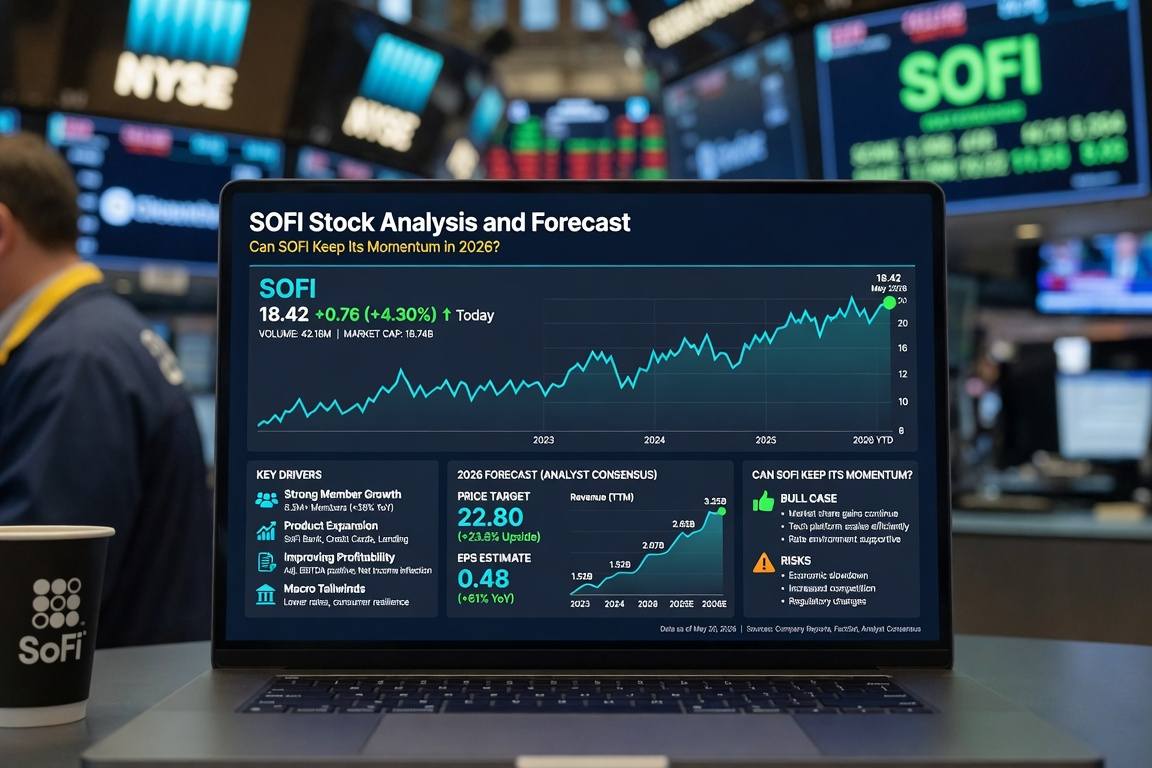
SoFi Technologies (NASDAQ: SOFI) has been one of the more polarizing fintech names on Wall Street. The company has delivered record results quarter after quarter, yet the stock spent much of 2026 under pressure, forcing investors to weigh exceptional execution against a valuation that still demands a lot of faith. As of mid-June 2026, SOFI trades near $18.36 after recovering from year-to-date lows, driven by a wave of new product launches and a genuinely surprising strategic pivot toward blockchain payments. This article breaks down what the numbers say, where analysts stand, and what risks could derail the bull case.
Q1 2026 Results: Records Across the Board
SoFi’s first quarter of 2026 was difficult to criticize on a headline basis. The company posted adjusted net revenue of approximately $1.1 billion, up 41% year over year, while net income came in at $166.7 million, more than double the figure from a year earlier. Diluted EPS reached $0.13, compared to $0.065 in Q1 2025. Adjusted EBITDA hit $340 million, a 62% increase, with an EBITDA margin of 31%.
Member growth accelerated meaningfully. Total membership reached 14.7 million, up 35% year over year, with a record 1.055 million new members joining in the quarter alone. Total products grew 39% to 22.2 million, with 43% of new products coming from existing members. That cross-sell ratio matters. It suggests SoFi’s flywheel is working: people join for one product and stay for several.
Total loan originations hit $12.2 billion, a 68% increase year over year. Personal loan originations totaled a record $8.3 billion, up 51%, and student loan originations reached $2.6 billion. For a company that started as a student loan refinancer, the lending segment has clearly transformed into something much broader.
| Metric | Q1 2026 | Q1 2025 | Year-over-Year Change |
|---|---|---|---|
| Adjusted Net Revenue | $1.1 billion | $776 million | +41% |
| Net Income | $166.7 million | $71.4 million | +134% |
| Adjusted EBITDA | $340 million | $210 million | +62% |
| Total Members | 14.7 million | 10.9 million | +35% |
| Total Products | 22.2 million | 15.9 million | +39% |
| Loan Originations | $12.2 billion | $7.3 billion | +68% |
| Diluted EPS | $0.13 | $0.065 | +100% |
The Segment That Dragged: Technology Platform
Not every line in the Q1 report was clean. The technology platform segment, which houses Galileo and is being rebranded as SoFi Technology Solutions, posted revenue of $75.1 million, down 27% year over year. Management was quick to contextualize this: a large client fully transitioned off the platform before year-end 2025, making the comparison unfavorable. On a like-for-like basis, the segment grew roughly 12% year over year.
Looking ahead, SoFi added 13 new clients in Q1 2026 that were not generating revenue a year prior. A new core platform implementation with SoFi Bank itself is scheduled to launch in the summer, which management views as a proof of concept to bring its banking stack to other financial institutions. The recovery in this segment is a key variable for whether the full-year revenue guide can be met.
SoFiUSD: The First Bank-Issued Stablecoin
The most significant strategic development in recent months has been the launch of SoFiUSD, a U.S. dollar-backed stablecoin issued directly by SoFi Bank, N.A. This makes SoFi the first U.S. national bank to issue a stablecoin natively inside a regulated banking application. The token is available on both Ethereum and Solana, and it offers a 4.2% yield, which is notable for a stablecoin tied to an insured banking relationship.
Members can buy, sell, hold, and convert SoFiUSD within the SoFi app without needing a separate crypto exchange. The roadmap includes tokenized deposits, cross-border payments, and potential exchange listings. Whether or not crypto themes are in favor at any given moment, the strategic logic is clear: reduce friction, deepen ecosystem engagement, and open new fee streams around payments and conversions.
It is worth being measured here. Stablecoin launches generate attention, but the revenue contribution from SoFiUSD will depend entirely on adoption rates and regulatory stability around crypto banking. The GENIUS Act and other legislation in the United States could either accelerate or complicate SoFi’s plans. Investors should treat this as a medium-term optionality play rather than an immediate earnings catalyst.
SoFi Coach, AI Tools, and the Engagement Play
SoFi also launched SoFi Coach, an AI-powered chat tool integrated into the SoFi Plus subscription. The tool is designed to guide members on budgeting, debt repayment, and long-term financial goal planning. Early engagement metrics appear strong, and management noted that early subscribers are predominantly existing members who subsequently add more products to their accounts.
The SoFi Plus relaunch as a paid subscription is a structural shift worth watching. If SoFi can convert a meaningful percentage of its 14.7 million members into paying subscribers who then cross-sell at higher rates, the unit economics of the business change materially. This is the kind of flywheel that SoFi’s management has been describing for years, but Q1 2026 shows early signs it may finally be gaining traction.
SpaceX IPO and Capital Markets Ambitions
SoFi appeared in the SpaceX IPO prospectus as a potential retail broker for distributing shares. This is not confirmed revenue, but the signal matters: SoFi is increasingly in the room for marquee capital markets transactions. The company also acquired most of PrimaryBid’s assets, a UK fintech that powers retail inclusion in equity offerings. This expands SoFi’s directed share program capabilities and its reach in global capital markets.
Combined with SoFi’s existing brokerage platform and over 22 million products across its ecosystem, the capital markets angle adds another potential revenue stream that is not fully reflected in current consensus estimates. It also reinforces the narrative that SoFi is transitioning from a consumer lender into a full-spectrum financial platform.
Analyst Sentiment: Cautious but Not Bearish
The Street’s current consensus is a Hold rating. Based on 15 analysts as of mid-June 2026, the average price target sits around $22.40, which implies meaningful upside from current levels but also reflects the divided nature of sentiment. Targets span a wide range, from a bullish $37 from Citigroup to notably bearish outliers from analysts concerned about credit quality and tech platform growth.
Truist recently trimmed its price target from $20 to $17 with a Hold rating, citing softer Q2 revenue expectations in both the lending and technology platform segments. Zacks assigned the stock a Rank 4 (Sell), flagging concerns around charge-offs, net interest margins, and valuation. On the more constructive side, Simply Wall St’s model carries a fair value estimate of $38, which was raised by $8 after strong Q3 2025 results.
The divergence in analyst views is itself informative. It tells you that SOFI is a name where the bull and bear cases are both defensible. Bulls point to 25% annual earnings growth forecasts, a 43% year-over-year revenue run rate, and platform optionality in stablecoins and AI. Bears point to rising charge-offs, a tech platform under transition, and a valuation multiple that prices in perfection.
Full-Year 2026 Guidance
Management maintained full-year 2026 guidance unchanged after Q1, which was itself a source of the post-earnings selloff. The market had hoped for an upward revision following the record quarter, but SoFi held the line. For the full year, guidance calls for adjusted net revenue of approximately $4.655 billion, adjusted EBITDA of approximately $1.6 billion, and adjusted net income of approximately $825 million.
For Q2 2026 specifically, management guided for a softer sequential result in lending and the technology platform, which contributed to Truist’s target cut. Whether Q2 results come in line or below that expectation will likely set the tone for the stock through the second half of 2026.
Key Risks Investors Should Not Ignore
Net charge-offs are rising. In Q1 2026, SoFi reported $201.6 million in net charge-offs, up from $168.7 million in Q1 2025. That is a 19.5% increase year over year. Personal loan borrowers remain the core of the lending book, and if the macro environment deteriorates or unemployment ticks higher, charge-off rates could escalate in a way that compresses net interest margins faster than revenue can grow.
The technology platform transition is real. Losing one large customer cost the segment 27% of its reported revenue in Q1. Even if the like-for-like growth of 12% is the honest comparison, the headline number creates noise and makes forecasting more difficult for analysts.
Valuation remains stretched. With a price-to-earnings ratio near 36.6 and a price-to-sales ratio around 5.2, SOFI is priced for a future that has not fully arrived. Any stumble in execution, whether from credit quality, member growth deceleration, or macro headwinds, can translate into sharp downside quickly. This is not a stock for investors with a low tolerance for volatility.
Finally, the stablecoin ambitions carry regulatory uncertainty. The integration of blockchain payments into a nationally chartered bank is genuinely novel, and while regulators have shown increasing openness to stablecoins in 2025 and 2026, the landscape could shift. Any adverse regulatory ruling on SoFiUSD would likely weigh on sentiment disproportionately given how much of the current bull narrative rests on this launch.
S&P 500 Inclusion as a Potential Catalyst
One underappreciated catalyst in the discussion around SOFI is the potential for S&P 500 inclusion. The company has now delivered ten consecutive quarters of GAAP profitability, and its market cap has crossed the $22.7 billion threshold required for consideration. Inclusion in the S&P 500 would trigger passive buying from index funds and ETFs at scale, which historically provides a meaningful one-time demand shock for qualifying stocks. This is speculative, and no timeline has been confirmed, but it is a factor worth monitoring in the second half of 2026.
Price Action: Where SOFI Stands Technically
SOFI climbed from the mid-$15 range in late May 2026 to close near $18.36 on June 17, 2026. The $16 to $17 zone has acted as a consistent support band, with dip buyers stepping in on each pullback through June. The stock has shown controlled intraday ranges suggesting accumulation rather than speculative excess. The $18.00 level now acts as an intraday pivot, and a sustained close above $19 would likely bring in additional momentum buyers.
Despite the recent recovery, SOFI remains down significantly from its early 2026 highs, and the stock is still navigating what has been described as a difficult year for shareholders broadly. The recovery since late May is encouraging but needs to be validated by Q2 results before the technical picture is truly constructive.
Bottom Line on SOFI Stock
SoFi Technologies is a company at an inflection point. The fundamental story has improved materially. Revenue is growing at over 40% annually, profitability is now a reality rather than a projection, and the product pipeline spanning stablecoins, AI coaching tools, and capital markets infrastructure is more ambitious than what most neobanks are attempting. The member base and cross-sell momentum suggest the platform model is working.
That said, the stock demands patience. Rising charge-offs, a technology platform in transition, unchanged full-year guidance, and a lofty valuation multiple all argue against treating SOFI as a low-risk position. The Hold consensus from Wall Street is arguably the intellectually honest view: the bull case is compelling but not yet fully de-risked.
For long-term investors, the combination of a bank charter, a growing consumer ecosystem, and genuinely differentiated moves in stablecoins and AI tools creates a setup that few fintech competitors can replicate at scale. For shorter-term traders, $16 to $17 has proven to be a meaningful support zone, and Q2 2026 earnings will be the next significant inflection point to watch.
This article is for informational purposes only and does not constitute financial advice. Always conduct your own due diligence before making investment decisions.