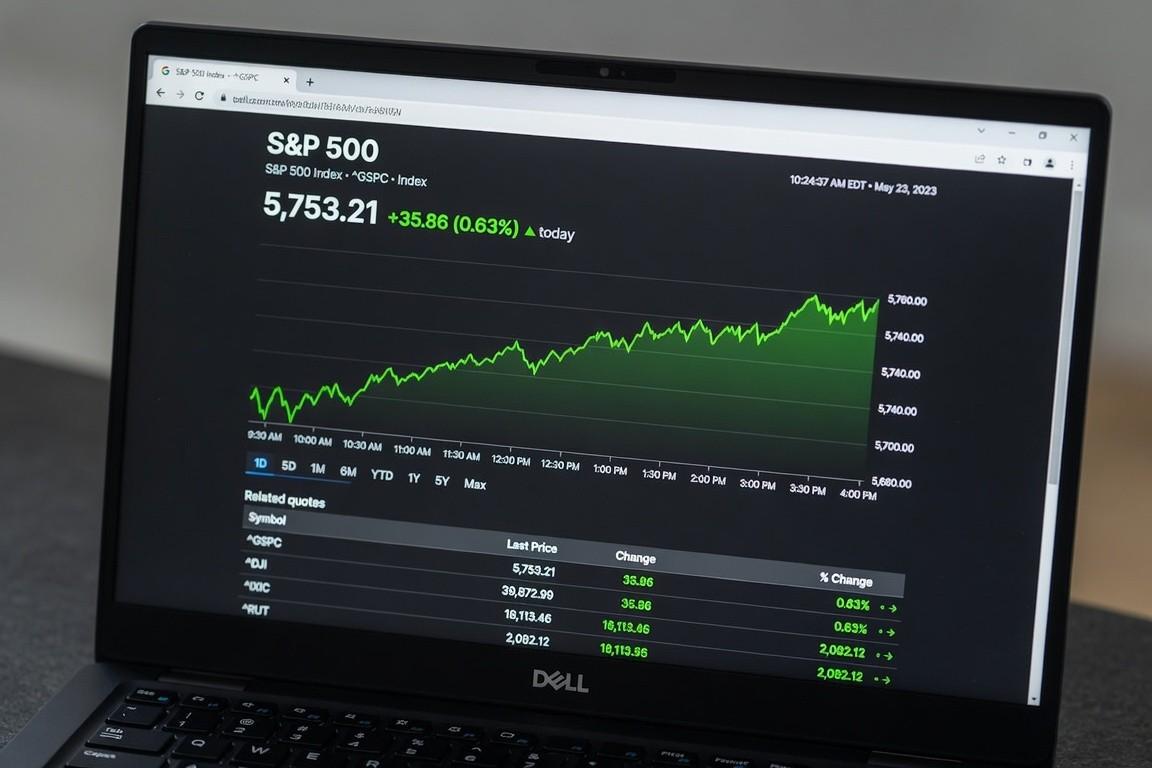
The S&P 500 closed last week at 7,457.69, down 1.6% over five sessions and roughly 4% off its recent highs, in a pullback that has as much to do with what is driving the index higher as with what is now dragging it down. The proximate causes are familiar: a semiconductor selloff, an escalating conflict in the Middle East pushing oil above $80 a barrel, and a market that had grown accustomed to one-way momentum in AI-linked names. But beneath the index-level decline sits a more important story for investors: a genuine standoff between an unusually strong earnings backdrop and a market structure that looks increasingly fragile.
The Earnings Case Is Real
Start with what is going right. FactSet data show S&P 500 companies are on pace for blended earnings growth near 24% for the 2026 calendar year, the strongest expansion since 2021, with Q3 and Q4 growth rates projected at 27% and 24.6%, respectively. Analysts raised rather than cut estimates heading into the quarter, an unusual pattern that reflects genuine confidence rather than sandbagged guidance. Goldman Sachs has pushed its 2026 S&P 500 earnings-per-share forecast to $340, implying 24% annual growth, with roughly half of that growth attributed to companies benefiting from AI infrastructure spending, which the firm expects to reach $754 billion this year across major hyperscalers.
That growth is not evenly distributed, and this is where the market’s current anxiety originates. Strip out AI infrastructure and energy, and consensus earnings growth for the rest of the S&P 500 falls to roughly 8%, closer to a historical norm than a boom. The index’s advance in 2026 has therefore been a bet on a relatively narrow set of beneficiaries continuing to deliver outsized returns on an extraordinary amount of capital spending, a bet that becomes more precarious every time a semiconductor name reports even modestly disappointing guidance.
Valuation Is the Fault Line
The forward twelve-month price-to-earnings ratio for the S&P 500 sits at 20.3, above both its five-year average of 19.9 and its ten-year average of 19.0. That is not extreme by the standards of past bubbles, but it leaves little room for error at a moment when the index’s gains are concentrated in a handful of mega-cap and semiconductor names trading at a premium even to that multiple. Bank of America has reaffirmed a 7,100 year-end target, roughly 5% below current levels, warning that its bear-market signposts point to speculation reaching extreme levels and noting that S&P 500 companies are generating less free cash flow relative to net income than history would suggest is sustainable. JPMorgan, despite raising its own target to 7,800 from 7,600, flagged crowded positioning in low-quality, speculative-growth names and a real probability of a sharp, non-linear drawdown even within an overall bullish view.
On the other side of the debate, Goldman Sachs has set an 8,000 target and Citigroup’s Scott Chronert projects S&P 500 earnings per share reaching $350 this year and $400 in 2027, arguing that further index gains will be driven primarily by earnings growth rather than continued multiple expansion. The spread between Wall Street’s most bearish and most bullish year-end targets, roughly 7,100 to 8,250, is unusually wide for this point in the year, a sign that strategists themselves are divided over whether the AI capital-spending cycle can keep converting into durable profit growth or whether current pricing has run ahead of it.
Breadth Tells a Different Story Than the Headline Index
The most useful signal from last week’s selloff may not be the S&P 500’s decline itself but where the decline was concentrated. The PHLX Semiconductor Index fell nearly 20% from its late-June peak after Chinese AI developer Moonshot AI released a model perceived to narrow the performance gap with leading U.S. labs, reviving questions about whether the return on massive AI infrastructure spending is as assured as current valuations imply. Yet the S&P 500 Equal Weight Index, which removes the distorting influence of the largest constituents, was roughly flat to slightly higher over the same stretch, and eight of eleven S&P 500 sectors advanced on Friday even as the headline index fell. That divergence suggests capital rotated out of the most crowded AI-adjacent trades rather than out of equities broadly, a healthier pattern than an indiscriminate risk-off move, though one that still leaves the index’s most heavily weighted names exposed to further repricing.
Geopolitics Adds a Second, Less Predictable Risk
Layered on top of the valuation debate is an active military conflict. The U.S. has continued strikes against Iran, and renewed threats to shipping through the Strait of Hormuz pushed Brent crude above $84 a barrel before easing slightly after President Trump stepped back from a proposed transit fee on vessels. Energy has been one of the best-performing sectors this earnings season precisely because of elevated prices, but a sustained supply shock would cut both ways, boosting energy-sector profits while pressuring input costs and consumer spending elsewhere in the index. Markets have so far treated the conflict as a contained risk rather than a systemic one, reflected in a Polymarket contract pricing a 68% probability of an up open to start the week, but the range of outcomes tied to the Strait of Hormuz remains wide enough to keep a risk premium embedded in oil-sensitive and rate-sensitive sectors alike.
| Metric | Latest Reading |
|---|---|
| S&P 500 (close, July 17) | 7,457.69 |
| Weekly change | -1.6% |
| Forward P/E (S&P 500) | 20.3x |
| 5-year average forward P/E | 19.9x |
| 2026 consensus EPS growth | ~24% |
| Wall Street year-end targets (range) | 7,100 to 8,250 |
| Brent crude | above $84/bbl |
What Investors Should Watch Next
The next two weeks will do more to resolve this standoff than any single macro data point. Alphabet’s earnings, the next major hyperscaler report after Meta’s recent capital-spending disclosures, will be closely parsed for whether AI infrastructure investment is translating into revenue rather than just capital expenditure. Intel and Tesla report this week as well, alongside a wider batch of second-quarter results, with 86 S&P 500 companies scheduled to report in the coming week alone. For a market this dependent on a narrow set of names delivering on an extraordinary growth narrative, the difference between a guidance beat and an in-line quarter from any single hyperscaler is likely to matter more to index-level returns than the broader macro calendar, which is otherwise light until Thursday.
This article is for informational purposes only and does not constitute investment advice. Past performance is not indicative of future results. Readers should conduct their own research or consult a licensed financial advisor before making investment decisions.