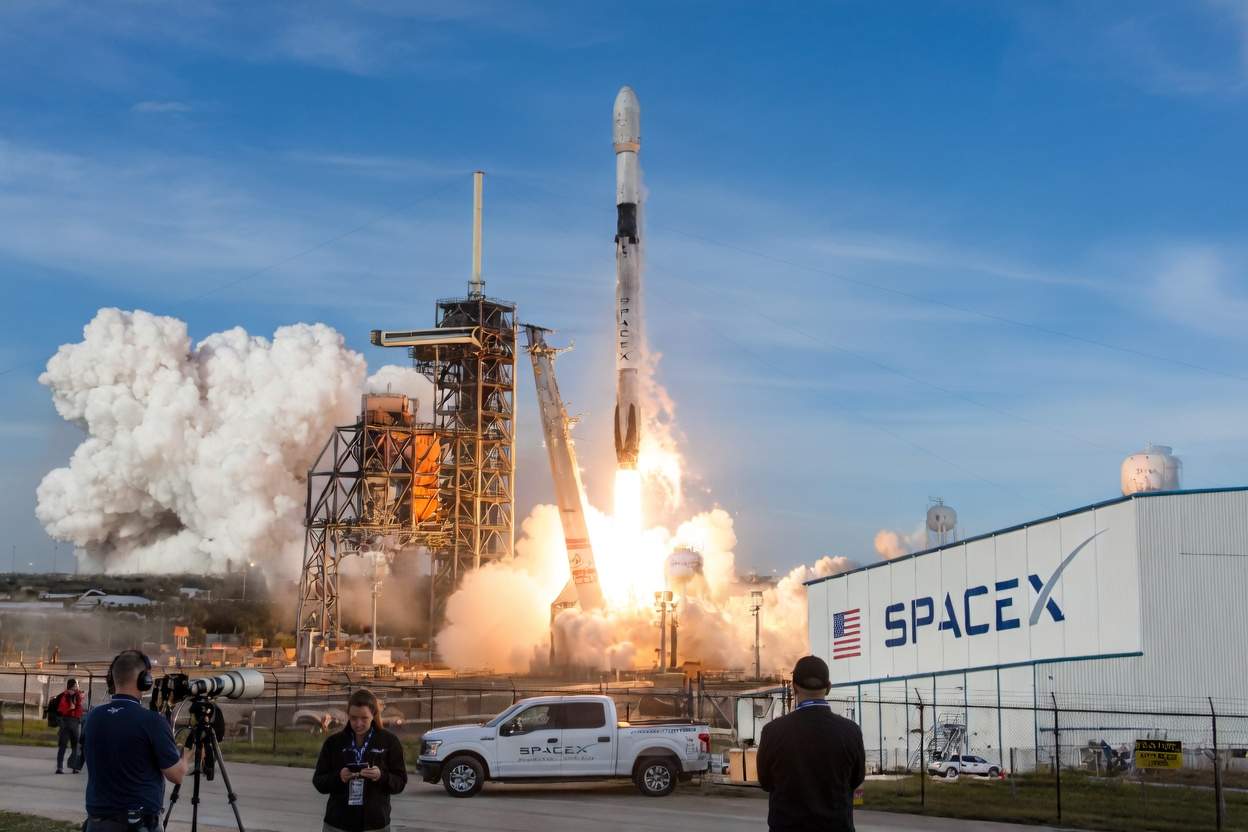
The largest initial public offering in human history is scheduled to begin trading in eight days. On June 12, 2026, Elon Musk’s SpaceX will list on the Nasdaq under the ticker SPCX at $135 per share, targeting a $1.77 trillion valuation and seeking to raise $75 billion in a single offering. To put those numbers in perspective: the previous record holder, Saudi Aramco, raised $29 billion in 2019. SpaceX is targeting more than twice that amount. On arrival, the company would rank as the seventh-largest publicly traded firm in the United States, eclipsing Tesla’s current market cap of roughly $1.6 trillion and landing just below Meta Platforms in the index hierarchy.
For ordinary investors, the SpaceX IPO is simultaneously the most exciting and most dangerous market event of the year. It offers genuine participation in a company that controls reusable rocket launches, a rapidly scaling global satellite internet network with 10.3 million subscribers, an artificial intelligence division, and, according to its own prospectus, “the largest actionable total addressable market in human history” at $28.5 trillion. Consequently, the question is not whether SpaceX is interesting. The question is whether it is investable at this price, and precisely how retail investors can access shares before they trade in the open market. This guide addresses both.
What SpaceX Actually Is: Three Businesses Under One Rocket Logo
Most people know SpaceX as Elon Musk’s rocket company. In practice, the entity going public in June 2026 is considerably more complex, comprising three distinct business segments with radically different financial profiles. Understanding this structure is essential before committing any capital.
Segment One: Connectivity (Starlink)
Starlink is the financial engine of SpaceX, full stop. The Connectivity segment generated $11.4 billion in revenue in 2025, representing 61% of the company’s total $18.7 billion in consolidated revenue for the year. Operating income for the Connectivity segment reached $4.4 billion, making it the only profitable division in the entire corporate structure. In the first quarter of 2026 alone, Starlink produced $3.257 billion in revenue and $1.188 billion in operating income.
The subscriber trajectory is equally impressive. Starlink has grown from 2.3 million users in 2023 to 8.9 million at year-end 2025, and then accelerated further to 10.3 million subscribers across 160 countries and territories by March 2026. Adjusted EBITDA margins for the Connectivity segment reached 63% in 2025, according to IPO filing data, a figure that materially outperforms traditional satellite operators whose margins typically run near 20%. Furthermore, the revenue mix is shifting toward higher-value enterprise and government contracts. Starlink’s aviation segment grew nearly tenfold in 2025, and maritime installations are expected to contribute $1.9 billion in 2026 revenue, a 55% year-over-year increase.
In May 2026, SpaceX also raised Starlink plan prices by up to $10 per month, signaling a deliberate pivot from subscriber growth at any cost toward monetizing its installed base. That pricing power is a meaningful signal for long-term investors.
Segment Two: Space (Rocket Launches)
The Space segment, SpaceX’s original business, generated $4.1 billion in revenue in 2025 and $619 million in Q1 2026. However, this segment operates at an ongoing loss: Space reported an operating loss of $662 million in 2025 and a further $662 million loss in Q1 2026 alone. The company invested $930 million into Starship research and development in the first quarter of 2026 and more than $3 billion in 2025, reflecting the sheer capital intensity of next-generation reusable rocket development.
The economic logic here is not conventional profitability but strategic positioning. Specifically, SpaceX’s reusable Falcon 9 and Falcon Heavy rockets have already made the company NASA’s primary launch partner since the retirement of the Space Shuttle program, and the company dominates global commercial launch market share by a wide margin. Starship, if it achieves full commercial operation, promises to reduce per-kilogram payload costs to orbit dramatically and to enable SpaceX’s stated ambitions in lunar infrastructure, in-orbit manufacturing, and ultimately Mars. Additionally, the Space segment provides a genuine competitive advantage for Starlink by allowing SpaceX to launch its own satellites at cost rather than paying third-party launch providers.
Segment Three: AI (SpaceXAI, formerly xAI)
The most controversial element of the SpaceX IPO is the AI segment. In February 2026, Musk merged xAI, his artificial intelligence lab that includes the Grok large language model and the X social media platform, into SpaceX in a deal valuing the combined entity at approximately $1.25 trillion. The resulting division, now called SpaceXAI, generated $818 million in Q1 2026 revenue but posted an operating loss of $2.469 billion in that single quarter alone. For full-year 2025, the AI segment recorded a $6.355 billion operating loss.
Morningstar analysts have characterized this as a “material threat of value destruction,” noting that xAI’s economic moat is “indeterminate.” In practice, Starlink’s profits are effectively subsidizing the AI segment’s research expenditure. Bulls argue this is precisely the kind of long-duration, capital-intensive bet that produces transformational companies. Bears argue investors are paying a $1.77 trillion valuation for a rocket business that loses money, an AI business that loses even more money, and a satellite internet business that, while genuinely profitable, does not alone justify the asking price.
The IPO Structure: What You Are Actually Buying
Share Price, Float, and Valuation
SpaceX has filed an amended statement with the SEC confirming it will sell 555.6 million Class A shares at a fixed price of $135 each, raising approximately $75 billion. Underwriters also hold an option to purchase an additional 83.33 million shares, which would raise an additional $11.2 billion. At the $135 price, the company is valued at $1.77 trillion, which assumes the EchoStar spectrum and Cursor transactions close as expected.
Critically, the float being offered represents approximately 3% of total shares outstanding. Consequently, the vast majority of SpaceX equity will remain with existing shareholders, insiders, and, most significantly, Elon Musk, who will retain over 82% of voting control after the offering through a super-voting share structure. In practice, this means public shareholders are buying economic exposure to SpaceX’s earnings, but not meaningful governance influence. Decisions on strategic direction, capital allocation, and executive leadership remain with Musk regardless of what public shareholders think.
The Morningstar Valuation Gap
The most important piece of independent analysis published ahead of the IPO comes from Morningstar, which initiated coverage with a fair-value estimate of $780 billion, roughly 56% below the $1.77 trillion IPO target. Morningstar’s discounted cash flow model identifies xAI’s losses as the primary drag, and characterizes the company as “significantly overvalued” at the offering price. However, the same analysts noted that SpaceX stock is likely to hold up immediately after the offering given the small initial float, strong institutional demand for AI infrastructure exposure, and a near-certain path to inclusion in major indices.
The Morningstar note included a telling recommendation: long-term investors who want SpaceX exposure will likely find better entry points in the weeks and months after the IPO rather than chasing the listing day. That has historically proven true for hyped technology IPOs. Snap, Lyft, and Rivian all experienced significant first-day or first-week pops followed by 30% to 60% retracements within 90 days. Conversely, Amazon and Google both rewarded investors who bought at the IPO or shortly after, but required years of patience. SpaceX’s long-term thesis is credible; the issue is the entry point, not the destination.
How to Buy SpaceX Shares: A Complete Retail Investor Guide
The Unprecedented 30% Retail Allocation
In a departure from standard IPO practice, SpaceX has reserved approximately 30% of its offering for retail investors, triple the historical norm of 5% to 10%. Moreover, SpaceX has confirmed through its SEC prospectus that retail buyers on participating platforms will receive shares at the same IPO price and at the same time as institutional investors. That is a genuinely unusual and meaningful concession to individual investors, reflecting Musk’s stated preference for broad public ownership of the company.
However, “30% of $75 billion allocated to retail” means approximately $22.5 billion in retail-accessible shares. That sounds enormous until you consider that tens of millions of retail investors globally are likely to express interest, meaning the actual share per individual request will likely be a fraction of what most people want.
The Five Platforms for IPO Price Access
The roadshow, originally expected to begin June 8, was accelerated to June 4 per Reuters and CNBC reporting, with pricing on June 11 and trading beginning June 12. The following five platforms have confirmed retail IPO access:
| Platform | Key Detail |
|---|---|
| Robinhood | Express interest via the IPO tab; allocation is lottery-based |
| Fidelity | Submit an indication of interest (IOI) through the IPO center |
| Charles Schwab | Submit a conditional offer to purchase (COTP) before 4 p.m. deadline; best access for accounts with $100,000 or more in eligible assets |
| SoFi | IPO investing feature in the app; available to eligible members |
| E*TRADE (Morgan Stanley) | Morgan Stanley is a lead underwriter; E*TRADE clients have direct access via the IPO platform |
Most retail investors will not receive a full allocation, or in many cases any allocation, at the $135 IPO price. Once SPCX begins trading on Nasdaq on June 12, any standard U.S. brokerage account can purchase shares in the open market at whatever the prevailing price is at that moment.
Buying SPCX After the IPO
For investors who do not receive an IPO allocation, or who choose to wait, the mechanics are straightforward: SPCX will trade like any other Nasdaq-listed stock from June 12 onward. The more nuanced question is when to buy in the aftermarket.
A conservative approach, as outlined by investment analysts at Gotrade, is to wait for the first earnings print as a public company, expected in early November 2026. That will give the market one full quarter of SEC-disclosed financials to digest under public scrutiny, removing some of the opacity that characterized SpaceX’s financials when it was private. Analysts from multiple research firms have noted that first-day pops on hyped tech IPOs frequently retrace 20% to 40% within the first 90 days, creating better entry opportunities for patient investors.
Pre-IPO Exposure: Secondary Markets and ETFs
For accredited investors who want SpaceX exposure before June 12, secondary market platforms offer another route. EquityZen, Forge Global, and Hiive all facilitated pre-IPO SpaceX share transactions. As of April 2026, Hiive listed SpaceX at around $832 per share in secondary market transactions. However, the minimum investment threshold on most secondary platforms runs from $50,000 to $100,000 per transaction, and accreditation requirements apply: investors must have individual income above $200,000 per year for at least two consecutive years, or a net worth exceeding $1 million excluding their primary residence.
For non-accredited investors seeking indirect pre-IPO or post-IPO exposure, the Fidelity Contrafund (FCNTX) held SpaceX as one of its positions prior to the IPO. Several other growth-oriented mutual funds and ETFs have disclosed SpaceX stakes as well. Furthermore, Tesla holds 18.99 million SpaceX shares valued at approximately $2.5 billion, meaning that Tesla stock carries embedded SpaceX exposure for investors who already own it.
The Bull Case: Why SPCX Could Justify Its Valuation
Starlink as a Trillion-Dollar Business
The Starlink subscriber growth trajectory, if sustained, is the most compelling argument for the $1.77 trillion valuation. From 2.3 million subscribers in 2023 to 10.3 million in Q1 2026 in just over two years, the network has scaled faster than almost any consumer technology product in history. Furthermore, SpaceX’s production of approximately 70 Starlink satellites per week at its Redmond, Washington factory, far ahead of Amazon’s Kuiper program which produces “tens per week,” creates a structural lead that will take years for any competitor to close.
If Starlink reaches 100 million subscribers by 2030 at average revenue per user of approximately $80 per month, the implied annualized Connectivity segment revenue would approach $100 billion, with EBITDA margins potentially compressing only modestly from current 63% levels as fixed satellite costs are spread across a much larger user base. Additionally, the Starshield government and defense business adds a high-margin, recurring revenue stream with limited competitive exposure, as SpaceX’s relationship with the Department of Defense and NASA is deeply embedded.
Starship as the Long-Term Optionality Prize
Starship represents the most asymmetric upside option embedded in the SpaceX thesis. The megarocket, which completed a test flight from Starbase, Texas, as recently as May 22, 2026, is designed to be the first fully reusable orbital-class vehicle. In the long term, if Starship achieves commercial operation, it would allow SpaceX to deploy Starlink satellites in larger batches at dramatically lower cost, service lunar infrastructure contracts with NASA’s Artemis program, and potentially begin space tourism and in-orbit manufacturing services.
SpaceX’s prospectus explicitly identifies lunar economy, manufacturing and energy production on the moon, orbital AI computing, and eventually asteroid mining as future market opportunities. These are speculative, but they are not fantasy. The company has the contracts, the technology trajectory, and, notably, the exclusive relationship with NASA for crewed lunar landings under the Artemis program.
The Bear Case: Why the Valuation Is Genuinely Risky
xAI Is a Massive Loss Engine
Intellectually honest analysis of the SpaceX IPO requires confronting the xAI problem directly. The AI segment lost $6.355 billion in 2025 and $2.469 billion in operating income in Q1 2026 alone. Morningstar’s characterization of xAI as having an “indeterminate economic moat” reflects the reality that Grok competes in a rapidly evolving large language model market against OpenAI, Anthropic, Google Gemini, and Meta Llama, all of which have substantial scale and distribution advantages.
Consequently, the SpaceX IPO investor is implicitly accepting responsibility for funding a money-losing AI venture at a valuation that embeds substantial expectations of future AI monetization. There is no guarantee those expectations materialize. Furthermore, the merger of X (formerly Twitter) into SpaceX introduces the reputational and regulatory risk associated with a politically contentious social media platform directly into the financials of a company that depends heavily on government launch contracts and NASA relationships.
Governance Risk: Buying Musk’s Vision, Not Your Own
The super-voting structure reserving 82% of voting control for Musk deserves serious consideration from any investor. In practice, SPCX public shareholders cannot influence board composition, executive compensation, strategic acquisitions, or capital allocation decisions through standard shareholder mechanisms. This is not unusual for founder-led technology companies: Meta, Alphabet, and Tesla all have similar share class structures. However, the degree of concentration at SpaceX is at the extreme end, and it introduces a key-man risk that few public companies carry to the same extent.
Additionally, Musk’s financial conflicts of interest are extensive and documented in the S-1 filing. Tesla holds SpaceX shares. xAI purchased Tesla Megapacks. SpaceX has intercompany transactions with multiple Musk entities. In isolation, none of these relationships is necessarily improper. In aggregate, they create a governance environment where minority shareholders have limited visibility and limited recourse.
The Net Loss Reality
Despite Starlink’s profitability, SpaceX as a consolidated entity posted a $4.9 billion net loss in 2025 on $18.7 billion in revenue. Total long-term debt at the end of March 2026 stood at $29.1 billion. At a $1.77 trillion valuation, investors are paying approximately 95 times 2025 revenue for a loss-making company. By comparison, Amazon’s peak revenue multiple during its hypergrowth phase was substantially lower. The bull case requires believing that xAI losses will eventually narrow as AI infrastructure monetization scales, and that Starship commercialization will unlock launch economics that justify the Space segment’s current losses. Both assumptions may prove correct. Neither is guaranteed.
What This Means for Ordinary Investors
Sizing the Position Correctly
IPOs are speculative by nature, and SPCX carries higher-than-average risk given its loss-making consolidated financials, governance concentration, and stretched valuation. Moreover, the combination of xAI exposure and Super-voting structure means investors cannot easily disentangle their SpaceX investment from broader Musk-entity risk.
For investors who are genuinely enthusiastic about the long-term SpaceX thesis, a position representing 1% to 3% of a diversified portfolio is appropriate as a high-volatility growth allocation. Sizing above 5% of a portfolio in a single IPO-day name, regardless of the quality of the underlying business, is inconsistent with prudent risk management. First-day IPO prices frequently do not represent fair value in either direction.
The Patient Capital Playbook
The most disciplined approach for most retail investors is to: submit an indication of interest through Robinhood, Fidelity, or Schwab before the June 11 pricing in order to secure whatever IPO-price allocation is available; accept that the allocation will likely be smaller than desired; and treat the first post-IPO earnings report in November 2026 as the real decision point. At that moment, for the first time, public investors will have a full quarter of SEC-disclosed, audited financials from a publicly accountable management team, rather than selectively released private data.
That earnings print will likely be the most important financial event in the second half of 2026. Consequently, watching from the sidelines in July, August, and September while the initial frenzy plays out is not a passive position. It is active patience, and it is frequently rewarded.
The Broader Significance: What the SpaceX IPO Means for Markets
SpaceX’s IPO is historically significant beyond the scale of the offering itself. Morningstar noted that at a $1.675 trillion pre-money valuation, the IPO exit value exceeds the combined exit value of all VC-backed IPOs from the last decade. Furthermore, it signals that the long-awaited “IPO window” for technology and AI companies is genuinely opening.
OpenAI and Anthropic are both reportedly on deck for public listings later in 2026 or 2027. Additionally, for limited partners in venture funds that hold SpaceX shares through private rounds, the IPO represents the single largest liquidity distribution event the asset class has seen. In aggregate, a successful SpaceX listing would inject substantial capital back into the venture ecosystem, funding the next generation of deep-technology startups in space, AI, and energy.
In short, the SpaceX IPO is not just a stock. It is a signal about where capital is flowing, what risks the market is willing to accept, and how the next decade of innovation may be financed.
Investment Conclusion
The SpaceX IPO on June 12, 2026 is the most consequential public market event of the year. Its $1.77 trillion target valuation, historically unprecedented retail allocation of 30%, and genuine business model complexity make it unlike any offering that has preceded it. Starlink is a world-class subscription business with 10.3 million subscribers, 63% EBITDA margins, and accelerating enterprise revenue. The Space segment is a strategic asset masquerading as a cost center. The AI segment is a cash-consuming bet on orbital computing and Grok monetization that may or may not pay off.
Morningstar’s $780 billion fair value estimate is a useful anchor for understanding the margin of safety the $135 IPO price does not provide. However, long-term investors with a five-year horizon who size SPCX as a high-conviction growth allocation, rather than a speculative full-position trade, are participating in a company that genuinely could deliver outsized returns if Starlink reaches mass scale and Starship achieves commercial viability.
Verdict: Submit an indication of interest now through your brokerage if you want IPO-price exposure. For larger positions, exercise patience: the first earnings print in November 2026 will be the definitive moment to size up or step aside. SPCX is not a safe stock. It may, however, be a generational one.
| Metric | Value |
|---|---|
| IPO Price | $135 per share |
| Shares Offered | 555.6 million Class A |
| Total Raise (base) | $75.0 billion |
| Total Raise (with overallotment) | approximately $86.2 billion |
| Implied Valuation | $1.77 trillion |
| Nasdaq Ticker | SPCX |
| Expected First Trading Day | June 12, 2026 |
| Retail Allocation | approximately 30% of offering |
| Lead Underwriters | Goldman Sachs, Morgan Stanley, BofA, Citi, JPMorgan |
| Total 2025 Revenue | $18.7 billion |
| Starlink 2025 Revenue | $11.4 billion (61% of total) |
| Starlink Subscribers (March 2026) | 10.3 million |
| Starlink Adjusted EBITDA Margin (2025) | 63% |
| xAI Operating Loss (2025) | $6.36 billion |
| Net Loss (2025) | $4.9 billion |
| Long-Term Debt (March 2026) | $29.1 billion |
| Musk Voting Control (post-IPO) | over 82% |
| Morningstar Fair Value Estimate | $780 billion |
All financial data sourced from SpaceX’s SEC S-1 filing and amended prospectus filed through June 3, 2026. Analyst estimates, price targets, and valuation assessments reflect publicly available research from Morningstar, Reuters, CNBC, Fortune, and brokerage research notes as of June 2026. This article is for informational purposes only and does not constitute investment advice. Investments-research.com does not hold positions in any of the securities mentioned. IPO investing involves substantial risk, including the potential for a complete loss of invested capital. Retail investors should carefully review the full S-1 prospectus before submitting any indication of interest.