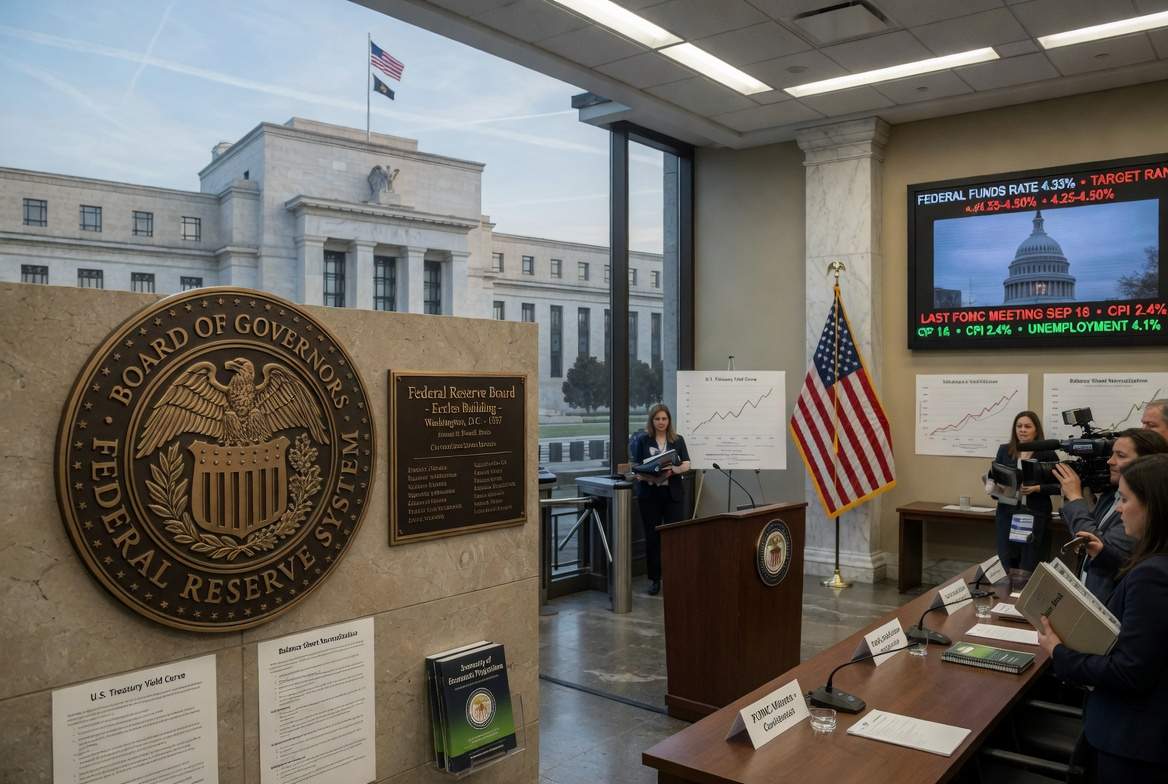
The Federal Reserve is navigating one of the most turbulent stretches in its modern history. In a single week, the central bank produced two major headlines every investor should watch closely. Jerome Powell, the former Fed chair, stepped forward to warn the public about a politicized central bank. At the same time, the Fed’s own inflation forecasting tool flagged accelerating price pressures heading toward a three-year high. Together, these developments reveal an institution under serious stress and a financial market far more fragile than its all-time highs suggest.
Understanding what is happening at the Fed right now matters beyond institutional politics. It has direct consequences for interest rates, borrowing costs, stock valuations, and the purchasing power of every American.
Powell Accepts a Courage Award and Warns the Public
On Sunday, June 1, Jerome Powell accepted the John F. Kennedy Profile in Courage Award at a ceremony in Boston. The JFK Library Foundation gave Powell the award for safeguarding one of the country’s most essential apolitical institutions under sustained personal and professional pressure.
Powell did not shy away from the central tension of the moment. He spoke directly about the fragility of democratic institutions. He listed the Federal Reserve alongside courts and universities as pillars that underpin the country’s stability and global standing.
“Democratic institutions take much time, effort, and patience to build but can be torn down all too quickly,” Powell said. He added that we must preserve what is good about these institutions even while working to improve them.
What the Stress Test Looked Like
The speech was particularly pointed because Powell named specific threats. The Trump administration attempted to remove Fed Governor Lisa Cook. Officials made repeated calls for Powell’s resignation. A criminal investigation targeted Powell personally. These are not minor procedural disputes. They represent an unprecedented level of political pressure on a body that has operated with substantial independence since the Federal Reserve Reform Act of 1977.
Powell’s term as Fed chair concluded on May 15. His successor, Kevin Warsh, took the oath of office on May 22. But Powell chose to remain on the Fed’s board of governors rather than step aside entirely. That decision carries significant implications. By staying on as a governor, Powell holds a board seat that would otherwise fall vacant. This prevents the Trump administration from making an additional appointment to the Fed’s seven-member board in the near term.
Why Fed Independence Matters to Every Investor
For investors focused on quarterly earnings or AI stock rallies, the question of Fed independence can seem abstract. It is not.
How the Fed Controls the Economy
The Federal Reserve’s primary tools are interest rate policy and balance sheet management. When the Fed sets the federal funds rate, it shapes borrowing costs across the entire economy. This includes mortgages, car loans, corporate debt, government bonds, and margin loans used by institutional investors. Fed decisions shaped by political pressure rather than economic data become unpredictable. Markets handle unpredictability poorly.
Powell made this argument clearly in his speech. He noted that the Fed’s structure allows monetary policy decisions free of political considerations. Administrations from both parties have historically respected those protections. He then drew a direct line to the present: if one administration removes Fed officials over policy disagreements, future administrations will do the same. The result would be public loss of faith that the central bank acts in the best interest of all Americans.
The Market Consequences of Lost Credibility
That loss of faith carries real financial weight. Bond markets respond to credibility. Inflation expectations rest partly on the public’s belief that the Fed will act to control prices regardless of political pressure. If that belief erodes, long-term interest rates can rise sharply even without any formal policy change. Investors price in the risk that the Fed might act too slowly or cut rates prematurely for political reasons. That scenario hurts bonds, growth stocks relying on cheap debt financing, and anyone holding a variable-rate mortgage.
The New Fed Chair and His Hawkish Record
Kevin Warsh replaced Powell as Fed chair on May 22. He brings a very different philosophy to the role. Trump handpicked Warsh as his successor. His voting record on the Federal Open Market Committee leans decisively hawkish. He has consistently favored higher interest rates as the primary tool for controlling inflation.
Why Warsh’s Instincts Matter Right Now
With inflation now projected to reach a three-year high, a hawkish chair will likely push for maintaining elevated rates or raising them further. This runs counter to what financial markets priced in for much of the past two years. Investors repeatedly anticipated rate cuts that never arrived. Under Warsh, that pattern is unlikely to change.
Warsh also takes over as the inflation picture grows more complicated. This is not the same post-pandemic supply chain shock that drove the last major inflation cycle. The primary driver this time is an energy price shock tied directly to a presidential military decision.
The Iran War and the Energy Shock Behind the Numbers
On February 28, President Trump ordered military strikes against Iran. Iran responded by closing the Strait of Hormuz to virtually all commercial vessels. That single action halted the movement of roughly 20 million barrels of petroleum liquids per day. This represents approximately 20 percent of global demand. The scale of disruption is hard to overstate.
How Energy Shocks Spread Through the Economy
American consumers felt the effects almost immediately. Gas prices rose at the fastest pace in over three decades. But the more important consequence is what happens next. Energy price shocks typically move through an economy in multiple stages.
The initial wave hits consumers at the fuel pump. This is painful and politically visible. The second and more damaging wave hits businesses. It raises transportation costs, heating and cooling costs for factories and warehouses, and the cost of producing and shipping virtually every physical product. Those higher business costs then feed back into consumer prices across the board. Inflation spreads from the energy sector into the wider economy.
Why This Will Last Longer Than Officials Claim
President Trump has characterized Iran war-driven inflation as a short-term problem that will resolve quickly. Historical precedent does not support that view. Energy price shocks from major geopolitical disruptions consistently prove more persistent than initially projected. Supply chains and investment decisions adjust slowly. Oil production cannot ramp up overnight to fill a supply gap. The inflationary effects of a sustained Strait of Hormuz closure will likely linger well into 2027 even under optimistic shipping assumptions.
The Cleveland Fed Inflation Nowcast: A Number Every Investor Should Track
While the debate about Fed independence dominates headlines, the data driving market outcomes comes from the Federal Reserve Bank of Cleveland’s Inflation Nowcasting tool. This model updates every business day as new economic data arrives. It gives one of the most current available estimates of where inflation actually stands.
What the Latest Numbers Show
The latest May update is not encouraging. The Cleveland Fed currently estimates trailing 12-month inflation through May at approximately 4.18 percent. That number sits 38 basis points above the 3.8 percent rate reported in April. It sits fully 178 basis points above the 2.4 percent rate recorded in February. Inflation has accelerated by nearly two full percentage points in just three months.
The Fed’s official target is 2 percent. At 4.18 percent, the current estimate is more than double that target. Unlike the post-COVID inflation surge, which the Fed could attribute to pandemic supply disruptions and stimulus spending, this surge ties directly to an ongoing military conflict with no clear end date.
What This Means for Rate Decisions
The practical implication for financial markets is significant. Rate cuts that investors widely anticipated at the start of 2026 are now off the table. The question has shifted from when the Fed will start cutting to whether the Fed will need to raise rates further. Under Warsh, a rate hike is more plausible now than at any point in the past several years.
What a Higher-for-Longer Rate Environment Means for Stocks
The stock market set all-time highs across all three major indices as recently as May 27. The Dow Jones Industrial Average, the S&P 500, and the Nasdaq Composite all set records at the same time. Artificial intelligence enthusiasm, record share buybacks, strong corporate earnings, and IPO excitement drove that rally.
The Foundation the Rally Was Built On
That rally rested in large part on the expectation of falling interest rates. Lower rates justify higher valuations by reducing the discount rate applied to future earnings. They also make debt financing cheaper, supporting the massive capital spending needed to build AI data centers. If rates stay elevated or move higher, both pillars weaken.
How Stretched Valuations Are Today
The S&P 500’s Shiller Price-to-Earnings Ratio, which adjusts for inflation using a 10-year earnings average, has reached its second-highest level in over 155 years. Investors are paying historically extreme prices for corporate earnings at precisely the moment when the cost of capital is rising and inflation erodes real returns. Markets at extreme valuations are not necessarily about to collapse. But they have far less room for error. A single inflation surprise or a hawkish statement from Warsh could trigger a rapid repricing of risk assets.
Which Stocks Face the Most Risk
Technology stocks in the AI infrastructure space face the greatest exposure. Their valuations depend most heavily on low discount rates and cheap debt financing. Companies spending tens of billions of dollars on data centers assume that financing will remain manageable. A sustained period of higher rates changes that calculation significantly.
The Broader Institutional Picture
Powell’s speech addressed more than just the Fed. He placed the central bank within a broader framework of democratic governance. He listed the Fed alongside courts and universities as structures that have historically operated independently from direct political control. His core argument was simple: the value of these institutions comes from their perceived neutrality. Once that perception is damaged, it is very hard to restore.
The Global Stakes for American Monetary Policy
For investors, this raises a question that goes beyond any single rate decision. The long-term credibility of American monetary policy is a foundational assumption in global financial markets. Foreign governments and central banks hold trillions of dollars in U.S. Treasury securities. They do so partly because they trust the Federal Reserve to manage inflation responsibly over time. If global investors begin to doubt that independence, the consequences could include higher long-term Treasury yields, a weaker dollar, and reduced demand for dollar-denominated assets.
None of that happens quickly, and none of it is inevitable. But Powell’s willingness to publicly defend institutional independence after leaving the chair’s seat signals that he views the risks as serious. His decision to remain as a governor, keeping a board seat out of the administration’s reach, is the kind of quiet institutional maneuvering that rarely makes front pages but can matter enormously over time.
Key Takeaways for Investors
The Federal Reserve faces two intersecting challenges at once. The first is an inflation problem driven by energy prices that is proving more persistent than official optimism suggested. The second is a political pressure campaign against its independence with no clear historical parallel in the modern era.
Rate Cuts Are Not Coming Soon
The Cleveland Fed’s inflation nowcast puts 2026 rate cuts firmly out of reach. A hawkish new chair will not move in that direction while inflation runs at more than double the official target.
Tech Stocks Face Real Valuation Risk
The AI-driven rally has been extraordinary. But cheap capital and the expectation of cheaper capital financed it. That expectation no longer holds. Technology stocks at stretched valuations are the most exposed to a sustained higher-rate environment.
Institutional Uncertainty Adds a Risk Premium
Markets do not price uncertainty about rules well. If investors begin to wonder whether future rate decisions follow economic logic or political logic, that uncertainty itself becomes a headwind for equities.
Short-Duration Assets Now Offer Real Competition
With short-term rates still elevated and no catalyst for imminent cuts, quality short-duration instruments offer competitive returns without the valuation risk embedded in the broader equity market.
The Federal Reserve has navigated political pressure before. Its institutional structure was designed specifically to make that navigation possible. Whether those structures hold under the current level of stress is a question that will shape financial markets for years to come.
This article is for informational purposes only and does not constitute financial advice. Always do your own research or consult a licensed financial advisor before making investment decisions.