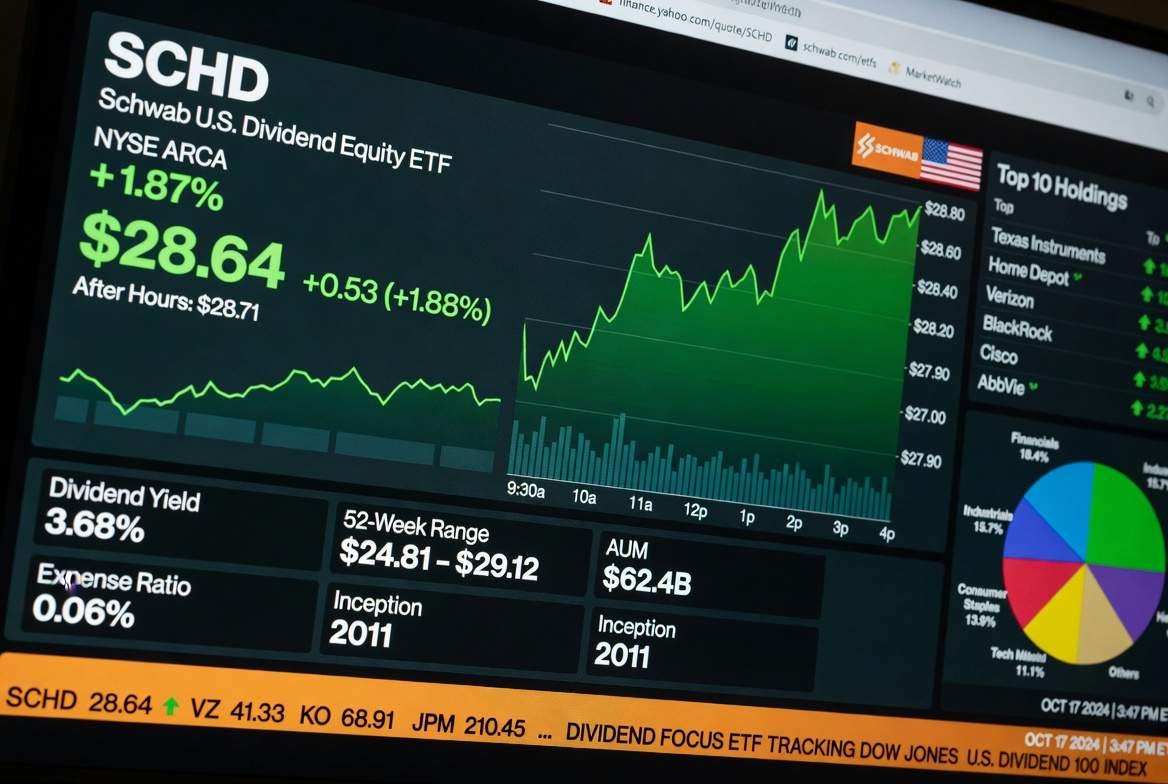
Ticker: SCHD | Exchange: NYSE Arca | Sector: Large-Cap Value / Dividend Equity | Rating: BUY Current Price (June 2026): ~$32.27 | 12-Month Total Return: ~27.80% | Dividend Yield: ~3.28% | AUM: ~$95.3B | Expense Ratio: 0.06%
Executive Summary
After years of underperforming the AI-fueled growth rally, the Schwab U.S. Dividend Equity ETF has staged one of the most decisive comebacks in the dividend ETF category in 2026. Supported by a sector rotation out of technology, a significant March portfolio reconstitution, and a 10-year dividend CAGR approaching 11%, SCHD is delivering what it was always designed to deliver: a rising income stream paired with equity upside from financially sound companies. The investment thesis is straightforward: SCHD gives investors exposure to 100 of the most fundamentally robust dividend-paying companies in the U.S. at a 0.06% expense ratio, with a track record of compounding both income and price at a pace that rivals the broader index over long time horizons.
Fund Overview
The Schwab U.S. Dividend Equity ETF was launched in October 2011 and tracks the Dow Jones U.S. Dividend 100 Index. That index applies a rigorous multi-factor screening process to a broad universe of U.S. equities, filtering for companies with at least 10 consecutive years of dividend payments and then ranking survivors on four fundamental metrics: free cash flow to total debt, return on equity, dividend yield, and five-year dividend growth rate. The 100 highest-scoring companies enter the portfolio.
What the Methodology Actually Screens Out
The screening process is worth understanding because it explains why SCHD behaves so differently from a broad dividend fund. REITs are excluded entirely. Companies with fewer than 10 years of dividend history are ineligible, which eliminates most technology growth names and virtually all recent IPOs. Individual securities are capped at 4% of the portfolio, and no single sector can exceed 25%. Consequently, the fund cannot become dominated by any one holding or theme, a structural discipline that has historically protected it during sector-specific drawdowns.
Furthermore, the methodology cuts holdings once they no longer qualify relative to peers, not based on absolute performance. This means SCHD will shed previously popular names like Cisco and AbbVie if newer entrants score higher on the composite metrics, regardless of whether the removed stocks remain strong businesses. That rules-based discipline is a feature, not a flaw: it keeps the portfolio anchored to quality rather than momentum.
As of June 2026, SCHD manages approximately $95.3 billion in assets under management, a figure that has grown by roughly $28 billion over the trailing 12 months alone, reflecting sustained inflows as dividend strategies have regained investor favor.
Financial Snapshot
| Metric | Value (as of June 2026) |
|---|---|
| Current Price | ~$32.27 |
| AUM | ~$95.3B |
| Expense Ratio | 0.06% |
| Dividend Yield (trailing) | 3.28% |
| Annual Distribution (trailing) | $1.06 per share |
| Distribution Frequency | Quarterly |
| Last Ex-Dividend Date | March 25, 2026 |
| 1-Year Total Return (TTM) | ~27.80% |
| 3-Year Total Return CAGR | ~15.30% |
| 5-Year Total Return CAGR | ~8.71% |
| 10-Year Price CAGR | ~8.96% |
| 15-Year Total Return CAGR | ~13.53% |
| 10-Year Dividend CAGR | ~10.99% |
| Number of Holdings | 100 |
| Index Tracked | Dow Jones U.S. Dividend 100 Index |
| Inception Date | October 20, 2011 |
The dividend history is particularly compelling for long-term investors. From a split-adjusted $0.12 per share in 2011, the annual distribution had grown to $0.74 per share by 2024, representing growth of over 516% in 12 years. Additionally, investors who purchased shares at the 2020 split-adjusted price of approximately $17.50 now enjoy a yield on cost of roughly 5.94%, illustrating the compounding power of dividend growth reinvestment over time.
The 2026 Market Rotation: Why SCHD Is Back
To understand SCHD’s 2026 performance, context matters. Between 2023 and 2025, the fund delivered positive returns but consistently lagged growth and technology-heavy indices. AI investment themes dominated capital flows, non-dividend payers led the market, and SCHD’s value tilt was a structural headwind.
The Rotation That Changed the Calculus
That dynamic reversed sharply at the start of 2026. Technology stocks that had led the prior rally began correcting. Nvidia dropped approximately 10% from its 2025 highs, and Microsoft fell roughly 22% from peak. Investors began rotating into cash-generating value names, energy stocks, and defensives, precisely the categories that dominate SCHD’s portfolio.
Notably, the prior year’s reconstitution, which significantly increased SCHD’s energy sector weighting to approximately 21%, turned out to be well-timed. Energy prices climbed in early 2026 amid Middle East geopolitical tensions, and SCHD’s overweight position in the sector provided meaningful outperformance. As a result, the fund was up approximately 20% year-to-date through late May 2026, meaningfully outperforming the S&P 500’s 11.26% YTD gain over the same period.
Moreover, the broader market narrative of a “soft landing” supported SCHD’s cyclical and consumer staples holdings, while the fund’s below-market P/E multiple of approximately 17.1x versus the broader market’s roughly 29.4x provided a valuation cushion that growth funds lacked.
The March 2026 Reconstitution: Portfolio Changes That Matter
SCHD’s annual index reconstitution, effective March 23, 2026, was one of the most closely watched events in the dividend ETF space this year. The scope was significant: 25 new companies entered the portfolio and 22 were removed, a larger-than-average rotation that meaningfully shifted sector exposures.
Who’s In and Who’s Out
The most notable additions include UnitedHealth Group, Abbott Laboratories, Procter and Gamble, Qualcomm, Accenture, Comcast, and Automatic Data Processing. Several of these names moved directly into or near the top 10 holdings given their market capitalization and high composite scores. Specifically, UnitedHealth and Abbott joined a top 10 that already includes Chevron, ConocoPhillips, Verizon, Merck, Coca-Cola, Texas Instruments, PepsiCo, and Amgen.
Conversely, notable removals include AbbVie, Cisco Systems, Halliburton, Valero Energy, and ConocoPhillips from certain tier positions. AbbVie and Cisco were particularly prominent prior holdings, and their removal illustrates how the index’s relative scoring can oust strong businesses when peers rank higher on the composite metrics.
Sector Shifts After the Reconstitution
| Sector | Pre-Reconstitution Weight | Post-Reconstitution Change |
|---|---|---|
| Energy | ~20% | Down approximately 8% |
| Healthcare | Previously lower | Up approximately 4% |
| Technology | Previously lower | Up approximately 3% |
| Financials | ~8.5% | Increased, reclaiming prior weighting |
| Consumer Staples | ~19% | Roughly stable |
The most pronounced shift is the deliberate reduction in energy exposure. After energy stocks contributed significantly to 2025 and early 2026 outperformance, the index trimmed the sector from approximately 20% to around 12%, locking in gains and reducing commodity-driven volatility. Healthcare and technology received modest boosts, improving the portfolio’s earnings growth profile without sacrificing the income focus.
Analysts broadly agree that the reconstitution does not fundamentally alter the fund’s character. As one Motley Fool analysis noted in March 2026, the quality and durability of the portfolio have not changed, which remains SCHD’s defining positive attribute.
Competitive Moat: Why SCHD Leads the Dividend ETF Category
SCHD does not compete with the S&P 500 on raw growth potential. Instead, its competitive advantage within the dividend ETF space rests on three structural pillars that competitors have not convincingly replicated.
The Triple Filter Advantage
Most dividend funds optimize for one dimension. The Vanguard Dividend Appreciation ETF (VIG) screens primarily for dividend growth track record. The Vanguard High Dividend Yield ETF (VYM) screens primarily for current yield. SCHD, by contrast, evaluates dividend growth, dividend yield, AND fundamental balance sheet quality simultaneously. Consequently, the fund avoids yield traps, excludes speculative payers, and maintains a portfolio of companies with genuine capacity to sustain and grow distributions.
The Expense Ratio at Scale
At 0.06%, SCHD is one of the lowest-cost dividend ETFs available. However, the more important metric at $95.3 billion in AUM is what that scale means for bid-ask spreads and trading efficiency. The fund trades approximately 27.5 million shares daily, making it among the most liquid dividend ETFs in the world. For retail investors and institutions alike, this combination of minimal cost and deep liquidity is difficult to match.
The Reconstitution Discipline
Furthermore, SCHD’s annual reconstitution acts as a systematic quality filter that active managers often fail to replicate due to behavioral bias. By removing holdings that no longer rank in the top 100 on composite metrics, the index forces a disciplined “buy quality, sell deterioration” rotation that has, on balance, served long-term investors well.
Key Demand Drivers in 2026
Several structural themes are driving renewed interest in SCHD specifically rather than dividend strategies broadly.
The Value-Growth Rotation
The rotation from growth to value that began in early 2026 has been the single most significant driver of SCHD inflows. Over the past six months alone, the fund added approximately $24.97 billion in net AUM, reflecting institutional and retail repositioning toward cash-generating equities. As long as the narrative around AI valuations remains contested and rate expectations stay elevated, value-oriented dividend funds benefit from relative preference.
Income Demand From Aging Demographics
Additionally, the demographic tailwind for income-generating equity funds is structural. Baby Boomers transitioning into retirement represent a multi-decade demand driver for vehicles that produce current cash flow without requiring the credit risk or complexity of fixed income alternatives. SCHD’s 3.28% yield, monthly-reinvestable quarterly distributions, and equity growth participation make it well-suited for this cohort.
Yield on Cost Compounding
For investors in the accumulation phase, the yield on cost argument is increasingly compelling. Investors who purchased SCHD at the 2020 lows now earn close to 6% on their original investment, before accounting for price appreciation. As awareness of dividend growth compounding spreads in retail investor communities, SCHD consistently appears at the top of recommended holding lists.
Competitive Risks
Intellectual honesty requires a rigorous bear case. SCHD has meaningful vulnerabilities that investors should not dismiss.
Technology Underexposure Is a Structural Drag in Bull Markets
The most persistent criticism of SCHD is valid: by design, it excludes or minimally weights the highest-growth companies in the U.S. economy. During the 2023 to 2025 AI-driven bull market, SCHD materially underperformed the S&P 500. If technology and growth stocks resume market leadership, SCHD investors will again experience relative underperformance. The fund is explicitly not a total return maximizer, and investors who need maximum long-term growth should acknowledge this trade-off clearly.
Dividend Sustainability Is Not Guaranteed at the Holding Level
SCHD’s index methodology screens for historical dividend quality, not future certainty. Individual holdings can and do cut dividends when business conditions deteriorate. A recession scenario that impairs earnings at consumer staples, energy, or financial companies could simultaneously depress SCHD’s price and reduce its distributions. The 2022 drawdown, in which SCHD declined only approximately 3% while the S&P 500 fell 18%, is often cited as evidence of downside resilience, but a deeper or more broad-based economic contraction has not been stress-tested against the current portfolio composition.
Concentration Remains Elevated
Approximately 41.7% of SCHD’s assets are concentrated in its top 10 holdings. While individual position caps at 4% prevent single-stock dominance, sector concentrations can still build through correlations between large holdings. Energy and financials together represent a meaningful portion of the portfolio, and both sectors are sensitive to commodity prices and credit cycles respectively.
The Reconstitution Can Create Tax Events
The annual reconstitution, while structurally beneficial, can trigger capital gains distributions in taxable accounts. Investors holding SCHD outside tax-advantaged accounts should review year-end distribution announcements and plan accordingly.
Valuation Framework: Three Scenarios
Bull Case: Sustained Rotation and Rate Cuts
Key assumptions:
- The S&P 500 value rotation continues through year-end 2026
- The Federal Reserve delivers at least one rate cut in the second half of 2026
- SCHD’s energy and healthcare holdings maintain current earnings trajectories
- Dividend growth rate sustains approximately 10% to 11% annually
Implied share price range: $36 to $40 (end of 2026) Implied yield at entry: approximately 2.6% to 2.9% What must be true: Technology continues to underperform value on a relative basis, and macro conditions remain constructive for defensive cyclicals.
Base Case: Moderate Market, Consistent Distributions
Key assumptions:
- S&P 500 ends 2026 up 9% to 12% from January levels
- SCHD performs roughly in line with large value category
- Dividend growth maintains a 9% to 10% annual pace
- No significant sector-level earnings impairment
Implied share price range: $32 to $36 (end of 2026) Implied yield at entry: approximately 3.0% to 3.3% What must be true: The current economic soft landing thesis holds and neither deep recession nor aggressive growth re-rating disrupts the value rotation.
Bear Case: Tech Re-Accelerates, Macro Deteriorates
Key assumptions:
- AI investment boom reignites and growth outperforms value sharply
- A credit stress event or earnings recession impairs holdings across energy and financials
- SCHD dividend distributions are reduced at one or more top holdings
- Broader market sells off more than 15% from current levels
Implied share price range: $24 to $28 (end of 2026) Implied yield at entry: approximately 3.8% to 4.4% What must be true: Either the macro environment deteriorates meaningfully or growth-stock dominance resumes as dramatically as 2023 to 2024.
Management and Capital Allocation
SCHD is a passively managed fund operated by Schwab Asset Management, a division of The Charles Schwab Corporation. Because the fund follows a rules-based index, there is no portfolio manager making discretionary allocation decisions. The fund’s annual turnover is driven by the index reconstitution rather than active trading, and the Dow Jones U.S. Dividend 100 Index reconstitutes annually in March with quarterly rebalancing for weight adjustments between annual reviews.
This structure has meaningful advantages. Specifically, passive management eliminates manager risk, keeps costs minimal at 0.06%, and ensures the fund’s behavior remains predictable and explainable. Schwab’s scale and operational infrastructure provide institutional-grade execution quality during reconstitution events. Fund flows over the trailing 12 months, at approximately $28 billion in net AUM growth, demonstrate that investor confidence in the product’s management execution remains high.
Comparing SCHD to Dividend ETF Peers
| Fund | Ticker | Yield | Expense Ratio | AUM | Key Differentiator |
|---|---|---|---|---|---|
| Schwab U.S. Dividend Equity ETF | SCHD | ~3.28% | 0.06% | ~$95.3B | Quality + yield + growth filter |
| Vanguard High Dividend Yield ETF | VYM | ~2.9% | 0.06% | Large | Yield focus, more holdings |
| Vanguard Dividend Appreciation ETF | VIG | ~1.7% | 0.06% | Large | Dividend growth track record focus |
| JPMorgan Equity Premium Income ETF | JEPI | ~7% to 8% | 0.35% | Large | Covered call income, lower upside cap |
| iShares Core Dividend Growth ETF | DGRO | ~2.2% | 0.08% | Mid | Dividend growth emphasis |
Against this peer set, SCHD’s combination of a 3.28% yield, 0.06% expense ratio, quality screening, and long dividend growth history positions it as the most complete offering in the dividend ETF space for investors seeking a balance of income and total return. JEPI offers a higher current yield, but its covered call structure limits upside participation in strong equity markets. VIG offers lower volatility but significantly less current income. VYM provides broader diversification but less rigorous quality screening.
Risk Summary Table
| Risk | Probability | Impact | Mitigation |
|---|---|---|---|
| Technology re-acceleration leads to relative underperformance | Medium | Medium | Complement with growth exposure (VOO or QQQ) if needed |
| Earnings recession reduces distributions | Low to Medium | High | High quality holdings, diversified across sectors |
| Energy sector reversal post-reconstitution | Medium | Medium | Energy now trimmed to ~12% after March 2026 reconstitution |
| Single-holding dividend cut | Medium | Low | 100 holdings; no position exceeds 4% |
| Tax events from annual reconstitution | High | Low | Hold in tax-advantaged accounts where possible |
| Rate-driven value rotation reversal | Medium | Medium | Long-term thesis does not depend on rate trajectory |
Investment Conclusion
SCHD is not trying to be the S&P 500. It is trying to be the best version of itself: a concentrated portfolio of financially sound, dividend-growing U.S. companies, reconstituted annually by a rules-based process that keeps quality high and sentiment out. In 2026, that approach is working at a level that has surprised even long-term advocates of the strategy.
The 10-year dividend CAGR of approximately 11%, the trailing 27.80% total return, the $95.3 billion in AUM reflecting sustained investor conviction, and the disciplined March reconstitution that trimmed energy and added healthcare and financial quality all point to a fund executing precisely as designed. The bear case is real: if AI-driven growth resumes dominance or macro conditions worsen materially, SCHD will underperform in relative terms. Investors should hold this fund as part of a diversified equity allocation, not as a substitute for broad market exposure.
Verdict: BUY for income-oriented and balanced investors. SCHD remains the benchmark dividend ETF for investors who want yield, quality, and growth discipline in a single, low-cost vehicle. At current prices, the 3.28% dividend yield combined with a 10-year dividend growth rate near 11% and a 15-year total return CAGR of 13.53% makes SCHD one of the most compelling income-and-growth propositions in the ETF universe.
Appendix: Key Metrics Table
| Metric | Value (as of June 2026) |
|---|---|
| Ticker | SCHD |
| Exchange | NYSE Arca |
| Current Price | ~$32.27 |
| AUM | ~$95.3B |
| Expense Ratio | 0.06% |
| Dividend Yield (trailing) | 3.28% |
| Annual Distribution | $1.06 per share |
| Last Ex-Dividend Date | March 25, 2026 |
| Distribution Frequency | Quarterly |
| YTD Return (to late May 2026) | ~20% |
| 1-Year Total Return (TTM) | ~27.80% |
| 3-Year Total Return CAGR | ~15.30% |
| 5-Year Total Return CAGR | ~8.71% |
| 10-Year Price CAGR | ~8.96% |
| 15-Year Total Return CAGR | ~13.53% |
| 10-Year Dividend CAGR | ~10.99% |
| Number of Holdings | 100 |
| Top 10 Concentration | ~41.7% |
| P/E Multiple (portfolio) | ~17.1x |
| Portfolio ROE | ~27.8% |
| Earnings Growth (portfolio) | ~9.3% |
| Index | Dow Jones U.S. Dividend 100 |
| Share Split History | 3-for-1 split effective October 2024 |
| Issuer | Charles Schwab / Schwab Asset Management |
Disclaimer: This article is for informational purposes only and does not constitute investment advice or a recommendation to buy, sell, or hold any security. All financial data referenced is based on publicly available information as of June 2026 and is subject to change without notice. Past performance is not indicative of future results. The scenarios and price ranges presented are illustrative assumptions, not forecasts. Investing in ETFs involves risk, including the potential loss of principal. Investors should consult a qualified financial advisor before making any investment decisions.