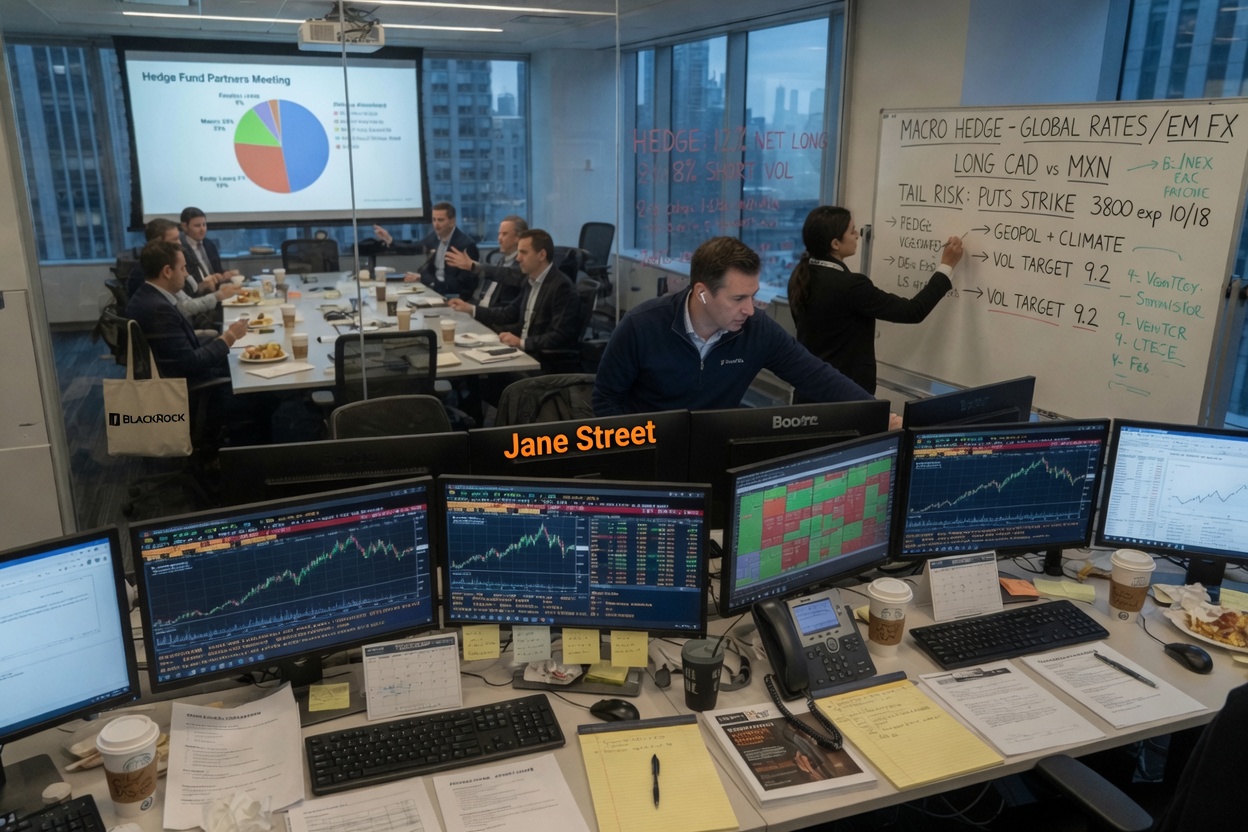
Every quarter, a quiet wave of disclosures ripples through the U.S. Securities and Exchange Commission’s EDGAR database. These filings, known as Form 13F reports, reveal the positions that the world’s most powerful investment firms have accumulated over the prior three months. What they show is not merely interesting: it is one of the clearest windows available into who actually moves markets, why prices behave the way they do, and which companies are about to face the most consequential decisions of their corporate lives.
Hedge funds collectively manage approximately $5.71 trillion in assets as of 2026, a figure projected to reach $8.83 trillion by 2031. That is not a niche corner of finance. It is a gravitational force that shapes equity valuations, accelerates corporate restructuring, drives volatility cycles, and determines where billions of dollars in capital flow on any given day. Furthermore, in an era when passive index investing has made the average retail investor a passenger on the market’s journey, hedge funds remain among the few actors who can actively steer the ship.
This article takes a close look at the mechanics of that influence, the specific firms that wield it most powerfully, and what the current moment in hedge fund history means for anyone watching financial markets in 2026.
The Scale of Institutional Power: Numbers That Matter
A $5.7 Trillion Industry at Full Stride
The hedge fund industry entered 2026 in the strongest position it has occupied in nearly a decade. After delivering double-digit returns for the second consecutive year in 2025, the industry recorded its highest capital inflows in almost two decades, according to a Barclays survey of over 340 institutional investors representing $7.8 trillion in combined assets under management. This performance inflection is not a coincidence: it reflects a fundamental shift in market conditions that systematically favors the strategies hedge funds employ.
Specifically, three macro factors have converged to create ideal conditions for hedge fund alpha generation. First, elevated equity valuations, with the S&P 500 trailing P/E at nearly the 96th percentile of its 20-year range as of late 2025, have increased the dispersion of returns between well-managed and poorly-managed companies. Second, macro volatility driven by trade policy uncertainty, geopolitical conflict, and shifting Federal Reserve posture has created pricing inefficiencies that skilled macro traders can exploit. Third, the partial breakdown of the traditional 60/40 portfolio model, as stock and bond correlations have shifted, has pushed institutional allocators to seek non-correlated return sources. Hedge funds are the primary beneficiary of all three dynamics simultaneously.
North America’s Chokehold on Global Capital
Despite the global nature of modern finance, North America remains the overwhelmingly dominant geography for hedge fund capital. As of 2025, North American funds accounted for approximately 73% of global hedge fund assets under management. However, the fastest growth is occurring elsewhere. Asia-Pacific hedge fund assets are projected to grow at 12.56% annually through 2031, as rising local institutions in Japan, South Korea, Australia, and Singapore build their own alternatives programs. This geographic shift will matter for investors in the coming decade, but for now, the story of hedge fund market influence is predominantly an American story.
The Big Five: Who Actually Moves Markets
Citadel: The Machine That Never Sleeps
No firm better exemplifies the industrial-scale transformation of hedge fund investing than Citadel, the $66 billion multi-strategy powerhouse founded and run by Ken Griffin. In many respects, Citadel is less a hedge fund than a financial technology company that happens to trade. As of September 2025, Citadel’s disclosed long portfolio via SEC filings encompassed an extraordinary 7,016 total positions, with the firm actively managing 3,558 additions, 3,446 trims, 1,404 new bets, and 1,233 full exits in a single quarter. The total disclosed market value was approximately $130 billion, spread across virtually every major sector in the economy.
This scale of activity is itself a market influence mechanism. Consequently, when Citadel rotates out of a sector or builds a multi-billion position in a single name, it does not merely respond to price signals: it generates them. Citadel’s flagship Wellington multi-strategy fund gained 10.2% in 2025, while its tactical trading fund, which combines equities with quantitative strategies, rose 18.6%. Since Citadel’s inception in 1990, the firm has produced an annualized net return of 19.2%, a record that rivals or exceeds virtually every long-term investment benchmark.
Griffin himself has been notably candid about the limits of the AI revolution in his domain. Speaking at the JPMorgan Robin Hood Investors Conference, he stated that generative AI has yet to deliver genuine alpha for hedge funds. “With GenAI, there are clearly ways it enhances productivity, but for uncovering alpha, it just falls short,” Griffin said. This perspective, coming from the CEO of arguably the world’s most technically sophisticated trading operation, carries significant weight and stands in deliberate contrast to the breathless AI optimism that pervades much of the technology sector.
Bridgewater Associates: The Macro Oracle
Founded by Ray Dalio in 1975, Bridgewater Associates is the progenitor of the modern macro hedge fund model. Its flagship Pure Alpha strategy, built on Dalio’s “All Weather” principle of balancing portfolio risk across economic regimes rather than chasing returns in a single environment, has been widely copied but rarely matched. In 2025, that approach produced its best-ever annual return: the Pure Alpha II fund gained 34%, while the All Weather strategy rose 20%.
That performance was not accidental. Rather, it reflected Bridgewater’s specific design for precisely the kind of environment 2025 delivered: tariff-driven market volatility, geopolitical uncertainty, and sharp divergences between asset classes. Bridgewater has built its institutional client base accordingly, serving sovereign wealth funds, university endowments, and pension funds that prioritize consistency and capital preservation over maximum returns. Its macro-focused approach to portfolio construction, emphasizing deep research into interest rate dynamics, inflation cycles, and currency flows, has become an intellectual framework that shapes how institutional investors think about portfolio construction globally, not merely how Bridgewater allocates its own capital.
Millennium Management: The Pod Model Perfected
Millennium Management, which manages approximately $83.5 billion in assets, has become the defining example of the multi-manager “pod” model that is now reshaping the entire hedge fund industry. Rather than relying on a single investment officer or a unified strategy, Millennium deploys capital to hundreds of semi-independent trading teams, each operating within strict risk limits set by the firm’s centralized risk infrastructure. When one pod underperforms, the loss is contained. When many pods outperform simultaneously, the compounding effect is substantial.
In 2025, Millennium gained 10.5%, a result that understates its strategic importance because the fund maintains one of the most risk-controlled profiles in the industry. The pod model has proven so effective that it is now being replicated by virtually every large hedge fund in the world. Multi-strategy platforms, as a category, held the largest share of the hedge fund market at 27.26% in 2025. Furthermore, multi-manager growth is expected to continue into 2026, with external allocations by these oversubscribed platforms showing no sign of slowing.
D.E. Shaw: Where Quantitative Strategy Meets Market Structure
D.E. Shaw represents a different kind of market influence: the power of quantitative systematic trading operating at the intersection of mathematics, computer science, and financial theory. The firm’s flagship Composite multi-strategy fund gained 18.5% in 2025, while its Oculus fund produced an estimated 28.2% return. These are not the results of a discretionary portfolio manager making concentrated bets on individual companies. Instead, they reflect a systematic process of identifying and exploiting pricing inefficiencies across thousands of simultaneous positions, often holding them for very short periods.
The market impact of systematic quantitative funds like D.E. Shaw operates through a different channel than discretionary funds. Quantitative strategies collectively accelerate price discovery, reduce certain forms of market inefficiency, and contribute significantly to daily liquidity. Nevertheless, they can also amplify short-term volatility when multiple quant funds identify the same signal simultaneously and all attempt to trade in the same direction. This “quant crowding” phenomenon has been documented in several episodes of unexplained sudden market movements and remains a genuine systemic risk factor in modern markets.
Elliott Management: The Activist Who Rewrites Corporate Strategy
Among all the major hedge fund archetypes, none produces more visible and direct market impact than the activist investor. In that category, Elliott Management, founded by Paul Singer in 1977 and now managing approximately $76.1 billion in assets, stands as the most consequential firm operating today.
In 2025 alone, Elliott launched 18 activist campaigns, spending nearly $20 billion in capital, according to Barclays data. These campaigns targeted some of the most recognizable companies in global business, including PepsiCo, where Elliott disclosed a $4 billion stake and called for an operational review; Southwest Airlines, where Elliott secured five board seats, the most it has ever obtained in a U.S. settlement; Starbucks, where its involvement preceded the appointment of Chipotle CEO Brian Niccol as the coffee chain’s new leader; and Honeywell, where Elliott pushed for a full conglomerate breakup that the company subsequently agreed to, splitting into three independently listed businesses.
The market mechanics of activist investing are immediate and measurable. When Elliott or any major activist discloses a stake, prices move dramatically and almost instantly. The day Elliott’s BP investment became public, BP shares rose to their highest level since August. Mere rumors of Elliott involvement were sufficient to trigger significant price jumps for targets including Lululemon and TripAdvisor in early 2026. This phenomenon, where the identity of a buyer is itself a market-moving event independent of any fundamental change, illustrates how far hedge fund influence extends beyond conventional supply-and-demand mechanics.
How Hedge Funds Move Markets: The Mechanisms
Position Size and Market Impact
The most direct mechanism of hedge fund market influence is simply the size of their positions relative to available market liquidity. Funds exceeding $50 billion in AUM often experience diminishing marginal returns precisely because their position sizes become large enough to move prices before they finish building them. Citadel and Millennium have both addressed this by closing flagship strategies to new investors when capacity thresholds are reached. Renaissance Technologies famously closed its Medallion Fund to outside investors entirely in 2005, because the fund’s returns depended on trading at a scale that would self-destruct under larger asset management.
This capacity constraint is a crucial insight for retail investors: the largest hedge funds face structural limits on their return potential precisely because of their size. Moreover, it implies that their trades are systematically leaving a market footprint that patient, informed investors can sometimes detect and follow.
The 13F Signal: Reading Institutional Hands
Every institutional manager with over $100 million in qualifying U.S. equities is legally required to file a Form 13F with the SEC within 45 days of each quarter’s end. These filings, while subject to a meaningful lag, reveal the structural positioning of institutional capital in ways that have genuine investment value.
The lag is simultaneously the signal’s greatest weakness and a surprisingly useful filter. Institutional investors generally do not flip portfolios overnight. When a major hedge fund builds a billion-dollar position, the process typically unfolds over multiple quarters. Consequently, even a 45-day-old 13F filing may accurately reflect a position that the fund continues to hold and even expand. The 2023 semiconductor rally, for instance, was confirmed by 13F filings that revealed systematic accumulation from technology-focused hedge funds, establishing that the move was driven by institutional conviction rather than retail momentum. The trend persisted for several additional quarters after those filings became public.
However, 13F filings reveal only what hedge funds want the public to see, and only partially at that. These filings show only long equity positions. Short positions, options hedges, fixed income holdings, currency bets, futures positions, foreign-listed stocks, and all private market investments are invisible. For a firm like Bridgewater, whose equity 13F represents only a small slice of a much larger multi-asset macro portfolio, the public filing can be actively misleading as a guide to the firm’s actual market view.
Short Selling: The Hidden Half of Hedge Fund Influence
Short selling, the practice of borrowing and selling shares in the expectation of buying them back at a lower price, is the most controversial and arguably the most market-valuable activity that hedge funds engage in. It is also entirely invisible in public filings.
Collectively, short sellers serve a critical function in market efficiency: they provide a mechanism for negative information to be incorporated into prices. Academic research consistently shows that markets with active short selling correct overvaluations faster and more accurately than markets where short selling is restricted. Nevertheless, hedge fund short campaigns against individual companies, particularly when coordinated with the public release of negative research, raise legitimate questions about the boundary between information provision and market manipulation.
In 2026, as activist investing has resurged and companies face renewed scrutiny of their capital allocation and operational efficiency, short campaigns have become more frequent and more public. Hedge funds are increasingly using media, investor letters, and even podcasts, as Elliott did during its Southwest Airlines campaign, to communicate their investment theses directly to shareholders, bypassing traditional corporate communication channels entirely.
The Quant Revolution: When Algorithms Become Whales
Rise of Systematic Strategies
Quantitative and systematic hedge fund strategies represent the fastest-growing segment of the industry, projected to expand at an 11.63% CAGR through 2031. Two Sigma, AQR Capital Management, D.E. Shaw, Man Group, and Renaissance Technologies each manage multi-tens-of-billions in assets using systematic approaches that range from relatively simple factor models to extraordinarily complex machine learning-driven signal generation.
The collective market impact of these firms operates at frequencies and scales that are genuinely invisible to most observers. High-frequency trading strategies, which hold positions for milliseconds or seconds, collectively account for a significant fraction of total market volume on major U.S. exchanges on any given day. Consequently, the price at which a retail investor buys or sells any large-cap stock is partly determined by algorithms making decisions measured in microseconds.
The AI Question: Promise vs. Reality
The relationship between artificial intelligence and hedge fund performance is more nuanced than most commentary suggests. On one hand, systematic funds have long used machine learning techniques that predate the current generative AI era. On the other hand, Ken Griffin’s public skepticism about generative AI’s ability to generate alpha reflects a genuine consensus among practitioners: language models are useful for productivity enhancement, but they have not yet demonstrated the ability to consistently identify market-beating trading signals.
However, this picture may change. Quant-focused funds are increasingly applying AI to alternative data sources, including satellite imagery of company parking lots, credit card transaction aggregates, shipping container tracking data, and social media sentiment analysis. These approaches represent a genuine extension of the information advantage that hedge funds have historically sought. As a result, the competitive moat of quantitative hedge funds may widen further in the coming years, even if generative AI specifically has not yet delivered on its promise.
The BlackRock Factor: When Asset Management Becomes Hedge Fund Competition
A $10 Trillion Firm Enters the Arena
Perhaps the most consequential structural development in the institutional investing landscape of 2025 and 2026 is BlackRock’s deliberate push into hedge fund-style strategies. BlackRock, the world’s largest asset manager with approximately $10 trillion in assets under management, is expanding its systematic active strategies and multi-manager platforms in a direct challenge to the dominance of Citadel, Millennium, and Bridgewater.
According to executives familiar with the firm’s plans, BlackRock is ramping up its BlackRock Systematic hedge fund unit, expanding its global macro and quantitative trading desks, and recruiting senior portfolio managers from rival firms. The firm’s effort centers on internalizing multi-manager hedge fund strategies, precisely the pod model that has made Millennium so profitable, while leveraging BlackRock’s massive data infrastructure, technology resources, and institutional client relationships.
This development matters for the broader market for two distinct reasons. First, it signals that the structural advantages of hedge fund-style investing are now recognized even by the world’s largest passive investment manager, which built its dominance on the proposition that beating the market consistently is essentially impossible. Second, it introduces a competitor with scale, technological resources, and distribution capabilities that no pure-play hedge fund can match.
Implications for Market Structure
If BlackRock succeeds in building a competitive multi-manager hedge fund platform, the likely consequence is increased competition for the same set of alpha opportunities, driving returns down across the industry. This dynamic has already begun at smaller scale, as the proliferation of multi-manager platforms has compressed returns in the most crowded strategies. Furthermore, it raises a structural question about whether the democratization of hedge fund-style strategies, made accessible to smaller investors through lower minimum investments starting at $25,000 to $100,000 on some platforms, will erode the information advantages that have historically justified premium fees.
What This Means for Ordinary Investors
The Asymmetry Problem
The most important practical implication of hedge fund market dominance for ordinary investors is the fundamental asymmetry in information and execution capability. A hedge fund with $50 billion in assets, a team of hundreds of analysts, access to alternative data sets unavailable to retail traders, and the ability to trade at institutional speed and scale is not operating in the same market as an individual managing a brokerage account. Technically, they buy and sell the same securities. In practice, the playing field is tilted in ways that are structural and persistent.
This asymmetry is the central argument for passive index investing. If you cannot consistently identify market-beating opportunities and you cannot execute at the speed and cost efficiency of institutional players, accepting market returns through low-cost index funds like SPY, VOO, or IVV eliminates the cost of losing the competition you were never likely to win. Moreover, the evidence that most actively managed funds underperform their benchmark over 15-year periods, even with professional management, reinforces this logic.
The Hidden Beneficiary of Hedge Fund Activity
Nevertheless, ordinary investors benefit from hedge fund activity in ways that are not always appreciated. Short sellers who identify and publicize corporate fraud, such as the campaigns that exposed Enron and Wirecard, provide a market integrity function. Activist investors who force poorly managed conglomerates to restructure, as Elliott has done repeatedly, often create genuine value for all shareholders, not merely the hedge fund itself. Furthermore, the liquidity that quantitative high-frequency traders provide reduces transaction costs for every market participant, including retail investors.
The presence of well-capitalized, highly analytical institutional investors also accelerates the speed at which fundamental information is reflected in prices. As a result, markets where hedge funds are active tend to be more efficient and harder to manipulate than markets where they are absent.
Following the Smart Money: What Works and What Doesn’t
A cottage industry exists around the concept of “following the smart money,” using 13F filings and other public disclosures to replicate hedge fund trades in retail portfolios. The evidence on this strategy is mixed. On one hand, research suggests that tracking the disclosed positions of highly concentrated, conviction-driven investors like Warren Buffett’s Berkshire Hathaway, where filings genuinely reflect long-term conviction trades, can add value. On the other hand, blindly copying a Citadel 13F filing, which discloses only the long equity slice of a massive, constantly rotating portfolio hedged with instruments that never appear in public filings, is likely to produce incomplete and potentially misleading signals.
The more useful application of 13F intelligence is understanding structural positioning across many managers simultaneously: identifying sectors where institutional capital is systematically building, noticing when a consensus trade appears overcrowded, and recognizing when a formerly favored position is being distributed. These are the slow-moving currents beneath the surface chop of daily trading, and they are the kind of signal that has the most relevance for investors with multi-month rather than multi-minute time horizons.
The Industry’s Direction: 2026 and Beyond
Record Activism, Record AUM
Activist investors set a record in 2025 with 255 global campaigns, according to Barclays data, a 5% increase over 2024 and the highest figure since records began. The bulk of this activity, more than half, remained concentrated in the United States, where 141 campaigns took place, up 23% from the prior year. Japan saw a record 56 campaigns as global activist strategies increasingly target Asian conglomerates with similar operational inefficiency arguments to those used against Western targets.
The trend is expected to continue. In 2026, rising interest rates, tighter financing conditions, and uneven equity performance have created precisely the environment in which activism historically thrives. When cheap capital no longer allows underperforming businesses to mask operational weakness, the activists arrive.
The $5 Trillion Milestone and What Comes Next
The hedge fund industry is on track to cross $5 trillion in total AUM, a milestone that was initially projected for 2028 but may now arrive a full year earlier given the pace of institutional inflows in 2024 and 2025. Beyond that, projections from Mordor Intelligence suggest $8.83 trillion by 2031, implying nearly a doubling of assets over five years.
Driving this growth are several structural forces that show no sign of reversing. Institutional allocators, including pension funds, sovereign wealth funds, and university endowments, are shifting away from the traditional 60/40 portfolio model as stock-bond correlations have become unreliable. In their place, hedge funds occupy the role of providing liquid, non-directional alpha that reduces portfolio volatility without sacrificing return potential. As long as that value proposition holds, capital will continue to flow toward the best performers.
Democratization and Its Limits
An August 2025 executive order from the Trump administration sought to include alternative investments, including hedge funds, in individual retirement accounts. This push toward democratizing access to strategies previously available only to institutions and ultra-high-net-worth individuals is a genuine structural shift. However, critics have raised legitimate concerns about suitability: hedge fund strategies designed for institutions with 10-year lock-ups and sophisticated risk management teams are not automatically appropriate for retail investors building retirement portfolios.
Furthermore, access to the top-tier managers, firms like Citadel, Millennium, Bridgewater, and D.E. Shaw, remains effectively closed to new investors. When these platforms do accept capital, they command fees that are impossible for retail investors to justify. The democratization story is more accurately described as democratized access to the second and third tier of the hedge fund industry, not to the firms that actually move markets.
Conclusion: The Invisible Hand Is Institutional
The romantic notion that stock markets are driven by millions of independent rational actors processing public information equally and simultaneously was always a simplification. In 2026, it is essentially fiction. The market is shaped in decisive ways by a relatively small number of extraordinarily well-resourced institutional investors, a handful of which have been profiled in this article.
Citadel is simultaneously a technology company, a market maker, a quantitative research engine, and a global multi-strategy fund that touches virtually every corner of the equity market. Bridgewater translates macro economic theory into systematic, diversified portfolios that influence how trillions in institutional capital is allocated. Millennium’s pod model has become the organizational template for modern institutional investing. Elliott Management has effectively become a shadow board of directors for dozens of major corporations, forcing strategic changes that reverberate across entire industries. BlackRock, not traditionally a hedge fund, is now moving into this space with resources that dwarf any existing player.
Understanding these actors is not optional for serious investors. It is, increasingly, the foundational requirement for understanding why markets behave the way they do, when prices diverge from fundamentals, and where the structural forces driving capital allocation are likely to push the market next.
The invisible hand of institutional investing is not invisible at all, for those willing to look.
This article is for informational and educational purposes only and does not constitute financial advice. Always conduct your own due diligence or consult a qualified financial adviser before making investment decisions. Investments-Research.com has no position in any securities mentioned at the time of publication.