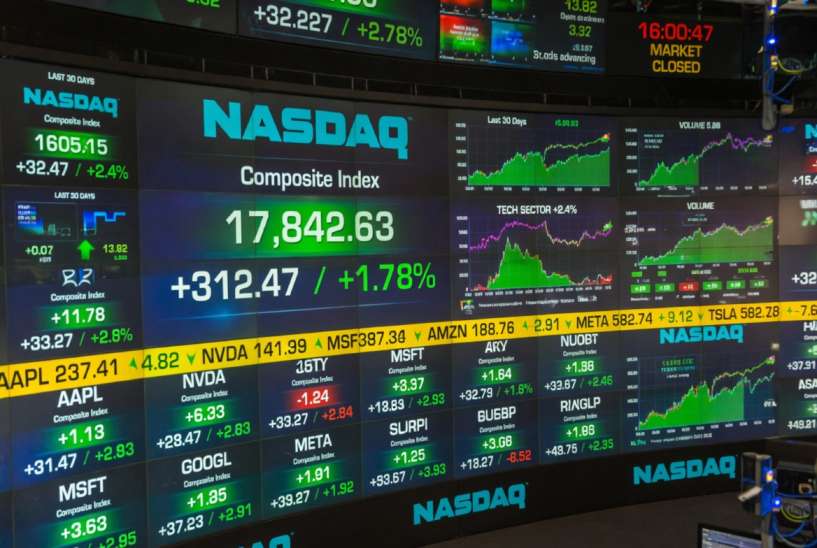
The Nasdaq index in 2026 has been one of the most dramatic stories in global financial markets. After a volatile start to the year, the Nasdaq-100 delivered its best single monthly performance in more than two decades in April 2026, surging +15.7% its strongest monthly gain since October 2002. Yet beneath the headline numbers lies a market undergoing a deep internal rotation that every investor needs to understand before positioning for the rest of the year.
Nasdaq in 2026: The Year So Far
U.S. equity markets entered 2026 on a constructive note, extending momentum from 2025. January was characterized by broad participation and improving market breadth. However, the year quickly shifted gears: February saw the Nasdaq-100 post its worst monthly decline since March 2025, falling 2.3%, while the Dow Jones edged only slightly higher and the S&P 500 dipped 0.8%.
March brought additional pain, with geopolitical risk driving energy prices sharply higher and weighing on all ten non-energy large-cap sectors. Treasury yields spiked, real rates rose, and the growth-heavy Nasdaq bore the brunt of the selling pressure as rate-sensitive technology valuations came under review.
Then April arrived and rewrote the script entirely.
April 2026: Nasdaq’s Best Month in 23 Years
Markets entered April deeply oversold, with investor sentiment near multi-month lows and positioning unusually light. As geopolitical headlines stabilized and corporate earnings came in ahead of expectations, risk assets responded with force. The Nasdaq-100 surged +15.7% in April 2026, marking its strongest monthly performance since October 2002 and registering new all-time highs.
The rebound was not isolated to large-cap tech. The S&P 500 gained +10.5%, the Russell 2000 climbed +12.3%, and the Russell Microcap Index rose +12.8%. The breadth of the April recovery was a signal that institutional investors were broadly re-risking across the market, not just chasing the Magnificent Seven.
| Index | April 2026 Return | Notable Achievement |
|---|---|---|
| Nasdaq-100 | +15.7% | Best month since Oct 2002 |
| Russell Microcap | +12.8% | New all-time highs |
| Russell 2000 | +12.3% | Best month since Nov 2020 |
| S&P 500 | +10.5% | New all-time highs |
What Is Driving the Nasdaq in 2026?
Earnings Growth Remains the Backbone
With 96% of S&P 500 companies having reported Q4 2025 results, earnings growth came in at 14.2% year over year, the fifth straight quarter of double-digit growth. While the 73% EPS beat rate and 6.8% aggregate earnings surprise were modestly below long-term averages, estimates have been revised meaningfully higher since quarter-end. For Q2 2026 and the full year, analysts have raised EPS forecasts further, reflecting confidence in earnings durability.
The forward 12-month S&P 500 P/E multiple stands at 20.9x. That is modestly above historical averages, but it is supported by the breadth and consistency of earnings growth across sectors.
AI and Technology Leadership: Still There, But Evolving
The Nasdaq’s 2023 and 2024 rally was overwhelmingly driven by artificial intelligence enthusiasm concentrated in a handful of mega-cap stocks. In 2026, that leadership is broadening. Equal-weight versions of the Nasdaq-100 and S&P 500 have outpaced their cap-weighted counterparts through much of the year, signaling that the rally is becoming healthier and more sustainable. Mega-cap growth and AI-adjacent software stocks have at times weighed on cap-weighted indices as investors rotate into mid-cap and value exposures.
Federal Reserve Policy and Rate Outlook
Producer prices firmed modestly in early 2026, but inflation expectations remained anchored, keeping alive the prospect of Federal Reserve rate cuts later in the year. The Fed faces a difficult balancing act: Core PCE printed with a 3-handle while GDP growth has come in below expectations at roughly half the 2.8% consensus. This environment keeps rate-sensitive tech names volatile, but also sustains the long-term bull case for growth stocks if the Fed eases.
Key Risks to the Nasdaq Outlook in 2026
Tariff and Geopolitical Uncertainty
The March 2026 selloff demonstrated how quickly geopolitical developments can reverse momentum in growth-heavy indices. Trade policy remains a live risk for Nasdaq-listed companies with global supply chains, particularly in technology hardware, semiconductors and AI chips. Any escalation in trade tensions could trigger another wave of derisking in mega-cap tech names.
Concentration Risk in the Magnificent Seven
Despite broadening market breadth, the top handful of Nasdaq stocks still represent a disproportionate share of the index’s market capitalization and performance attribution. A significant earnings miss or regulatory action against any of these names has the potential to drag the headline index far more than the underlying breadth of the market would suggest.
Valuation Premium
At a forward P/E of nearly 21x for the S&P 500, and meaningfully higher for many Nasdaq-100 constituents, valuations leave limited margin for earnings disappointment. Any guidance cut or macro deterioration could trigger a sharp multiple compression, particularly for companies whose valuations embed aggressive long-term growth assumptions tied to AI monetization timelines that have yet to be validated.
Nasdaq vs. Other Indices: How Does It Stack Up in 2026?
The rotation story of 2026 has been defined by small-cap and mid-cap outperformance in the early months, followed by a tech-led rebound in April. Over the full year, the picture remains nuanced. The Nasdaq-100 has been the strongest performer on an absolute basis after April’s surge, but equal-weight and small-cap indices have demonstrated better breadth and more consistent participation throughout the year. Investors seeking to match Nasdaq headline returns without the concentration risk should consider equal-weight Nasdaq ETFs or mid-cap complements to a core tech allocation.
How to Invest in the Nasdaq in 2026
For long-term investors, the most common vehicle for Nasdaq exposure remains ETFs tracking the Nasdaq-100 (QQQ) or the broader Nasdaq Composite. Equal-weight alternatives such as QQQE provide the same sector exposure without the extreme concentration in the five largest stocks. For investors concerned about near-term volatility, covered call overlay strategies on QQQ positions can generate income while maintaining upside participation.
Active stock selection within the Nasdaq also remains compelling in 2026. The broadening of earnings growth beyond the Magnificent Seven into areas like industrial automation, biotech, clean energy infrastructure, and mid-cap software creates a richer opportunity set for investors willing to move down the capitalization ladder within the index.
Nasdaq 2026 Outlook: What to Watch
- Federal Reserve rate decisions: Any surprise cut in H2 2026 would be a significant catalyst for Nasdaq growth stocks.
- Q2 2026 earnings season: Analysts have revised estimates higher. Strong beats could sustain the post-April momentum. Misses could trigger a sharp pullback.
- AI monetization evidence: Investors are increasingly demanding concrete revenue from AI infrastructure spending. Companies that deliver proof will be rewarded; those that cannot may face significant multiple compression.
- Geopolitical and tariff headlines: The March experience proved this remains a live volatility driver for tech-heavy indices.
- Breadth sustainability: Watch whether equal-weight indices continue to outperform their cap-weighted counterparts sustained breadth is the hallmark of a durable bull market.
Bottom Line
The Nasdaq in 2026 has delivered both extremes painful drawdowns in February and March, followed by one of the most powerful monthly recoveries in the index’s history. Earnings growth remains solid, AI investment continues to reshape the technology sector, and market breadth is improving. However, concentration risk, elevated valuations, and macro uncertainty mean that navigating the Nasdaq in 2026 requires a clear-eyed view of both the opportunity and the risks ahead.
This article is for informational purposes only and does not constitute investment advice. Past index performance is not indicative of future results. Always consult a licensed financial advisor before making investment decisions.