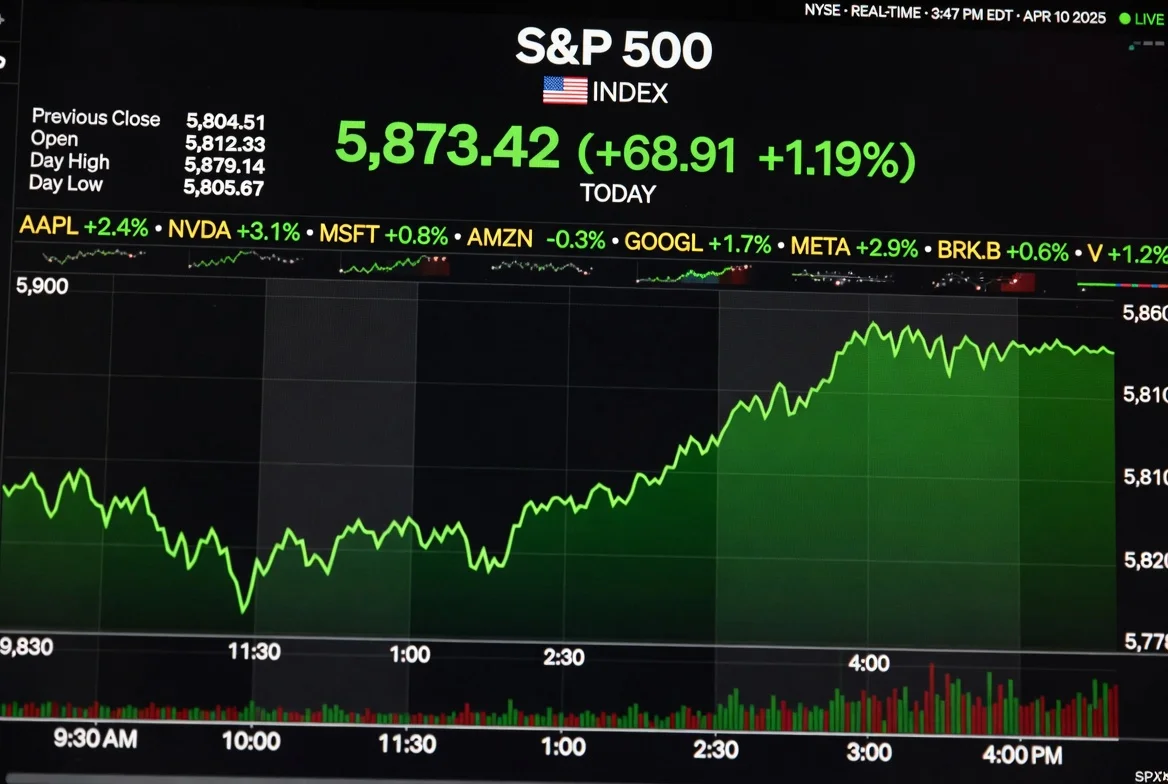
The S&P 500 in 2026 has delivered one of its most volatile and ultimately rewarding stretches in recent history. After stumbling in February and March, the benchmark index surged +10.5% in April alone reaching new all-time highs and confirming the underlying resilience of U.S. corporate earnings. With a forward P/E of 20.9x, Q2 2026 earnings estimates revised higher, and GDP growth still positive despite below-consensus prints, understanding where the S&P 500 goes from here requires a careful look at the data not the noise.
S&P 500 in 2026: The Story of the Year So Far
The S&P 500 entered 2026 on strong footing, building on a 17.88% gain in 2025. January saw broad participation and improving market breadth, with cyclical and value sectors leading alongside small and mid caps. The index appeared positioned for a healthy continuation of the prior year’s bull market.
February brought the first real test. The S&P 500 declined 0.8% its second negative month in three as mega-cap growth and AI-adjacent software names weighed on the cap-weighted index. March intensified the pain: geopolitical risk drove energy prices sharply higher, Treasury yields spiked, real rates rose, and all ten non-energy large-cap sectors declined together. It was the broadest single-month sector drawdown in over two years.
Then April happened. Markets entered the month deeply oversold, with positioning light and sentiment depressed. As headlines stabilized and Q1 2026 earnings reports began landing ahead of expectations, institutional investors re-risked decisively. The S&P 500 surged +10.5% in April, reaching new all-time highs.
| Month | S&P 500 Return | Key Driver |
|---|---|---|
| January 2026 | Modest positive | Broad participation, breadth improvement |
| February 2026 | -0.8% | Mega-cap tech drag, rate sensitivity |
| March 2026 | Negative | Geopolitics, energy surge, yield spike |
| April 2026 | +10.5% | Earnings beats, re-risking, new ATH |
What Is Driving the S&P 500 in 2026?
Five Consecutive Quarters of Double-Digit Earnings Growth
The most important fundamental driver of the S&P 500 in 2026 is earnings. With 96% of companies having reported Q4 2025 results, the index tracked 14.2% earnings growth year-over-year the fifth straight quarter of double-digit EPS expansion. The 73% beat rate and 6.8% aggregate earnings surprise were modestly below longer-term averages but, critically, estimates have been revised meaningfully higher since quarter-end. Q2 2026 and full-year EPS estimates are both higher than they were entering the year, signaling growing analyst confidence in earnings durability across the economic cycle.
The forward 12-month S&P 500 P/E stands at 20.9x modestly above historical averages but, as Nasdaq analysis noted, supported by the breadth and consistency of earnings growth across sectors, not just the Magnificent Seven.
Broadening Market Breadth: The Healthiest Sign of 2026
One of the most encouraging developments in the 2026 S&P 500 story is the broadening of market leadership. Early in the year, seven of the eleven large-cap sectors were within 0.5% of their respective 52-week highs simultaneously a rare signal of simultaneous broad strength across the market. Equal-weight versions of the S&P 500 outperformed the cap-weighted index repeatedly through the year, confirming that the bull market was not dependent on a handful of mega-cap names.
This breadth improvement is the hallmark of a durable bull market, as opposed to the narrowly concentrated 2023 to 2024 advance that made the S&P 500 vulnerable to any pullback in just five or six stocks.
Federal Reserve Policy: The Dominant Macro Variable
The Fed remains the most consequential single variable for S&P 500 valuation in 2026. Producer prices firmed modestly early in the year but inflation expectations remained anchored keeping alive the prospect of rate cuts in H2 2026. However, GDP growth came in at roughly half the 2.8% consensus expectation in Q1 2026, and Core PCE printed above 3%, creating a stagflationary dilemma. The S&P 500 is navigating a dual uncertainty: strong earnings argue for staying long, while mixed macro signals argue for caution on multiple expansion.
The 7,000 Level: Psychological Resistance
Heavy one-sided positioning on the long side of equities has made the 7,000 level on the S&P 500 a persistent psychological resistance point in 2026. Forex.com analysis noted that this “challenge at the 7k psychological level” has created a backdrop similar to February 2025 where a pullback was possible while the underlying longer-term bull thesis remained intact. A clean breakout above 7,000 on strong volume and broad participation would be a significant bullish signal for the remainder of 2026.
S&P 500 2026 Forecast: What the Numbers Say
Multiple analytical models project S&P 500 gains through year-end 2026, with the consensus centered around a 12% full-year return from January levels. Goldman Sachs specifically projected a 12-month return of approximately 12% for the S&P 500, implying a year-end level that would represent continued earnings-driven appreciation. The forward P/E of 20.9x provides limited room for multiple expansion, meaning future gains need to be earnings-led rather than valuation-driven.
Key analyst inputs for the H2 2026 outlook include:
- Q2 2026 earnings season (July): With estimates revised higher, a strong beat cycle would provide the next leg of the bull case. An earnings miss wave would be the most immediate downside catalyst.
- Federal Reserve H2 decisions: Any rate cut would be an immediate valuation-positive event. A pause or reversal would pressure multiples.
- GDP trajectory: Sustained GDP growth above 2% supports the bullish EPS revision cycle. Growth below 1.5% for two consecutive quarters would begin to stress analyst forecasts.
- Geopolitical risk: March 2026 demonstrated how quickly geopolitical shocks can reverse sentiment. The midterm election cycle also introduces political uncertainty that historically creates short-term volatility.
Key Risks to the S&P 500 in 2026
Valuation Leaves Little Room for Error
At a forward P/E of 20.9x, the S&P 500 is priced for a continuation of the positive earnings surprise cycle. Any meaningful negative earnings revision whether from a macro slowdown, geopolitical trade disruption, or sector-specific shock would trigger multiple compression on top of earnings degradation, amplifying the downside from any given negative catalyst. The S&P 500 has historically corrected 10 to 15% during periods of valuation stress even without accompanying recessions.
Mega-Cap Concentration Still Matters
Despite the encouraging breadth improvement in 2026, the S&P 500’s cap-weighted construction still means that the five largest stocks represent a disproportionate share of total index returns. Any significant earnings disappointment, regulatory action, or antitrust development affecting the largest technology companies would register meaningfully in the headline index even if the other 495 companies perform in line with expectations.
Stagflation Risk: The Fed’s Difficult Position
The combination of below-consensus GDP growth and above-consensus inflation (Core PCE above 3%) is the classic stagflationary setup that equity markets historically struggle with. In a pure stagflationary scenario, the Fed cannot cut rates to support growth without risking re-acceleration of inflation. Corporate profit margins would come under pressure from both slowing revenue growth and sticky input costs. This scenario remains a tail risk rather than a base case, but it is a meaningful one given the current data configuration.
How to Invest in the S&P 500 in 2026
For long-term investors, the S&P 500 remains the core of most U.S. equity portfolios. The most widely held vehicles are Vanguard’s VOO and iShares’ IVV both tracking the S&P 500 with expense ratios below 0.05%. SPY (the SPDR S&P 500 ETF Trust) remains the most traded S&P 500 ETF by volume and is preferred by active traders and institutional investors who need intraday liquidity.
In 2026’s rotation environment, the equal-weight S&P 500 ETF (RSP) deserves attention alongside the standard cap-weighted exposure. Equal-weight versions have outperformed cap-weighted indices on multiple occasions in 2026, reflecting the breadth improvement that has been a defining feature of the year. Investors who want market exposure without over-weighting the five largest mega-caps should consider a core allocation to RSP alongside a standard S&P 500 ETF.
S&P 500 2026: Key Levels and Catalysts to Monitor
- 7,000 level: Immediate psychological resistance. A confirmed breakout above this level on strong volume would signal the next leg of the bull market.
- Forward P/E contraction below 19x: If earnings revisions accelerate significantly higher, multiples can compress while the index still rises. Watch for this as a signal of earnings-led rather than valuation-led gains.
- Q2 2026 earnings season (July): The first major test of whether bullish estimate revisions hold. A 70%+ beat rate with positive guidance would sustain momentum.
- Federal Reserve September 2026 meeting: The most anticipated potential pivot point for H2 2026 rate policy based on current market pricing.
- S&P 500 equal-weight vs. cap-weight spread: Sustained equal-weight outperformance signals healthy breadth; a reversal signals that the rally is narrowing and becoming more fragile.
S&P 500 vs. Other Indices in 2026: The Scorecard
| Index | 2025 Full-Year Return | April 2026 Return | 2026 YTD Trend |
|---|---|---|---|
| Nasdaq-100 | +21.24% | +15.7% | Strongest absolute gains |
| S&P 500 | +17.88% | +10.5% | Broad, durable recovery |
| Russell 2000 | Lagged large caps | +12.3% | Small-cap comeback |
| Dow Jones (DJIA) | Modest positive | +0.3% (Feb) | Value/blue-chip rotation |
Bottom Line
The S&P 500 in 2026 has proven that earnings matter more than narrative. After absorbing significant geopolitical and rate shocks in February and March, the index rebounded powerfully on the strength of solid corporate fundamentals, broad market participation, and improving analyst confidence. The forward picture remains constructive but not without risk. Valuations are elevated, macro uncertainty is real, and the 7,000 psychological resistance level has yet to be convincingly broken. For long-term investors, staying invested in a diversified S&P 500 exposure through this cycle remains the most historically well-supported strategy. For active investors, the current environment rewards disciplined sector selection and attention to earnings quality over headline momentum.
This article is for informational purposes only and does not constitute investment advice. All data and forecasts reflect information available as of May 2026. Past index performance does not guarantee future results. Consult a licensed financial advisor before making investment decisions.