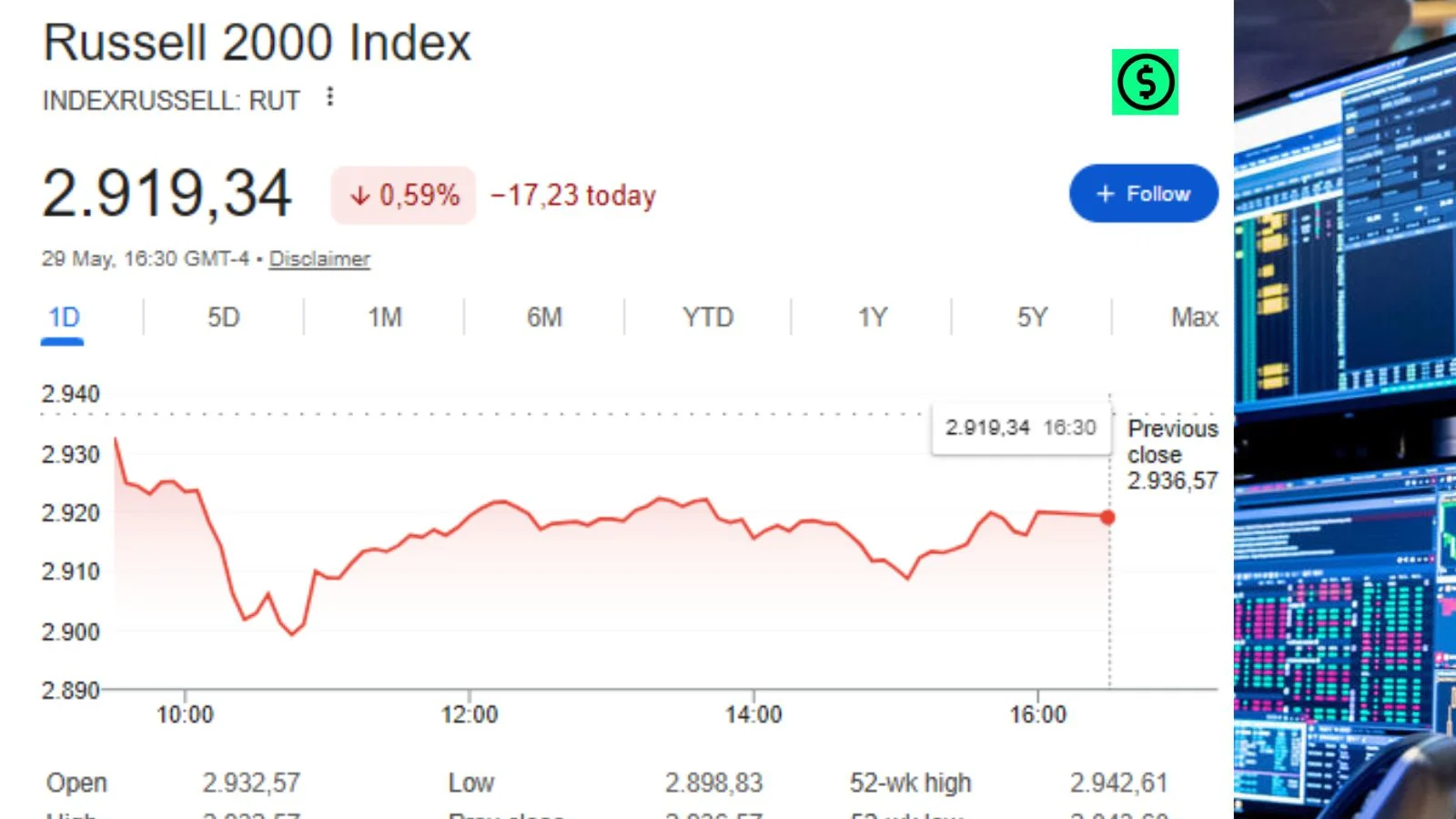
The Russell 2000 in 2026 has emerged as one of the most compelling and most debated investment stories in U.S. equity markets. After years of lagging behind the S&P 500 and Nasdaq, small-cap stocks have staged a powerful comeback, with the Russell 2000 surging +12.3% in April 2026 alone its strongest monthly performance since November 2020. With the index up roughly 12–17% year-to-date depending on the measurement period, investors are asking one critical question: is this the beginning of a genuine small-cap supercycle, or a cyclical bounce heading into renewed headwinds?
Russell 2000 in 2026: The Year So Far
The Russell 2000 entered 2026 with significant momentum. So on January saw small- and mid-cap indices outperform their large-cap peers, with the Russell 2000 and S&P MidCap 400 delivering solid absolute returns while equal-weight versions of the S&P 500 and Nasdaq-100 also outpaced their cap-weighted counterparts. This was a clear signal that market leadership was broadening after two years of narrow dominance by the Magnificent Seven.
February and March brought headwinds, as geopolitical risk elevated Treasury yields and broader risk-off sentiment weighed on the more volatile small-cap segment. However, the April recovery was historic. The Russell 2000 surged +12.3%, reaching new all-time highs alongside the Nasdaq-100 and S&P 500 confirming that the April rally was a genuine broad-market re-risking event, not a narrow tech rebound.
| Period | Russell 2000 Performance | vs. S&P 500 |
|---|---|---|
| January 2026 | Strong outperformance | Led large caps |
| February-March 2026 | Underperformed | Risk-off headwinds |
| April 2026 | +12.3% | Best since Nov 2020 |
| YTD (mid-2026) | ~+12% to +17% | Roughly on par |
What Is Driving the Russell 2000 in 2026?
The Federal Reserve Rate Cut Catalyst
Small-cap stocks are hypersensitive to interest rate changes, and the Russell 2000’s 2026 performance cannot be understood without understanding the Federal Reserve on the trajectory. The index contains a disproportionate share of companies with floating-rate debt meaning that when the Fed cut rates in late 2025, borrowing costs for hundreds of Russell 2000 companies dropped immediately, directly improving their interest coverage ratios and bottom-line earnings.
With further rate cuts projected for Q2 2026, this dynamic could continue. Goldman Sachs analyst Ben Snider noted in his December 2025 research that the bank’s macro outlook including forecasts for accelerating U.S. GDP growth, below-consensus inflation, and continued Fed easing was “supportive for small-cap upside in early 2026.” Futures positioning and elevated short interest in small-cap names further suggested asymmetric upside risk.
Domestic Insulation from Global Trade Risk
Unlike the S&P 500 and Nasdaq-100, which are heavily exposed to international revenue streams and global supply chains, the Russell 2000 generates the majority of its revenues domestically. This makes the index structurally less sensitive to tariff escalation, currency volatility, and geopolitical trade disruptions all of which were meaningful market risks in early 2026. As large-cap multinationals faced earnings headwinds from global trade uncertainty, small-cap domestic-focused companies offered a degree of insulation that attracted rotational capital.
Valuation Discount Relative to Large Caps
As of January 2026, the Russell 2000 traded at a price-to-earnings ratio of approximately 18.11x meaningfully below the S&P 500’s valuation of around 22x. This relative discount attracted investors seeking higher-beta exposure without the extreme concentration risk embedded in mega-cap growth indices. Goldman Sachs highlighted that the index’s return dispersion is more than twice that of the S&P 500, creating fertile ground for active stock-picking strategies.
AI Adoption, M&A Activity, and Fiscal Policy Tailwinds
Goldman Sachs identified three additional structural drivers for small-cap outperformance in 2026: increased corporate adoption of artificial intelligence lowering operating costs for smaller companies, a pickup in merger and acquisition activity that frequently rewards small-cap acquisition targets with premium valuations, and changes in fiscal policy that may disproportionately benefit domestic-focused businesses. Each of these creates idiosyncratic return opportunities within the Russell 2000 beyond the broad index level.
Russell 2000 2026 Forecast: Key Scenarios
Multiple analytical frameworks point to a constructive but range-bound outlook for the Russell 2000 through year-end 2026:
- Bull case: If U.S. GDP growth sustains above 2% and the Fed delivers additional rate cuts, the Russell 2000 could clear the 2,500 resistance level and target a year-end milestone of 2,800, according to BingX analysis.
- Base case: Goldman Sachs projects a 12-month return of approximately 10% for the small-cap index, broadly consistent with (but slightly below) the 12% forecast for the S&P 500, given above-average valuations and the caveat that EPS growth estimates of 61% for the index appear “far too optimistic.”
- Bear case: If the floating-rate debt burden (which benefited from rate cuts) reverses, or if a domestic economic slowdown materializes, the 40% of unprofitable Russell 2000 companies become a significant drag on index performance. The high proportion of non-earning companies has historically been the index’s greatest vulnerability in stress scenarios.
Key Risks for the Russell 2000 in 2026
The Profitability Problem
Over 40% of Russell 2000 constituents are currently unprofitable. This is the index’s most discussed structural vulnerability. In rising-rate environments or economic contractions, unprofitable small-cap companies burn cash rapidly and face severe multiple compression. Some investors have responded by rotating toward the S&P SmallCap 600, which requires positive earnings for inclusion, as a way to access small-cap exposure with a profitability screen already applied.
Consensus EPS Growth Estimates Are Overstated
Consensus forecasts for Russell 2000 earnings per share growth in 2026 stood at 61% a number Goldman Sachs explicitly called “far too optimistic.” When consensus EPS estimates are significantly above realistic outcomes, stocks tend to underperform expectations even when absolute earnings improve, because the market has already priced in the optimistic scenario. Managing expectations around EPS growth realization is critical to sizing Russell 2000 exposure appropriately.
Rate Reversal Risk
The same sensitivity to interest rates that made the Russell 2000 a beneficiary of Fed easing in 2025 makes it a victim of any rate reversal. With Core PCE inflation printing above 3% and GDP growth below consensus, the Fed faces a stagflationary dilemma. Any decision to pause or reverse rate cuts would directly increase borrowing costs for the floating-rate debt-heavy Russell 2000, compressing earnings margins across the index’s more leveraged constituents.
How to Invest in the Russell 2000 in 2026
The iShares Russell 2000 ETF (IWM) is the largest and most liquid vehicle for Russell 2000 exposure, with net assets of approximately $75 billion. For investors who want small-cap exposure with a quality or growth tilt, the Vanguard Russell 2000 Growth ETF (VTWG) and Vanguard Russell 2000 Value ETF (VTWV) offer targeted factor exposures within the same universe. For those concerned about the profitability issue, the S&P SmallCap 600 (via IJRE or similar ETFs) applies an earnings filter that screens out the most speculative components.
Active stock selection within the Russell 2000 remains among the highest-alpha opportunities in public equity markets in 2026. With return dispersion more than twice that of the S&P 500, the gap between the best and worst performers in the index is enormous creating significant value-add potential for disciplined fundamental analysis focused on profitability screens, balance sheet quality, and domestic revenue exposure.
Russell 2000 vs. S&P 500: Who Wins in 2026?
The debate over Russell 2000 vs. S&P 500 outperformance in 2026 remains unresolved. Goldman Sachs concluded that while small caps have a strong setup for early 2026 outperformance, the full-year picture is likely to be roughly in line with the S&P 500, not a decisive small-cap victory. The Motley Fool analysis has been more bullish, citing structural tailwinds from rate sensitivity, domestic insulation, and the possibility of more Fed cuts than the market currently expects. The truth likely lies in between: the Russell 2000 should deliver strong absolute returns in 2026, but the degree to which it outperforms the S&P 500 will depend critically on the Fed’s H2 2026 rate decisions and the trajectory of domestic economic activity.
Bottom Line
The Russell 2000 in 2026 has staged its most convincing recovery in years, driven by Fed rate cuts, domestic insulation from trade risk, and a broadening of market leadership beyond mega-cap tech. The valuation discount, improving earnings environment, and structural tailwinds from AI adoption and M&A activity create a genuine bull case. However, the 40% unprofitable company problem, overstated EPS consensus estimates, and rate reversal risk demand careful position sizing. For investors who do the work or select quality ETFs small caps remain one of the most interesting opportunities in 2026 equity markets.
This article is for informational purposes only and does not constitute investment advice. All data and forecasts cited reflect information available as of May 2026 and are sourced from third-party research. Consult a licensed financial advisor before making investment decisions.