Equity research is the structured process analysts use to decide whether a stock is undervalued, fairly valued, or overvalued and whether it deserves a Buy, Hold, or Sell recommendation. Most retail investors skip most of these steps. That is precisely why gaps between price and fundamental value open up and persist long enough for disciplined investors to take advantage of them.
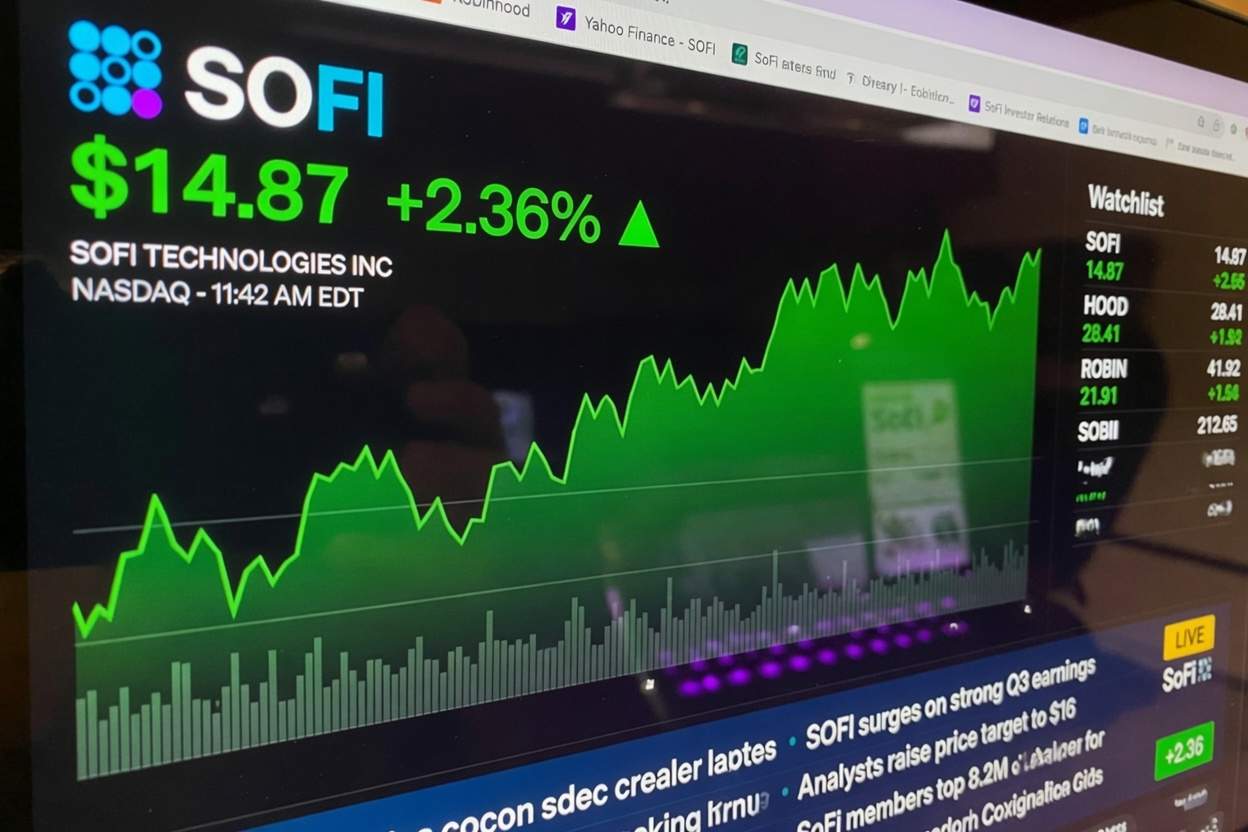
This walkthrough applies the full methodology to SoFi Technologies (NASDAQ: SOFI) as of June 8, 2026, with the stock trading at $16.03 and down roughly 35% year to date from its January opening price of $26.18.
The formula is simple: Business Quality × Growth × Valuation × Risk = Investment Decision. Each section below addresses one layer of that formula in sequence.
Understand the Business
Before touching a single financial metric, the first question is straightforward: what does this company actually sell and how does it make money?
SoFi Technologies operates as a digital financial services platform with four distinct revenue-generating segments:
| Segment | What It Does | Revenue Type |
|---|---|---|
| Lending | Personal loans, student loan refinancing, home loans | Interest income, origination fees |
| Financial Services | Checking, savings, credit cards, investing, crypto | Net interest margin, interchange, subscription |
| Technology Platform (Galileo) | API infrastructure powering other fintechs | Recurring B2B fees |
| SoFiUSD Stablecoin | Bank-issued USD stablecoin on Ethereum and Solana | Transaction and conversion fees |
The lending segment generates the majority of revenue today. The Technology Platform is the highest-margin business and the one with the most durable long-term moat. The stablecoin launch is the newest initiative, and SoFi is currently the only US bank legally permitted to issue a regulated stablecoin at scale.
The core competitive advantage is integration. SoFi’s members can borrow, save, invest, insure, and now transact in digital assets inside a single app. That integration drives cross-sell rates and lifetime value in a way that standalone neobanks cannot replicate. The PrimaryBid acquisition, completed in early 2026, extends that integration into capital markets access for the company’s nearly 15 million members.
What makes it hard to copy: A national bank charter, a proprietary technology stack serving external clients, 14.7 million members generating compounding cross-sell data, and regulatory approval to issue a stablecoin that competitors do not yet hold.
Industry Analysis
SoFi operates at the intersection of digital banking, consumer lending, and fintech infrastructure. Each of those carries its own set of external forces.
Interest rates are the single most important external variable. SoFi is a lending-heavy bank. When rates rise, net interest margin expands on new originations but credit demand softens and refinancing volumes fall. When rates fall, origination volumes accelerate. The current environment, with the May 2026 jobs report showing 172,000 payrolls added against an 80,000 estimate, has revived rate hike speculation and is suppressing SOFI’s multiple directly.
| External Force | Current Status | Impact on SOFI |
|---|---|---|
| Interest rate direction | Hike narrative revived post-May jobs report | Negative for near-term sentiment |
| Fintech regulation | National bank charter held; stablecoin regulatory moat active | Positive structural advantage |
| Digital banking TAM | US digital banking market projected to exceed $2 trillion in assets by 2028 | Large runway remaining |
| Competition | JPMorgan, Chime, Robinhood, traditional banks | Intense but SoFi differentiated on integration |
| AI in financial services | SoFi Coach AI guide launched Q2 2026 | Supports engagement and retention metrics |
Porter’s Five Forces summary for SoFi: supplier power is low (deposits are sticky and cheap), buyer power is moderate (switching costs exist once members hold multiple products), competitive rivalry is high, threat of substitutes is moderate, and barriers to entry at the regulated bank level are high. The charter is the moat.
Financial Statement Analysis
SoFi reported Q1 2026 adjusted net revenue up 41% year over year to a record $1.1 billion, adjusted EBITDA up 62% to a record $340 million, and total loan originations at a record $12.2 billion.
Income Statement
| Metric | Q1 2026 | Year-over-Year Change |
|---|---|---|
| Adjusted Net Revenue | $1.10 billion | +41% |
| Adjusted EBITDA | $340 million | +62% |
| Net Income | $167 million | +134% |
| EPS | $0.12 | Met consensus |
| Net Interest Margin | 5.94% | Improving |
The Q1 2026 revenue beat consensus by 4.76%, and the tenth consecutive profitable quarter was delivered alongside record member and product growth.
Balance Sheet
Loans held for sale stood at $25.5 billion, loans held for investment at $15.3 billion, and investment securities at $3.2 billion as of March 31, 2026. Total deposits sit at $40 billion. The balance sheet is growing and the deposit base provides stable, low-cost funding for the lending business.
The key balance sheet risk is loan quality in a higher-for-longer rate environment. Credit performance has remained strong through Q1, but that is the variable to watch most closely if the rate hike narrative continues to build.
Cash Flow
SoFi is now generating positive operating cash flow on a sustained basis, which is a meaningful inflection from its pre-profitability phase. Free cash flow visibility is improving as the lending book seasons and Technology Platform revenues compound. The caveat is that a lending business inherently requires ongoing capital deployment, so reported FCF will always be a moving target as origination volumes change.
Build Forecasts
Management has provided full-year 2026 guidance of $4.655 billion in adjusted net revenue. CEO Anthony Noto has set medium-term targets of at least 30% compounded adjusted revenue growth and a 38% to 42% EPS CAGR through 2028.
| Metric | 2025A (est.) | 2026E (guidance) | 2027E (consensus) | 2028E (mgmt target) |
|---|---|---|---|---|
| Adjusted Net Revenue | ~$3.3B | $4.655B | ~$5.8B | ~$7.0B+ |
| Adjusted EBITDA margin | ~28% | ~31% | ~33% | ~36% |
| Net Income | ~$500M | ~$700M | ~$950M | ~$1.3B |
| Members | 10.9M | ~17M+ | ~22M | ~28M |
Key forecast assumptions: rate environment stabilizes in H2 2026 allowing lending volumes to hold, Technology Platform margins recover from their Q1 compression toward the 30% range, stablecoin and crypto services add a high-margin revenue layer, and member cross-sell rates continue their upward trend as the product suite matures.
The guidance conservation is worth flagging. Management beat Q1 estimates by 5% and held full-year guidance flat. The street read that as a lack of confidence. The more charitable interpretation is that management is sandbagging in an uncertain macro environment. The June 17 AGM is the next opportunity to test which reading is correct.
Valuation
A. Relative Valuation (Multiples)
Based on 24 analysts, the average 12-month price target for SOFI is $21.00, implying 31% upside from current levels, with the average rating sitting at Hold.
| Multiple | SOFI (current) | Fintech peer average | Implied read |
|---|---|---|---|
| P/E (trailing) | ~37x | ~25x to 45x | Fairly valued on earnings |
| P/S (trailing) | ~3.5x | ~4x to 8x | Discounted vs. growth peers |
| EV/EBITDA | ~18x | ~20x to 30x | Discounted |
| P/B | ~1.8x | ~2x to 4x | Below peer range |
The multiple compression is almost entirely sentiment-driven. A 43% revenue growth company with 134% net income growth trading at 3.5x sales is pricing in either a growth slowdown that has not yet shown up in results, or a legal/macro risk premium that the market has not yet been given reason to remove.
B. DCF Framework
A simplified DCF using management’s own growth targets:
| Assumption | Input |
|---|---|
| Revenue CAGR (2026 to 2028) | 25% |
| Terminal growth rate | 4% |
| EBITDA margin (terminal) | 38% |
| Discount rate (WACC) | 11% |
| Shares outstanding | ~1.05 billion |
Under these inputs, intrinsic value per share lands in the $22 to $28 range depending on how quickly Technology Platform margins recover. The bear case using a 9% discount rate and 18% growth CAGR produces a value near $16, which is approximately where the stock is trading today. The market is currently pricing in the bear case while the company is operationally delivering closer to the base case.
Qualitative Factors
Management quality: Anthony Noto has purchased SOFI shares with personal capital on three separate occasions in 2026, most recently at $15.73. That is not a trivial signal. CEOs who buy their own stock with personal money at depressed prices are making a statement that language alone cannot replicate.
Competitive moat: The national bank charter, Galileo’s embedded fintech infrastructure, the stablecoin regulatory position, and 14.7 million members with compounding cross-sell data constitute a genuine multi-layer moat. None of these are easily replicated in the near term.
Legal and reputational risk: The Muddy Waters short report from March 2026 remains unresolved. Block and Leviton’s class action investigation is active. Neither constitutes a proven legal liability but both are creating institutional hesitation that is suppressing the stock below where fundamentals alone would place it.
Product quality: SoFi’s ecosystem generates high lifetime value through product depth, data leverage, and network effects, with a moat forming in digital banking that strengthens as members add more products.
Insider activity summary:
| Date | Action | Price | Who |
|---|---|---|---|
| March 2026 | Personal purchase post-Muddy Waters | $17.30 | CEO Anthony Noto |
| Q1 2026 | Personal purchase | $15.73 | CEO Anthony Noto |
| 2026 YTD | Third purchase | Various | CEO Anthony Noto |
Three personal purchases in a single year from a CEO who understands this business better than any analyst on the street is one of the stronger qualitative signals available in public markets.
Investment Thesis
Stock: SoFi Technologies (NASDAQ: SOFI) Current Price (June 8, 2026): $16.03 Analyst Consensus Target: $21.00 Implied Upside to Consensus: +31% Our Fair Value Range: $22 to $26 (base case, 12-month horizon) Recommendation: Cautious Buy with defined risk levels
The thesis in plain language: SoFi is a 43% revenue growth company with record net income, $40 billion in deposits, 14.7 million members, and a CEO who keeps buying his own stock. It is trading at a price that reflects the bear case, not the operating reality. The gap exists because of three converging sentiment headwinds: a rate hike narrative that punishes anything rate-sensitive indiscriminately, an open class action investigation that creates institutional hesitation without a proven legal liability, and Technology Platform margin compression in Q1 that spooked growth investors.
None of those headwinds are permanent. The June 17 Annual General Meeting is the first scheduled opportunity for management to close at least two of them. Q2 earnings on July 27 are the next fundamental test.
Key risks:
| Risk | Probability | Impact |
|---|---|---|
| Federal Reserve hikes rates in H2 2026 | Medium | High; NIM expands but origination volumes fall and multiple compresses |
| Class action escalates into formal lawsuit with adverse outcome | Low | High; sentiment destruction |
| Technology Platform margin fails to recover | Medium | Medium; thesis is delayed but not broken |
| Loan credit quality deteriorates | Low to medium | High; core business impairment |
| CEO departure or management change | Low | High; Noto’s execution record is central to the thesis |
The honest risk-reward: At $16.03 the downside to the next meaningful support is roughly 6% to $15.00. The upside to the analyst consensus is 31%. The upside to the DCF base case is 37% to 62%. That asymmetry is what makes the current setup worth attention despite the noise sitting on top of it.
This article is for informational and educational purposes only. It does not constitute financial advice. Always conduct your own due diligence before making any investment decisions.