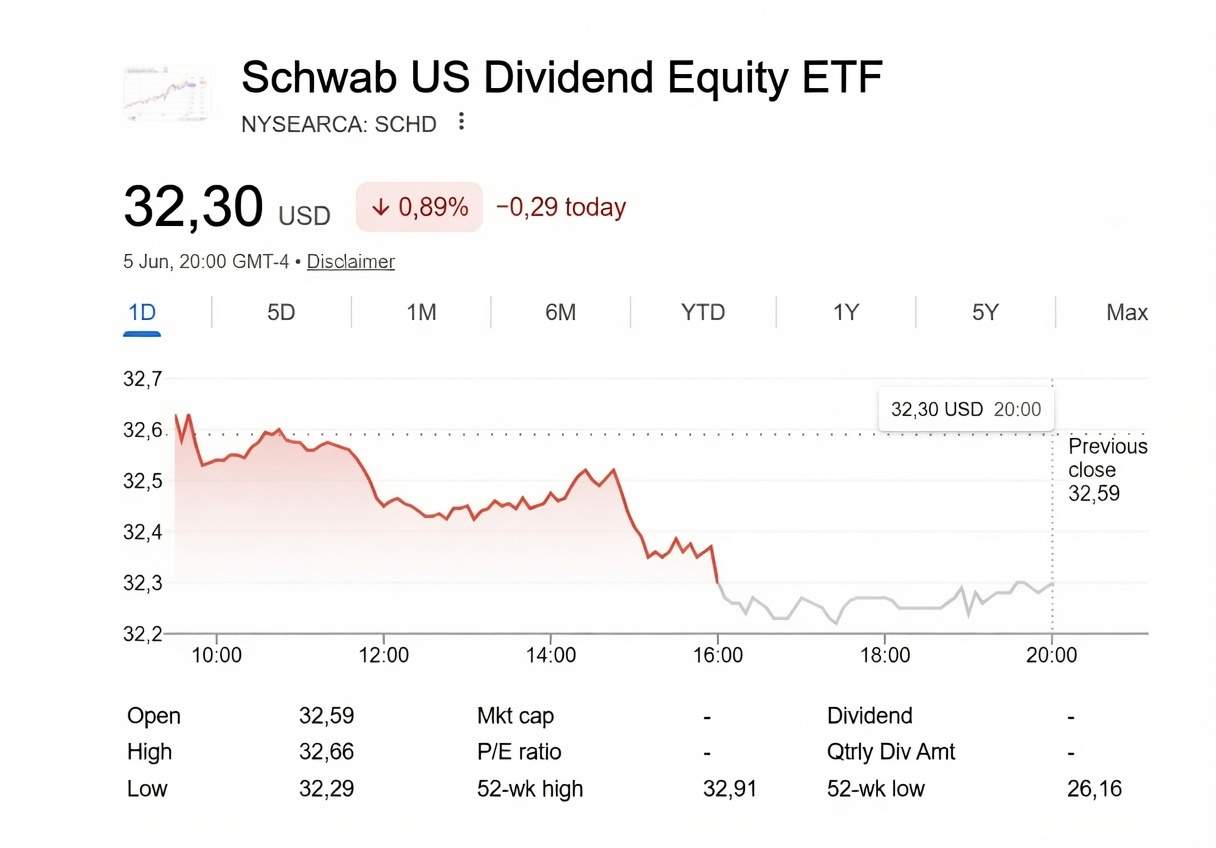
The Schwab U.S. Dividend Equity ETF (NYSEARCA: SCHD) is heading into one of the most anticipated dividend events of the year. The Q2 2026 ex-dividend date is confirmed for June 24, 2026, with the distribution paid on June 29. That gives investors still on the sidelines a narrow window to act. This article covers everything dividend investors need to know right now: the confirmed dates and amounts, what the Q1 2026 record payout means, how SCHD has performed so far in 2026, what changed in the annual reconstitution, and what the upcoming payment means in real dollar terms for different portfolio sizes.
The Q2 2026 Dividend: Dates and Amounts
SCHD pays dividends quarterly, in March, June, September, and December. The Q2 2026 schedule is as follows.
| Quarter | Ex-Dividend Date | Record Date | Payment Date | Distribution |
|---|---|---|---|---|
| Q1 2026 | March 25, 2026 | March 25, 2026 | March 30, 2026 | $0.2569 (confirmed) |
| Q2 2026 | June 24, 2026 | June 24, 2026 | June 29, 2026 | ~$0.26 (projected) |
| Q3 2026 | September 23, 2026 | September 23, 2026 | September 28, 2026 | TBD |
| Q4 2026 | December 10, 2026 | December 10, 2026 | December 15, 2026 | TBD |
Source: TopDividendETFs.com, Wall Street Horizon, Stock Events. As of June 7, 2026.
To receive the June 29 payment, you must own SCHD shares before the close of trading on June 23, 2026. Buying on June 24 or later means you miss Q2 entirely and wait until September.
One important note for investors considering a purchase purely to capture the dividend: on the ex-dividend date, the share price typically falls by approximately the distribution amount. Dividend capture is not a free return. The income is real, but the price adjustment offsets it on the day.
Q1 2026 Was a Record. Here Is Why That Matters.
SCHD paid $0.2569 per share in Q1 2026. That is the largest first-quarter distribution in the fund’s entire history since its October 2011 launch, representing a 3.3% increase over the Q1 2025 payout.
That may sound like a modest number in isolation. But context matters here. SCHD paid a total of $1.05 per share across all four quarters of 2025. The Q1 2026 figure alone already annualises to roughly $1.03, meaning the fund is on pace to match or exceed 2025’s full-year total in the first quarter alone if the remaining quarters hold at similar levels.
The dividend growth story is the real reason long-term holders stay in this fund. When SCHD launched in 2011, it paid $0.224 per share annually. Fifteen years later, investors who held from inception are collecting approximately $1.05 per share per year, a more than fourfold increase in raw dollar income from the same original shares. That compounds into a yield on cost well above 12% for those original holders, on what started as a roughly 2.6% entry yield.
Real Dollar Income: What SCHD Pays at Different Position Sizes
At the projected Q2 2026 distribution of approximately $0.26 per share, here is what different position sizes receive on June 29.
| Position Size | Shares Held (at $32.55) | Q2 Distribution | Estimated Annual Income |
|---|---|---|---|
| $10,000 | 307 shares | ~$80 | ~$320 |
| $25,000 | 768 shares | ~$200 | ~$800 |
| $50,000 | 1,536 shares | ~$400 | ~$1,600 |
| $100,000 | 3,072 shares | ~$799 | ~$3,200 |
| $250,000 | 7,680 shares | ~$1,997 | ~$7,990 |
Estimates based on $0.26 projected Q2 distribution and $32.55 share price as of June 5, 2026. Actual amounts will vary.
These figures assume you hold shares before June 23 and receive the full Q2 distribution. They also assume the Q2 payout lands near the $0.26 projection. The final amount will be confirmed closer to the ex-date.
SCHD Performance in 2026: A Strong Recovery
After a difficult stretch from 2023 through 2025, where SCHD lagged a growth-dominated market, the fund has come back strongly in 2026.
| Metric | Figure |
|---|---|
| Price (June 5, 2026) | $32.55 |
| 52-Week Range | $26.16 to $32.91 |
| YTD Return 2026 | approximately +20% |
| 1-Year Total Return (with dividends) | 27.60% |
| 3-Year Average Annual Return | 13.8% |
| Since Inception Average Annual Return | 13.21% |
| AUM | approximately $93 billion |
| Expense Ratio | 0.06% |
| Trailing Dividend Yield | approximately 3.24% |
| Beta | 0.53 |
Source: Stock Analysis, Investing.com, TradingView. As of June 5, 2026.
The 20% year-to-date gain is notable. It follows a period where the fund’s heavy energy and consumer staples exposure dragged performance while the Nasdaq surged. The 2026 recovery reflects a rotation toward value and income-generating equities, as well as the impact of this year’s reconstitution bringing in stronger-performing sectors.
Fund flows tell the same story. SCHD pulled $711 million in net inflows in a single week ending May 19, 2026. Over a trailing one-year period, total net inflows have reached approximately $10.7 billion. Investors are clearly moving money toward dividend quality.
The 2026 Reconstitution: What Changed Inside SCHD
Every March, the Dow Jones U.S. Dividend 100 Index reconstitutes. Holdings that no longer meet the criteria are removed. New qualifiers are added. Sector weights shift. The March 2026 reconstitution was one of the more significant in recent years.
The current sector breakdown after reconstitution:
| Sector | Approximate Weight |
|---|---|
| Consumer Staples | 18.7% |
| Healthcare | 18.5% |
| Information Technology | 15.3% |
| Energy | 15.2% |
| Industrials | 10.6% |
| Financials | 8.4% |
| Other | 13.3% |
Source: Harry’s Financial, Seeking Alpha. As of 2026 reconstitution.
The most notable development is Information Technology now sitting at 15.3%, placing it third in the portfolio. That would have been unusual for SCHD in prior years. It reflects the growing number of established technology companies that now have ten-plus year dividend histories and the financial strength to meet SCHD’s screening criteria.
Energy, which peaked at over 19% after the 2025 reconstitution and was widely cited as a drag on 2025 performance, has been reduced to approximately 15.2%. Consumer staples and healthcare anchor the defensive core.
Notable additions in the 2026 reconstitution included UnitedHealth Group, Procter & Gamble, Qualcomm, Abbott Laboratories, and Accenture. These are high-quality businesses with strong dividend track records that now sit among the fund’s top holdings.
How SCHD Compares to Peers Right Now
Two comparisons are worth making in June 2026.
SCHD vs. VIG and DGRO
The standard peer group for SCHD remains the Vanguard Dividend Appreciation ETF (VIG) and the iShares Core Dividend Growth ETF (DGRO). Over the trailing twelve months through May 2026, SCHD’s 27.60% total return outpaced DGRO at approximately 21% and VIG at approximately 19%. SCHD’s current yield of 3.24% also leads both peers, with DGRO yielding approximately 2.0% and VIG yielding approximately 1.7%.
SCHD vs. International Dividend ETFs
A more pointed comparison has emerged in 2026. International dividend ETFs are now outpacing SCHD’s yield by nearly 2 full percentage points. The iShares International Select Dividend ETF (IDV) carries a yield near 4.40%. Schwab’s own international dividend fund (SCHY) and Franklin International Low Volatility High Dividend (LVHI) are yielding similarly.
The trade-off is consistency and payment structure. European and Asia-Pacific dividend payers commonly distribute on a semi-annual or annual schedule rather than quarterly. Payout amounts are also more variable from period to period. SCHD’s quarterly cadence, predictable amounts, and US-domiciled holdings remain core advantages for investors building a structured income schedule.
The 10-Year Treasury Comparison
The 10-year US Treasury currently yields approximately 4.5%. SCHD’s trailing yield of 3.24% does not clear that bar on a raw basis. This is a legitimate challenge worth acknowledging directly. The case for holding SCHD over a Treasury is not yield today. It is yield growth over time, equity upside, and inflation protection that a fixed coupon cannot deliver. An investor who bought SCHD at inception in 2011 is now earning a yield on cost that exceeds 12%. A 2011 Treasury buyer locked in the coupon of that era permanently.
Key Risks to Keep in Mind
No article on SCHD is complete without addressing what can go wrong.
The annual reconstitution introduces genuine portfolio turnover. SCHD today looks materially different from SCHD one year ago. Holdings change, sector weights shift, and past performance is not a guarantee that the reconstituted portfolio will behave identically going forward.
Healthcare concentration is worth watching. UnitedHealth Group alone represents over 5% of the fund. UNH has faced significant controversy in 2026 related to its insurance business practices and regulatory scrutiny. A material decline in a single holding of that size has a visible impact on SCHD’s NAV.
Energy exposure at 15.2% remains meaningful. Oil price volatility, OPEC production decisions, and the ongoing energy transition create uncertainty around a sector that drove SCHD’s underperformance in 2025.
The fund’s low beta of 0.53 limits downside in crashes but also caps upside in strong bull markets. Investors who need maximum total return and are willing to accept higher volatility will consistently find SCHD disappointing relative to a growth-oriented index fund.
Final Thoughts
The June 24 ex-dividend date is the immediate event. But the more important context for SCHD investors in June 2026 is that the fund has recovered meaningfully from its 2023 to 2025 underperformance, set a first-quarter payout record, attracted nearly $11 billion in new inflows over the past year, and entered a reconstituted portfolio with better sector balance than it carried a year ago.
For income investors building toward retirement, or already in retirement and relying on quarterly distributions, SCHD continues to offer what it has always offered: a disciplined, low-cost, quality-screened approach to dividend income with a 15-year track record of growing what it pays. The Q2 distribution is small in isolation. Compounded over a decade or more, with dividends reinvested and positions added consistently, it is the foundation of a meaningful income stream.
The deadline to qualify for Q2 is June 23. Everything else is a longer game.
Disclaimer: This article is published by Investments Research and is intended for informational purposes only. It does not constitute investment advice or a recommendation to buy, sell, or hold SCHD or any other security. Dividend projections are estimates and subject to change. All data sourced from Stock Analysis, Investing.com, Harry’s Financial, TipRanks, Wall Street Horizon, TopDividendETFs.com, and Seeking Alpha as of June 7, 2026. Past performance is not indicative of future results. Consult a qualified financial advisor before making any investment decision.