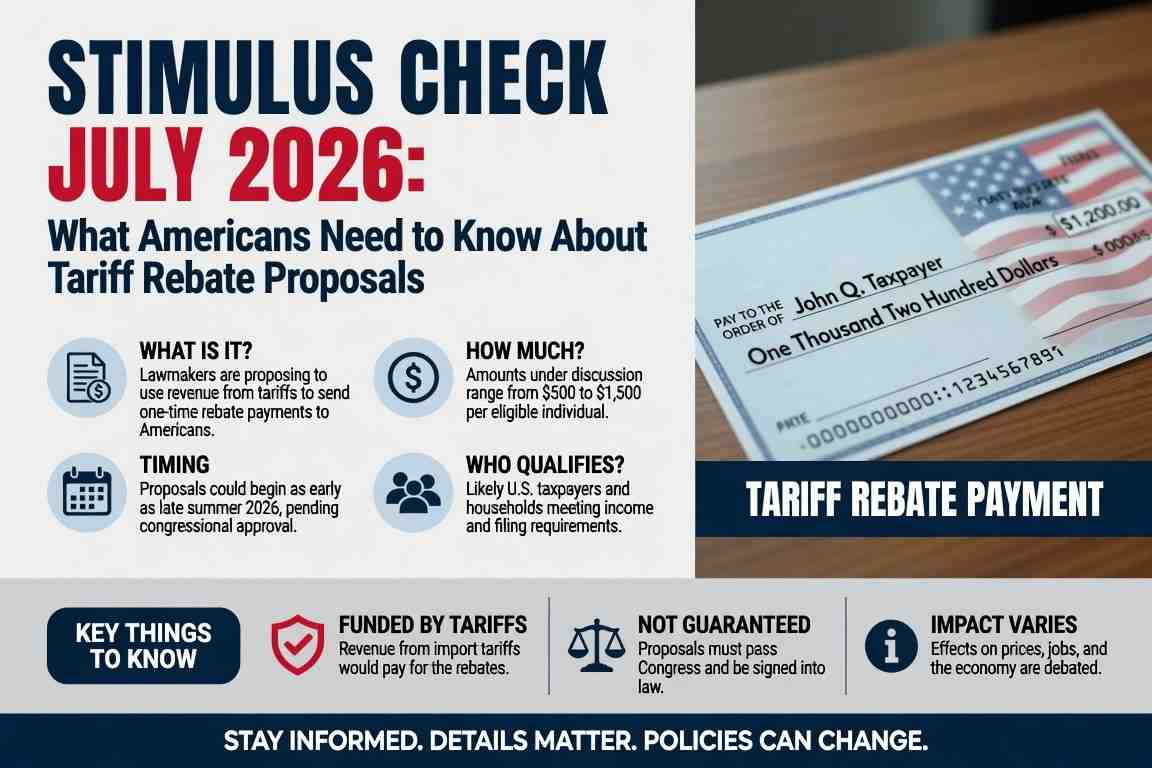
Talk of a new stimulus check has resurfaced heading into July 2026, but the reality on the ground is far more complicated than the headlines suggest. No federal legislation authorizing a direct payment to Americans has passed Congress, and eligible recipients should not expect a check in their mailbox or bank account this month. However, several competing proposals remain active, and the funding debate tied to tariff revenue continues to shape the conversation in Washington. Below, we break down every proposal currently on the table, why none of them have moved, and what households should actually do while they wait.
Where the Stimulus Check Debate Stands Right Now
The idea of a tariff-funded dividend gained traction after President Trump floated a payment of at least 2,000 dollars per person for working-class families. White House economic adviser Kevin Hassett later told CBS News that a formal proposal could come before Congress, citing an improved deficit picture as justification. That said, no bill carrying presidential backing has advanced to a floor vote, and the process required to authorize new payments remains at an early stage.
Meanwhile, a separate and complicating factor has entered the picture. The Supreme Court struck down a portion of the administration’s tariff program as unlawful, which opened the door to potential refunds for consumers rather than new dividend payments. Estimates for that repayment obligation run as high as 175 billion dollars, a liability that directly competes with any new stimulus proposal for the same pool of tariff revenue. In other words, the government may owe money back to importers at the same time it is being asked to send new checks to households, and both obligations cannot be funded from the same limited pool.
A Brief History: How We Got Here
To understand why the stimulus conversation feels so unsettled in July 2026, it helps to look back at how many different versions of this idea have circulated since the start of the current administration. Roughly a year and a half ago, a proposal tied to the Department of Government Efficiency called for a so-called DOGE dividend, which would have used about 20 percent of the savings identified by the agency to send payments worth up to 5,000 dollars to households, with the remaining 80 percent applied toward the national debt. That plan never gained meaningful traction in Congress, though Hassett later confirmed the concept was still on the table as of last November.
Separately, the administration did follow through on a narrower payment. In December, roughly 1.454 million service members received a one-time check worth 1,776 dollars, structured as a basic allowance for housing supplement rather than a broad stimulus payment. That program was funded through 2.9 billion dollars appropriated to the Pentagon rather than tariff revenue, despite early messaging suggesting otherwise. It illustrates a pattern that has repeated throughout this stimulus debate: targeted, smaller-scale payments have occasionally materialized, while the broad, universal check promised in public statements has not.
The Competing Bills in Congress
Several lawmakers have introduced their own versions of a rebate program, and understanding the differences between them helps explain why nothing has moved quickly. Representative Henry Cuellar introduced the American Consumer Tariff Rebate Act of 2026 in March, proposing 231.35 billion dollars in refunds tied to the estimated consumer cost of tariffs. Under that bill, individual rebates would range from roughly 1,020 to 2,040 dollars depending on filing status. As of late June, the bill has no cosponsors and remains in committee.
Senator Martin Heinrich introduced a competing measure, the Tariff Refunds for Working Families Act, in the Senate in March. That version targets a narrower income band, offering 1,200 dollars to joint filers earning under 180,000 dollars annually, plus an additional 600 dollars per child. Neither bill has been reconciled with the other, and neither has secured the bipartisan support needed to reach a vote. On top of these two, additional proposals such as the Make Billionaires Pay Their Fair Share Act and the Ultra-Millionaire Tax Act have been introduced as alternative funding mechanisms, though these focus more on revenue generation than on the structure of the payments themselves.
| Proposal | Sponsor | Estimated Payment | Status as of Late June 2026 |
|---|---|---|---|
| American Consumer Tariff Rebate Act of 2026 | Rep. Henry Cuellar | $1,020 to $2,040 per filer | In committee, no cosponsors |
| Tariff Refunds for Working Families Act | Sen. Martin Heinrich | $1,200 joint filers, plus $600 per child | In committee |
| Presidential dividend proposal | White House / Trump administration | At least $2,000 per person (unconfirmed) | No formal bill submitted |
| DOGE dividend concept | White House economic team | Up to $5,000 per household | Described as “on the table,” no bill filed |
Why a July Payment Is Unlikely
Financial planners have grown increasingly skeptical that any broad stimulus program will materialize in the near term. Certified financial planner Stephen Kates has pointed out that even if tariff revenue were to rebound to prior levels, there does not appear to be enough political support in Congress to push a stimulus measure through. That assessment lines up with the current legislative calendar, where none of the pending bills have cosponsors or scheduled votes.
On top of the political gridlock, the mechanics of funding present a real obstacle. Households paid an average of 1,725 dollars in tariff costs between February 2025 and January 2026, according to the Senate Joint Economic Committee. That figure underscores why lawmakers are proposing rebates in the first place, but it also highlights the scale of money involved. With the government potentially on the hook for up to 175 billion dollars in court-ordered tariff refunds, there is limited room left over to fund a separate dividend program at the same time. Furthermore, eligibility questions have already surfaced around earlier versions of these proposals. The individual behind the original DOGE dividend concept confirmed that taxpaying immigrants without legal status would not qualify under that plan, a detail that adds further complexity to any legislative negotiation over a final bill.
The Broader Economic Backdrop
It is also worth placing the stimulus debate within the wider economic picture heading into the second half of 2026. Early in the year, job losses and rising gasoline prices tempered expectations for the strong growth the administration had promised. Since then, geopolitical tension tied to the conflict involving Iran has added fresh inflationary pressure through energy markets, which complicates the case for injecting additional stimulus into the economy. A large cash payment tends to be inflationary in the short term, and policymakers weighing a rebate program now have to balance the political appeal of sending checks against the risk of adding fuel to already elevated prices at the pump and grocery store.
What Americans Should Actually Do This July
Rather than waiting on a payment that has not been approved, the more productive step for most households is to make sure existing tax and benefit filings are in order. The IRS has continued processing 2025 returns throughout the filing season, and taxpayers who missed the deadline can still file at no cost through IRS Free File. Filing promptly ensures that if a rebate or refund program is eventually approved, eligibility will be based on accurate and current income data rather than an outdated return.
It is also worth watching for scams. Whenever stimulus talk enters the news cycle, fraudulent texts and emails claiming to offer early access to a payment tend to follow. No legitimate stimulus program requires a fee, a gift card, or a bank login sent by text message. Any communication asking for that kind of information should be treated as fraudulent regardless of how official it looks. As a general rule, the only reliable sources for stimulus updates are the IRS website, the Treasury Department, and official congressional records, not social media posts or unsolicited messages.
How This Connects to Retirement Planning
For retirees and near-retirees, the stimulus debate is closely tied to broader questions about Social Security and cost of living adjustments this year. Since a universal check is not guaranteed, retirees are generally better served focusing on the levers they can control, such as required minimum distributions, Social Security claiming strategy, and retirement account contribution limits. Readers looking for a fuller picture of how these pieces fit together alongside the stimulus discussion can review our complete Retirement and Stimulus Check Guide for 2026.
Frequently Asked Questions
Is a stimulus check confirmed for July 2026?
No. As of late June 2026, no bill authorizing a new stimulus payment has passed Congress or been signed into law.
How much would the payment be if approved?
Proposals range from roughly 1,020 dollars to 2,040 dollars under the Cuellar bill, 1,200 dollars plus 600 dollars per child under the Heinrich bill, and up to 5,000 dollars under the earlier DOGE dividend concept. None of these figures are final.
Where can I check for legitimate updates?
The IRS newsroom, the Treasury Department, and Congress.gov are the most reliable sources. Avoid third-party sites or messages claiming to offer early registration or fees for faster processing.
Until a bill actually clears both chambers of Congress and receives a presidential signature, any dollar figure attached to a future stimulus check remains speculative. Investors and consumers alike are better served tracking the legislative process directly through official channels rather than relying on social media speculation about payment dates.
Disclaimer: This article is for informational purposes only and does not constitute financial, tax, or investment advice. Readers should consult a licensed financial advisor or tax professional before making decisions based on this information.