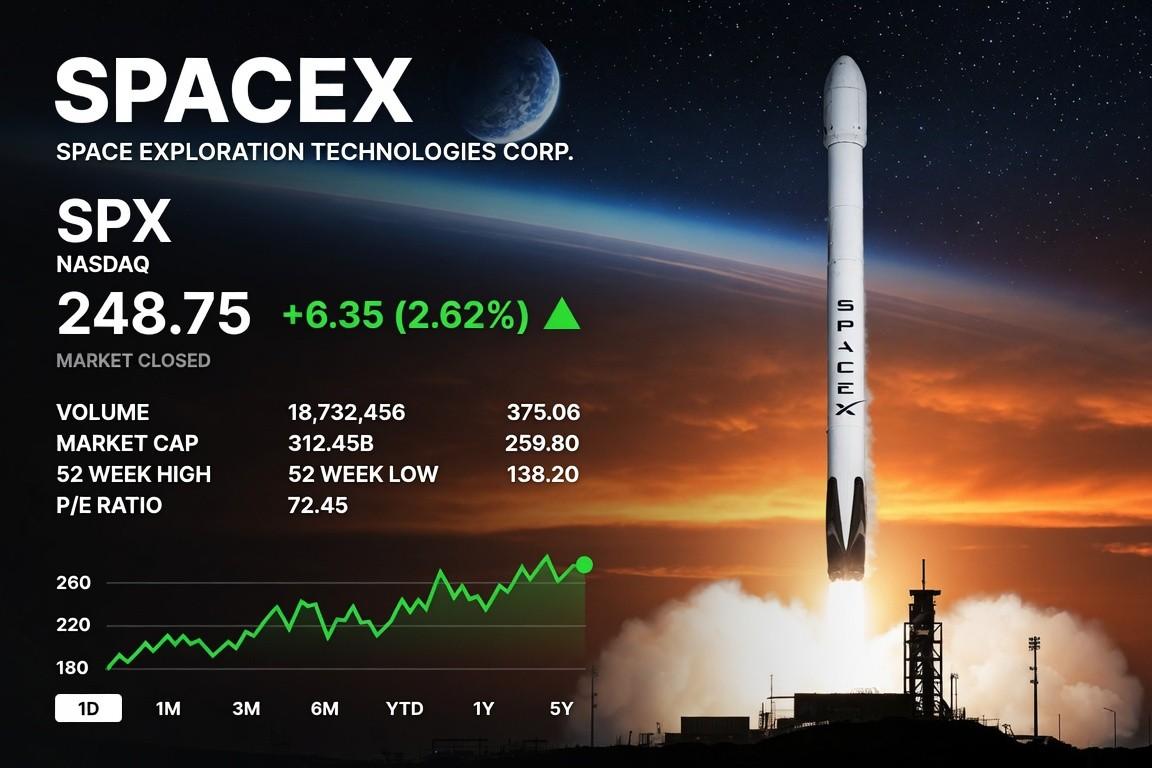
SpaceX (NASDAQ: SPCX) is trading at $153.23 as of June 29, 2026, within a daily range of $148.51 to $158.40. The 52-week range already spans $135.00 to $225.64 in fewer than three weeks of public trading, a spread that captures the entire risk profile of this stock in a single statistic. From the June 16 intraday peak of $225.64, SPCX has retraced 32% and now sits 13.5% above its $135 IPO price. The post-debut selloff was driven in part by a broader tech sector rotation and in part by valuation recalibration among institutional investors who received allocations at $135 and are now reassessing their entry basis against a company still reporting significant net losses.
Wall Street Analyst Ratings and Price Targets
Ten analysts have initiated coverage of SPCX since the June 12 listing, producing a consensus rating of Buy from S&P Global and a 12-month average price target of $187.80 per TipRanks data, with a more recent consensus of $222.20 based on seven analysts polled over the past three months. The spread between the high estimate of $310 and the low of $62 is not a sign of disagreement over short-term trading levels. It reflects a fundamental dispute about what SPCX actually is and what discount rate applies to a company burning $20 billion in free cash flow annually.
Oppenheimer initiated at Outperform with a $190 target, citing the absence of any publicly traded comparable across three verticals simultaneously. CFRA issued a Sell at $115, anchoring its view to capital intensity and execution risk. Argus initiated at Hold, noting that it expects years before valuation multiples approach normal levels. Morningstar published a fair value estimate of $63 using a probability-weighted discounted cash flow model. MarketBeat’s aggregated consensus sits at $212.67. Cathie Wood’s ARK has already been buying the stock, adding SPCX to portfolios previously heavy in space and disruption themes.
| Analyst Firm | Rating | 12-Month Price Target |
|---|---|---|
| Oppenheimer | Outperform | $190 |
| NewStreet Research | Buy | $165 |
| Argus | Hold | Not disclosed |
| CFRA | Sell | $115 |
| Morningstar | Sell (fair value) | $63 |
| MarketBeat Consensus | Buy | $212.67 |
| TipRanks Consensus (7 analysts) | Moderate Buy | $222.20 |
| Investing.com Consensus (5 analysts) | Buy | $187.80 |
Revenue and Earnings Forecasts
Analyst consensus for Q2 2026 revenue stands at $6.73 billion, with a range of $5.30 billion to $8.03 billion. EPS for the next quarter is forecast at a loss of $0.22, ranging from a loss of $0.50 to a loss of $0.11. Simply Wall St projects that revenue will grow at 36.5% per year, materially above the US market average of 12.6%, and that SPCX is forecast to reach profitability within three years. Free cash flow on a trailing basis is deeply negative at approximately negative $20 billion annually, driven by Starship development costs and xAI capital expenditure. The company raised $75 billion at IPO and followed with a $25 billion senior notes offering within days, a signal that cash requirements exceed what equity proceeds alone can cover in the near term.
| Metric | 2025 Actual | Q2 2026 Consensus Estimate |
|---|---|---|
| Total Revenue | $18.7 billion | $6.73 billion |
| Starlink Revenue | $11.39 billion | Growing (est. 69% of group) |
| Net Loss | $4.9 billion | EPS est. loss of $0.22 |
| Free Cash Flow | Negative | Approx. negative $20 billion annualized |
| Starlink Subscribers | 10.3 million | Growth expected |
Price Forecast by Scenario
Short-term quantitative forecasts show near-term pressure. Panda Forecast projects a target of $152.68 for June 29 and $151.46 for June 30, with volatility in the 3% to 4% daily range. The model turns marginally positive around July 3 to 4, with targets of $152.32 and $158.17 respectively. The monthly projection for July holds at an optimal target near $153 on the base case.
Looking at year-end and beyond, we frame three scenarios for investors.
| Time Horizon | Bear Case | Base Case | Bull Case |
|---|---|---|---|
| Year-End 2026 | $100 to $120 | $150 to $165 | $200 to $240 |
| 12-Month Target | $62 to $115 | $165 to $190 | $222 to $310 |
| Key Driver | Lockup selling, Starship delays, xAI losses widen | Steady Starlink growth, Flight 13 success, partial xAI stabilization | Strong Q2 earnings, Nasdaq-100 buying, Tesla merger, Cursor monetization |
The bear case rests primarily on lockup math. The staggered unlock schedule allows up to 20% of insider shares to be sold from late July onward, with a further 28% becoming eligible after the Q3 earnings call and full restrictions lifting in mid-December. Against a float of just 4.2%, even partial insider monetization represents a significant supply shock. The Motley Fool’s year-end base case of $150 to $160 effectively prices in this headwind while assuming retail demand sustains the floor.
The bull case depends on three independent outcomes arriving in sequence: a Q2 earnings report that demonstrates Starlink subscriber acceleration, a successful Starship Flight 13 that validates the V3 architecture after the Ship 36 static fire explosion on June 18, and some evidence that xAI losses are peaking rather than widening. Wedbush analyst Dan Ives has placed an 80% to 90% probability on a Tesla-SpaceX merger closing in the first half of 2027, which, if confirmed, would force a complete revaluation of both companies.
Near-Term Catalyst: Nasdaq-100 Inclusion on July 7
SpaceX joins the Nasdaq-100 on July 7, 2026. This is the single most defined price catalyst in the immediate calendar. Passive funds and ETFs tracking the index must purchase SPCX shares to match index weights, generating price-insensitive demand into a stock with a 4.2% float. The structural buying pressure from MSCI inclusion triggered a short squeeze dynamic in the days following the IPO, and the Nasdaq-100 inclusion event is a second instance of the same mechanical dynamic. Investors should expect elevated volume and upward price pressure in the days surrounding July 7, independent of any fundamental news. This does not change the medium-term valuation picture but creates a defined, time-boxed trading opportunity.
Key Risks Investors Must Price In
The cash runway is the most immediate balance sheet risk. Simply Wall St identifies less than one year of cash runway based on the current free cash flow trend of negative $20 billion. SpaceX will need to raise additional capital or improve operating cash generation before mid-2027, which introduces dilution or incremental debt risk on top of an already highly leveraged balance sheet following the $25 billion bond offering.
The xAI segment consumed 76% of group capital expenditure in Q1 2026 and generated a $6.35 billion operating loss. All eleven co-founders of xAI have reportedly departed. The company is now betting approximately $60 billion on the acquisition of AI coding tool Cursor, which has lost market share. If Cursor fails to produce measurable revenue acceleration by Q3 2026, the AI segment will remain a persistent drag with no credible near-term monetization path.
Governance is a structural risk that receives less attention than the business fundamentals. Elon Musk retains over 80% voting control through dual-class shares. The prospectus provided limited disclosure on governance frameworks and execution risk benchmarks, which several analysts flagged as unusual for a company of this size. Public shareholders have limited recourse if capital allocation decisions diverge from what the market expects.
Credit markets are already expressing caution. Credit default swaps on SpaceX debt were trading at elevated levels following the $25 billion bond sale, reflecting fixed-income market skepticism that equity investors have been slower to price.
Our Rating and 12-Month Price Target
Rating: HOLD. 12-month price target: $175.
At $153.23, SPCX is not obviously cheap and not obviously expensive on the terms this stock requires to be evaluated. It is a story stock in the truest sense: the price reflects a probabilistic bet on outcomes that will not be definitively confirmed or denied for three to five years. The $175 target represents a fair midpoint between the consensus ranges, applying a modest premium over the base case for the Nasdaq-100 inclusion tailwind and the optionality value of Starship commercialization, while discounting the near-term overhang from the lockup schedule and xAI cash burn.
Long-term investors with a horizon beyond 2028 and tolerance for 30% to 40% drawdowns should consider accumulating on weakness toward the $135 to $140 range, which represents the IPO price support floor and the level at which the lockup unlock risk is most fully priced. Adding aggressively above $175 before the first earnings report and before the lockup releases absorb supply is difficult to justify on risk-adjusted terms, regardless of the long-term thesis.
Traders should watch the $175.50 level closely. That is the price at which SPCX trades 30% above its IPO price, the threshold that triggers accelerated lockup releases tied to the Q2 earnings announcement. A sustained move through $175.50 into earnings is structurally bearish for the subsequent period even if bullish for the moment, as it activates additional supply. A sustained hold below $175.50 through earnings is structurally constructive, as it keeps the more aggressive unlock schedule from triggering.
The first public earnings report in late July or early August 2026 is the definitive event of the year for SPCX. It sets the baseline against which all subsequent forecasts will be measured, establishes management’s credibility with public markets, and determines whether the staggered lockup releases arrive into a stock that has reconfirmed its growth trajectory or one that has disappointed on its first outing.
This news article is for informational purposes only and does not constitute financial advice. Investors should conduct their own due diligence before making investment decisions.