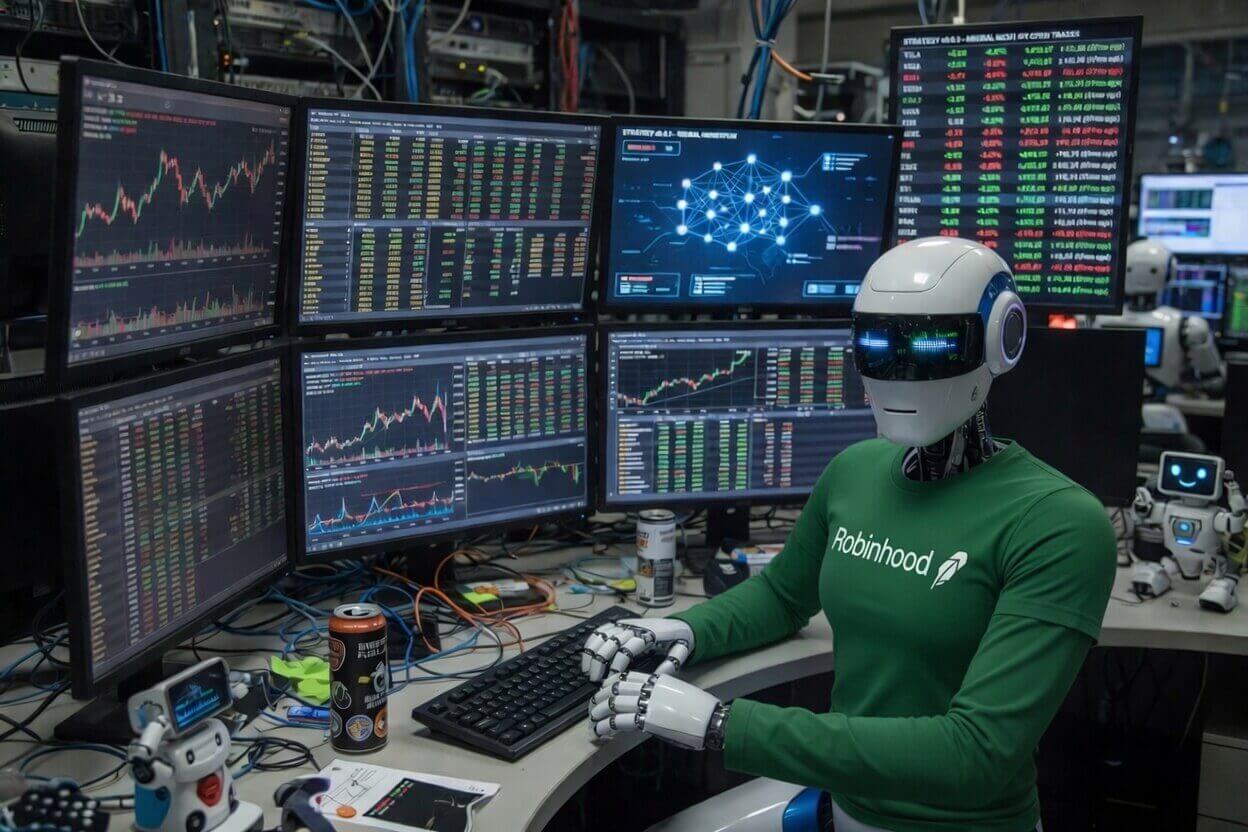
On May 27, 2026, Robinhood officially announced the beta launch of Agentic Trading a product that allows users to connect third-party AI agents directly to their Robinhood accounts and give those agents real, executable trading authority. This is not a simulation. This is not read-only analysis. An AI agent connected to your Robinhood Agentic account can place actual market orders, build portfolios, rebalance positions, and respond to market events all without requiring you to approve each individual transaction.
This launch marks one of the first times that a mainstream US retail brokerage has opened its infrastructure to fully autonomous AI-driven investing for ordinary customers. Until now, algorithmic and quantitative trading systems of this kind were the exclusive domain of hedge funds, institutional desks, and sophisticated developers with API access to specialized brokers.
CEO Vlad Tenev framed it directly: “Our mission has always been to democratize finance for all, and now, that mission extends to AI agents.” The statement reflects a broader strategic pivot from a commission-free trading app associated with meme stocks to a serious financial infrastructure platform.
Context
The launch follows OpenAI’s own personal finance tool rollout just weeks earlier, and comes as hedge funds and ETF providers have been deploying AI-driven quantitative systems for years. Robinhood is now bringing a version of that technology directly to 27 million retail investors.
1. What Is Robinhood Agentic Trading?
On May 27, 2026, Robinhood officially announced the beta launch of Agentic Trading a product that allows users to connect third-party AI agents directly to their Robinhood accounts and give those agents real, executable trading authority. This is not a simulation. This is not read-only analysis. An AI agent connected to your Robinhood Agentic account can place actual market orders, build portfolios, rebalance positions, and respond to market events all without requiring you to approve each individual transaction.
This launch marks one of the first times that a mainstream US retail brokerage has opened its infrastructure to fully autonomous AI-driven investing for ordinary customers. Until now, algorithmic and quantitative trading systems of this kind were the exclusive domain of hedge funds, institutional desks, and sophisticated developers with API access to specialized brokers.
CEO Vlad Tenev framed it directly: “Our mission has always been to democratize finance for all, and now, that mission extends to AI agents.”
2. How It Works: MCP Explained
The technical backbone of Robinhood’s Agentic Trading is the Model Context Protocol (MCP) an open standard, originally developed by Anthropic, that lets AI agents connect to external services and take actions on behalf of users. Think of MCP as a universal plug: instead of each AI platform needing a custom integration for every service, MCP provides a standardized bridge.
Robinhood has built and operates its own Trading MCP server, accessible at:
https://agent.robinhood.com/mcp/trading
Once an AI platform (Claude, ChatGPT, Cursor, etc.) is connected to this endpoint, the agent gains the ability to query real-time portfolio data and place orders within the dedicated Agentic account. The key architectural principle is isolation: the agent can read data from all your Robinhood accounts, but can only execute trades within the separate, ringfenced Agentic account you pre-fund for it. This prevents an AI error from draining your entire portfolio.
Why MCP matters
MCP is already becoming a standard across the AI industry. Any agent that supports MCP connections not just the officially listed platforms can connect to Robinhood’s trading infrastructure using the single endpoint URL above. This future-proofs the integration as new AI tools emerge.
3. What Your AI Agent Can Actually Do
Robinhood’s official documentation lays out five primary capability categories for connected agents. These range from passive analysis to fully autonomous execution:
Portfolio Building
You can instruct an agent to research and construct a portfolio from scratch. Example from Robinhood’s own documentation: “Look through news and industry reports to build a portfolio that represents little-known tickers across the AI supply chain.” The agent will scan analyst notes, identify securities, and place the orders all in one natural-language instruction.
Automated Trading Strategies
Rule-based execution becomes conversational. You can instruct an agent with logic like: “Buy $100 of [ticker] every time the price decreases 2% or more in a single day.” The agent monitors the market and fires trades when conditions are met. This is retail-accessible algorithmic trading no coding required.
Portfolio Rebalancing
Maintaining target allocations is a common but tedious task. With an agent, you simply state your target: “Rebalance my portfolio to 20% in X and 80% in Y.” The agent calculates the required trades and executes them. This alone is a significant time-saving capability for passive investors.
Risk and Exposure Analysis
Agents can analyze concentration risk, sector exposure, and portfolio-level vulnerabilities. The MCP connection gives the agent access to your full transaction history and current positions, enabling genuinely personalized analysis rather than generic market commentary.
Market Research and Sentiment
Agents can be instructed to analyze news, social sentiment, and recent price action to build theses around specific securities. Example: “Look at news, social sentiment, and recent quotes to build a bull and bear thesis for [ticker].” This bridges the gap between research and execution in a single workflow.
Important
At launch, the beta supports equity (stock) trading only. Robinhood has confirmed that options, crypto, event contracts, futures, and prediction markets will be added in subsequent updates. Check Robinhood’s official announcements for availability timelines.
4. Step-by-Step Setup Guide
Setting up Agentic Trading requires three things: an existing Robinhood account in good standing, access to the beta (rolling out via email invite), and a compatible AI platform. Desktop is required for the initial setup you cannot complete onboarding from a mobile device.
Step 1: Confirm beta access. Agentic Trading is currently rolling out in waves. If you have not received an email invitation, you may not have access yet. Monitor your Robinhood notification center and registered email.
Step 2: Choose your AI platform. Select an AI agent you already use or plan to use: Claude Code, Claude Desktop, ChatGPT (with Developer Mode), Codex, Codex CLI, Cursor, or any other MCP-compatible platform.
Step 3: Connect the Robinhood Trading MCP. Follow the connection instructions for your specific platform. All platforms ultimately require you to add this MCP endpoint: https://agent.robinhood.com/mcp/trading
Step 4: Authenticate and open your Agentic account. During the MCP authentication flow, Robinhood will automatically prompt you to open a dedicated Agentic account. This is a separate self-directed individual investing account. You can have up to 10 self-directed individual accounts in total (including this one).
Step 5: Fund the Agentic account. Transfer a specific amount of capital from your main account or an external bank into the Agentic account. This is the only money your agent can use to trade. It is completely ringfenced from your primary portfolio.
Step 6: Define your agent’s strategy. In your AI platform, give your agent a clear mandate what strategies to run, what risk parameters to respect, and whether to ask for your approval on individual trades or operate autonomously. This is the most important step and deserves careful thought.
Step 7: Monitor via the Robinhood app. All trades executed by your agent will generate push notifications. There is also a real-time activity feed in the Robinhood app where you can track every action your agent takes. You can disconnect your agent at any time directly from within the app.
5. Supported AI Platforms: Connection Instructions
Robinhood officially lists six platforms with step-by-step connection guides. Additionally, any AI platform that supports MCP connections can integrate via the standard endpoint.
Claude Code
Run in terminal:claude mcp add robinhood-trading --transport http https://agent.robinhood.com/mcp/trading
Enter /mcp in Claude Code and select robinhood-trading.
Claude Desktop
Go to Settings → Connectors → Add custom connector and add the MCP link: https://agent.robinhood.com/mcp/trading
ChatGPT
Enable Developer Mode, go to Settings → Apps → Create app, add the MCP link and authenticate.
Codex
Go to Settings → MCP servers, select Streamable HTTP, add the MCP link and authenticate.
Codex CLI
Run in terminal:codex mcp add robinhood-trading --url https://agent.robinhood.com/mcp/trading
Cursor
Go to Settings → Cursor Settings → Tools & MCPs → Connect, paste the MCP link and authenticate.
Other Platforms
Any MCP-compatible agent works. Simply add https://agent.robinhood.com/mcp/trading to your platform’s MCP configuration.
6. The Agentic Credit Card
Alongside Agentic Trading, Robinhood launched the Agentic Credit Card, a virtual version of the Robinhood Gold Card that can be assigned to an AI agent, giving it spending authority for purchases (not just trading authority).
Key Features:
- 3% cash back on all categories
- User-defined spending limits
- Optional approval mode for every transaction
- Works with Claude, Cursor, Codex, and any MCP-supporting agent
- Agents only have access to assigned cards and not your main financial accounts
7. What Data Does Your Agent Access?
Read Access:
- All Robinhood account numbers
- All positions and balances
- Transaction and order history
Write Access:
- Trade execution (only inside the Agentic account)
No Access:
- Main account trading
- Fund transfers
- Personal/banking details
Privacy Note: When you connect a third-party AI agent, that agent’s platform (OpenAI, Anthropic, etc.) will have access to the data it retrieves from Robinhood. Review each AI platform’s data handling and privacy policy before connecting.
8. Risks and Safety: What You Must Understand
You Bear Full Legal Responsibility
Robinhood’s disclosures are unambiguous: all investment decisions made through Agentic Trading are legally yours. Robinhood is not liable for losses resulting from AI-generated decisions.
AI Agents Make Mistakes
Current large language models can misinterpret instructions, hallucinate data, or execute strategies in unintended ways.
Market Risk Is Amplified by Automation Speed
An AI agent can execute many trades in rapid succession. Losses can accumulate faster than manual trading would allow.
Robinhood’s Built-In Safeguards:
- Isolated Agentic account
- Push notifications for every trade
- Real-time activity feed
- Optional approval mode
- Instant disconnect option
Risk Warning: Only allocate to an Agentic account capital you can afford to lose entirely. Monitor your agent’s activity regularly.
9. Regulation and Legal Landscape
As of May 2026, US securities regulation has not formally addressed AI-driven autonomous retail trading accounts. Robinhood’s legal positioning is clear: by assigning all investment decision-making responsibility to the user, Robinhood sidesteps fiduciary obligations.
You have full responsibility, minimal external oversight, and no guaranteed recourse if an AI agent generates trading losses.
10. Strategic Use Cases for Investors
Use Case 1: Systematic Rebalancing
Automate portfolio rebalancing to maintain target allocations.
Use Case 2: Rules-Based Entry/Exit
Execute price-based rules automatically (buy on dips, sell on targets).
Use Case 3: Research-to-Trade Pipelines
Let the agent research and execute trades based on news and analysis.
Use Case 4: Satellite Portfolio Management
Run active strategies in an isolated account separate from your core holdings.
Use Case 5: Learning and Backtesting
Test strategies with limited capital in a live environment.
Best Practice: Start with approval mode enabled. Run the agent for at least two to four weeks before switching to full autonomy.
11. Robinhood’s Roadmap: What’s Coming Next
- Stock trading: Live (Beta)
- Options trading: Announced
- Crypto trading: Announced
- Futures trading: Announced
- Event contracts: Announced
- Agentic Platinum Card: Announced
- Broader beta rollout: In Progress
12. Robinhood vs. Other AI Trading Platforms
| Platform | Approach | Target User | Key Distinction |
|---|---|---|---|
| Robinhood Agentic | User-defined AI agent via MCP | Retail investors | Agent-agnostic |
| OpenAI Finance Tool | AI-powered financial insights | ChatGPT users | Read-only analysis |
| Alpaca + MCP | Brokerage API for AI agents | Developers | More flexible but technical |
| Robo-advisors (Betterment) | Managed AI portfolio | Passive investors | Less control, built-in fiduciary |
| Institutional Algo | Quantitative trading systems | Institutions | Full professional infrastructure |
13. Frequently Asked Questions
Can AI agents really trade stocks on Robinhood without my approval?
Yes. You can configure your agent to place trades without requiring manual confirmation. You remain legally responsible for all trades.
What AI platforms work with Robinhood’s Agentic Trading?
Claude Code, Claude Desktop, ChatGPT, Codex, Codex CLI, Cursor, and any MCP-compatible platform.
Is Robinhood Agentic Trading available to all users?
No. It is currently in beta and rolling out gradually. Robinhood will email users when access is granted.
What assets can an AI agent trade?
At launch, only equities (stocks). Options, crypto, futures, and prediction markets are planned for future updates.
Who is responsible if the AI agent makes a bad trade?
You are fully responsible. Robinhood is not liable for losses resulting from AI-generated decisions.
14. Final Verdict
Robinhood’s Agentic Trading is a genuinely landmark product. It brings institutional-grade AI trading capabilities to retail investors for the first time.
Strengths: True autonomy, agent-agnostic design, isolated account structure, and strong potential for systematic investing.
Weaknesses: High user responsibility, still in beta, limited asset support, and regulatory uncertainty.
Recommendation:
If you have access to the beta and use AI tools regularly, it is worth experimenting with a small, dedicated amount of capital. Start small, monitor closely, and scale only what works.
Start small. Monitor closely. Scale only what works.
Disclaimer: This article is for informational purposes only and does not constitute financial advice. AI-driven trading involves significant risk, including the potential loss of all invested capital. Past performance does not guarantee future results. Always consult a qualified financial advisor before making investment decisions.