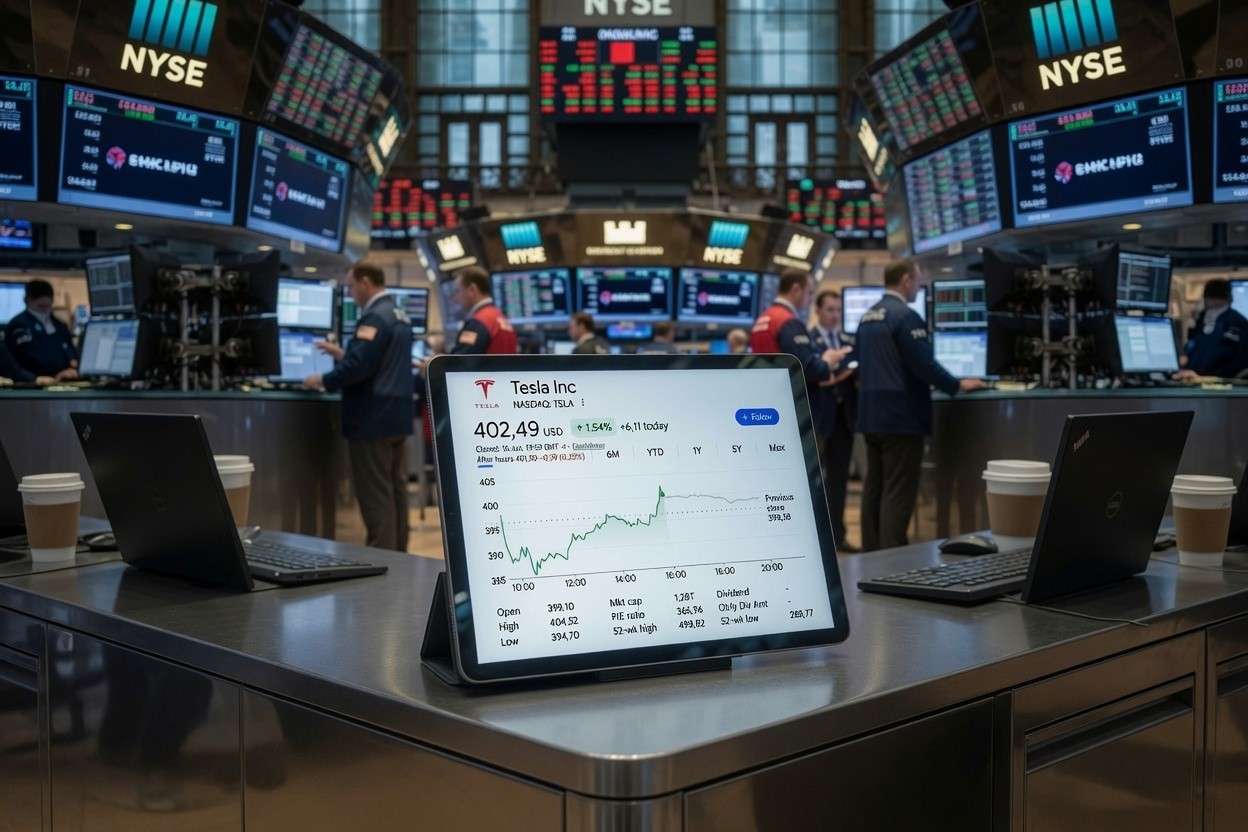
Tesla (TSLA) is trading around $406 per share as of mid-June 2026, roughly 20% below its all-time high of $498.88 set in December 2025. The SpaceX IPO landed on June 12 and, at least on day one, did not trigger the capital rotation out of Tesla that some analysts feared. TSLA closed up 1.8% on IPO day at $406.43. That initial reaction matters, but it does not settle the medium-term question of where Tesla actually goes from here on fundamentals.
This analysis focuses on what the financial data says, not the narrative. Tesla has real margin improvement, real cash burn, a speculative AI pivot, and a valuation that already prices in a great deal of success. Those four things cannot coexist comfortably, and that tension is the core of the Tesla trade right now.
Where TSLA Stands After the SpaceX IPO
SpaceX debuted on Nasdaq on June 12, 2026 at a target price of $135 per share, opened at $150, and surged nearly 20% on its first trading day. The deal raised approximately $75 billion at an overall IPO valuation of around $1.77 trillion, making it the largest IPO in global history. The fear before the listing was straightforward: retail investors who overlap between the Tesla and SpaceX fan bases would sell TSLA to fund SPCX purchases, draining demand from the stock.
That did not materialize in any meaningful way on day one. TSLA gained on SpaceX’s debut. However, the 30-day return heading into the IPO was down 8.72%, meaning Tesla had already absorbed significant selling pressure in the weeks prior. The initial stability post-IPO is not evidence the risk has passed. It is one data point.
The more structurally interesting link between the two companies is financial. According to Tesla’s Q1 2026 disclosures, Tesla made a $2 billion equity investment in SpaceX. The two companies have also begun jointly building what Tesla calls the largest chip foundry in the U.S. at the Gigafactory Texas campus. That cooperation directly undermines the narrative that the SpaceX IPO is a threat to Tesla. Musk is not building two competing capital sinks; he appears to be threading them together. Whether that creates value for Tesla shareholders or simply serves his broader ambitions is a question the market has not answered.
Merger speculation is also active. CNBC reported in late May 2026 that Musk had discussed combining Tesla and SpaceX with colleagues. There is no formal proposal, no board vote, and no regulatory filing. Investors should treat merger speculation as a sentiment variable, not a fundamental one, until something concrete emerges.
Q1 2026 Earnings: The Good and the Expensive
Tesla’s Q1 2026 results were genuinely better than the headline numbers suggest at first glance. Revenue came in at $22.39 billion, up 16% year over year. Adjusted EPS was $0.41, beating the consensus estimate of $0.37. Gross margin reached 21.1%, up nearly 500 basis points from 16.3% in Q1 2025. Operating income rose 136% year over year. These are not soft numbers.
| Metric | Q1 2025 | Q1 2026 | YoY Change |
|---|---|---|---|
| Total Revenue | $19.3B | $22.4B | +16% |
| GAAP Gross Margin | 16.3% | 21.1% | +478 bps |
| Operating Income | $399M | $941M | +136% |
| Adjusted EPS | $0.27 | $0.41 | +52% |
| Services Revenue | $2.6B | $3.7B | +42% |
| Energy Revenue | $2.7B | $2.4B | -12% |
| Free Cash Flow | Negative | $1.44B | Significant recovery |
The services segment is worth highlighting. At $3.7 billion and up 42% year over year, it includes insurance, charging, software subscriptions, and the early robotaxi business. Service revenue carries structurally higher margins than vehicle sales, and it compounds with fleet size. That is the right trajectory for a company trying to transition from a hardware manufacturer to a software and services platform.
The problem is the capex guidance. Tesla raised its 2026 capital expenditure forecast to over $25 billion, up from a prior $20 billion target, a $5 billion increase disclosed in a single quarter. That number covers AI compute, Cybercab production, Optimus manufacturing lines, and the Megafactory in Texas. TIKR consensus estimates project Tesla burning approximately $9.4 billion in negative free cash flow in 2026 and a further $1.9 billion in 2027 before turning positive in 2028. That is three years of heavy spending before the company’s next-generation businesses need to start carrying the weight.
Robotaxi: Real but Revenue-Immaterial in 2026
Tesla’s robotaxi service has expanded to Austin, Dallas, and Houston. This is a real product in operation, not a vague promise. FSD (Supervised) also received approval in the Netherlands in April 2026, expanding Tesla’s autonomous driving footprint into Europe. These are meaningful milestones.
The hard constraint is Hardware 3. On the Q1 earnings call, Musk confirmed that vehicles equipped with Hardware 3 computers will not be able to run unsupervised FSD. This matters because Hardware 3 vehicles make up a large portion of Tesla’s existing fleet. Retrofitting those vehicles to Hardware 4 would require dedicated micro-factories and significant cost. Until the fleet composition shifts toward Hardware 4 and 5 capable vehicles, the addressable base for robotaxi monetization remains narrow.
Robotaxi revenue is classified inside the services segment and remains, by Tesla’s own characterization, immaterial to 2026 financials. The unit economics may work at scale, as management argued on the earnings call, but scale is still years away. Investors pricing robotaxi into Tesla’s 2026 valuation are underwriting a business that does not yet generate meaningful numbers.
Optimus and the Hardware Pivot
Tesla ended production of the Model S and Model X in early May 2026 and began retooling the Fremont factory for Optimus humanoid robot production. Management stated on the Q1 call that the first large-scale Optimus factory would target one million units per year in initial-generation capacity.
Musk has set and missed ambitious production timelines before, including for the Semi, Cybertruck ramp, and earlier robotaxi rollout dates. That history does not mean Optimus will fail. It does mean that the timeline carries meaningful execution risk, and investors should assign appropriate skepticism to the one million unit claim until production data exists to support it.
What is measurable is the spending. Tesla and SpaceX are jointly building a chip foundry at Gigafactory Texas, and Tesla separately disclosed $12.7 billion directed toward AI infrastructure as part of the broader Musk ecosystem capex in 2025. The company is building an AI and robotics stack in-house rather than sourcing it externally. If that bet pays off, the margin profile in 2028 to 2030 could be transformative. If it does not, the company will have burned through tens of billions on businesses that never scaled.
Valuation: Where the Risk Actually Sits
At the current price around $406, Tesla trades at approximately 15.6 times sales. Comparable automotive peers trade at roughly 1.4 times sales. The ratio that would be considered fair for a traditional auto business points to around 3.5 times sales according to Simply Wall St analysis. The gap between where Tesla trades and where an auto company would trade reflects investor premiums for FSD, robotaxi, Optimus, and energy storage businesses that have not yet materialized at scale.
GuruFocus puts Tesla’s GF Value at $287.46, implying the stock is approximately 41% overvalued at current prices. The GF Score is 87 out of 100, reflecting strong performance across operational metrics. The overvaluation signal and the strong score are not contradictions; Tesla the operating business is performing well. Tesla the stock is pricing in a future that has not yet arrived.
Piper Sandler analyst Alexander Potter has a Buy rating with a $500 price target, arguing that valuing Tesla’s 17 business lines produces approximately $400 per share on known businesses alone, with Optimus optionality effectively free at current prices. The MarketBeat consensus of 41 analysts produces an average 12-month target of $395.20. TipRanks reports a Hold consensus: 12 Buys, 12 Holds, and 5 Sells with an average target of $403.86.
| Source | Rating | 12-Month Price Target |
|---|---|---|
| Piper Sandler (Potter) | Buy | $500 |
| MarketBeat Consensus (41 analysts) | Mixed | $395.20 |
| TipRanks Consensus | Hold | $403.86 |
| GuruFocus GF Value | Overvalued | $287.46 |
| TIKR Street Mean | Mixed | ~$412 |
Key Risks Worth Tracking
Energy storage revenue fell 12% year over year in Q1 2026, driven by Chinese battery cell tariff impacts and increased competition. This segment was a growth driver through 2024 and 2025; its reversal in Q1 is a warning sign that the competitive environment in grid storage is shifting. The new Megafactory in Texas is expected to come online later in 2026 and may restore the growth trajectory, but the sequential deterioration warrants watching.
Tesla also holds Bitcoin on its balance sheet. Net income in Q1 was reduced by mark-to-market charges following a 22% drop in Bitcoin’s price during the quarter. That is an earnings headwind that has nothing to do with the company’s operating performance and everything to do with balance sheet composition choices.
Insider selling is another data point to monitor. GuruFocus reports $21.7 million in insider share sales over the three months to mid-June. This does not indicate anything definitive in isolation, but it is not a signal of internal confidence at current price levels.
China sales data from May 2026 showed a 22% jump, snapping a two-month decline. That single data point does not confirm a demand recovery in the company’s most competitive market, but it does suggest the prior months were not a structural collapse.
What the Forecast Actually Looks Like
TIKR consensus projects Tesla revenue growing from approximately $102 billion in 2026 to $223 billion by 2030. Net income margins are projected to expand from 6.2% in 2025 to around 23% by 2030, driven by FSD subscriptions, robotaxi gross margin at scale, and Optimus shifting the product mix toward high-margin software and services. That is an aggressive projection. It is also the scenario the current stock price requires in order to be defensible.
The bull case requires Hardware 3 to be retired faster than expected, robotaxi to achieve gross margin profitability by 2027, Optimus to enter meaningful production volume by 2028, and the energy storage segment to recover and grow. None of those outcomes are impossible. All of them are being underwritten simultaneously at current valuations.
The bear case does not require catastrophe. It requires that one or two of those pillars miss their timelines by a couple of years, capex remains elevated, and the stock re-rates toward something closer to its cash flow reality rather than its 2030 forecast. A re-rating to the GF Value range near $287 would represent a 29% decline from current levels and still leave Tesla trading at a significant premium to traditional automotive peers.
Tesla is not a story about whether the technology works. FSD is improving, robotaxi is operating, and margins are recovering. It is a story about whether the pace of monetization justifies the price investors are currently paying to own it. On that question, the data available as of mid-June 2026 does not give a clear answer in either direction. The margin improvement is real. The cash burn is real. The gap between current performance and the scenario required to justify the valuation is also real.
This article is for informational and research purposes only and does not constitute investment advice. TSLA is a volatile security. Past performance is not indicative of future results. Always conduct your own due diligence before making investment decisions.