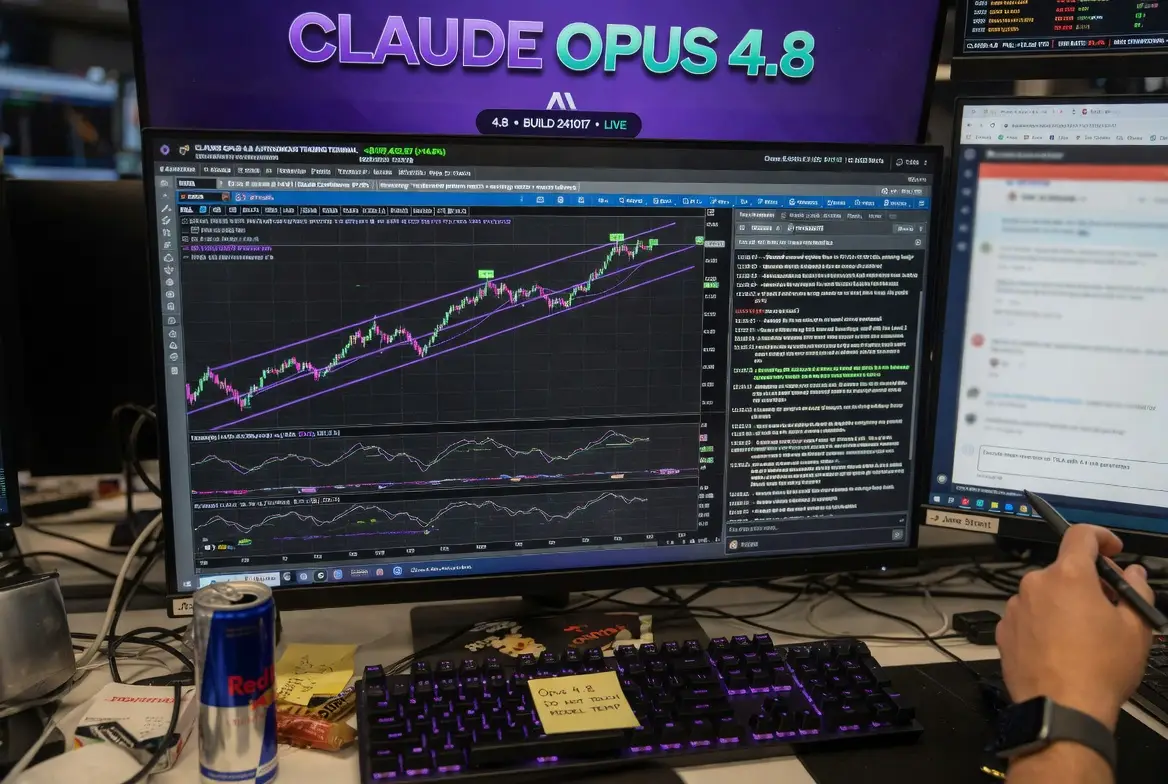
Timing is everything in finance. So when Anthropic dropped Claude Opus 4.8 on May 28, 2026 exactly one day after Robinhood opened the door to autonomous AI trading for retail investors it was hard to miss the signal. The infrastructure for AI driven investing just got a meaningful upgrade, and if you are building or using an agentic trading workflow, this release directly affects the quality of the decisions being made on your behalf.
This is not a release about making Claude sound nicer or write better poems. Anthropic’s own announcement specifically calls out gains in agentic financial analysis as one of the headline improvements. That is a deliberate message directed at a very specific audience: people who want AI to actually interact with their money.
Let us break down what changed, what it means for traders, and whether the upgrade actually moves the needle.
What Is Claude Opus 4.8, Exactly?
Claude Opus 4.8 is Anthropic’s flagship model as of May 28, 2026. It is the fourth point release in the Opus 4.x family following 4.5 in November 2025, 4.6 in February 2026, and 4.7 just six weeks earlier in April 2026. That is an aggressive cadence, and it reflects how competitive the frontier model space has become ahead of Anthropic’s anticipated IPO later this year.
Anthropic describes it with refreshing honesty as a modest but tangible improvement on Opus 4.7. That matters: the AI industry rarely admits when a release is incremental rather than a revolution. The fact that Anthropic does this, and that their own evaluation data supports it, is itself a signal about the model’s most important new characteristic: honesty.
The model is available on claude.ai for Pro, Max, Team, and Enterprise plans. Developers can access it via the API using the model ID claude opus 4 8. It runs on Amazon Bedrock, Google Vertex AI, and Microsoft Foundry. Pricing is unchanged from Opus 4.7 at $5 per million input tokens and $25 per million output tokens with an optional Fast Mode at 2.5x speed now priced at $10/$50 per million tokens, three times cheaper than Fast Mode on previous versions.
The Benchmarks: Where It Actually Improved
Overall Performance vs Opus 4.7
| Benchmark | Opus 4.7 | Opus 4.8 | Change |
|---|---|---|---|
| SWE bench Verified (coding) | 87.6% | 88.6% | +1.0 pp |
| SWE bench Pro (real world coding) | 64.3% | 69.2% | +4.9 pp |
| MCP Atlas (agentic multistep tasks) | 77.3% | 82.2% | +4.9 pp |
| BrowseComp single agent (web research) | 79.3% | 84.3% | +5.0 pp |
| OSWorld Verified (computer use) | n/a | 83.4% | Best in class |
| GPQA Diamond (graduate science) | 94.2% | 93.6% | Flat |
| GDPval AA Elo (general knowledge) | n/a | 1,890 | Highest rated |
| USAMO 2026 (advanced mathematics) | 69.3% | 96.7% | +27.4 pp |
The mathematics jump is the outlier that deserves your attention. A 27 percentage point improvement on the 2026 USA Mathematical Olympiad benchmark is not incremental in any normal sense of the word. For a model being used in financial contexts where options pricing, portfolio optimization, and quantitative strategy execution all depend on precise numerical reasoning that is a substantial upgrade in the analytical substrate.
How Opus 4.8 Stacks Up Against Competitors
| Benchmark | Opus 4.8 | GPT 5.5 | Gemini 3.1 Pro |
|---|---|---|---|
| Agentic coding (SWE bench Pro) | 69.2% | 58.6% | 54.2% |
| Computer use (OSWorld) | 83.4% | n/a | n/a |
| Terminal agent tasks | n/a | Narrow lead | n/a |
| Multimodal / chart analysis | Competitive | Competitive | Leading |
| Agentic financial analysis | Leading | n/a | n/a |
Opus 4.8 leads the market on the tasks most relevant to financial agents: multistep agentic work, computer use, and specifically financial analysis pipelines.
The Trading Angle: Why This Release Is Different for Investors
Agentic Financial Analysis Is Now a Named Priority
This is the sentence that should catch every trader’s eye in Anthropic’s release notes: Opus 4.8 delivers improvements in agentic financial analysis. Not financial analysis as a byproduct. Not coding improvements that happen to help with spreadsheets. Agentic financial analysis meaning AI agents, acting autonomously, doing financial work is now an explicit benchmark category that Anthropic measures, tracks, and publishes results for.
That is a strategic signal. Anthropic is telling the market that financial workflows are a first class use case for its flagship model. The timing alongside Robinhood’s Agentic Trading launch makes the direction of travel unmistakable.
In practical terms, the improvements translate to an agent that can handle multistep research pipelines pulling filings, cross referencing data points, synthesizing sector trends with fewer tool calls per task. Fewer tool calls means lower cost and faster execution.
The Hallucination Problem: Finance’s Biggest AI Risk, Getting Smaller
Ask any portfolio manager or quant analyst what keeps them up at night about AI in trading, and the answer is usually some version of the same thing: what happens when the model invents a number?
Hallucinated financial data is not a minor inconvenience. A fabricated earnings figure, a misattributed analyst rating, or an invented regulatory filing detail fed into an autonomous trade execution system can result in real, irreversible losses.
Opus 4.8 addresses this directly. Anthropic reports the model is roughly four times less likely than Opus 4.7 to allow flaws in its own output to pass unremarked. Early testers confirm the model is more likely to flag uncertainty and less likely to present unsupported claims as facts.
That behavioral shift from confident wrong answer to flagged uncertainty is exactly what you want in a model handling financial information.
The Mathematics Upgrade and What It Means for Quant Workflows
The 27 point USAMO improvement is significant for quantitative work. It signals a model that can handle deep, chained numerical reasoning required for:
- Options pricing calculations (Black Scholes and variations)
- Portfolio variance and covariance matrix analysis
- Kelly Criterion position sizing
- Risk adjusted return calculations
- Quantitative backtest logic verification
Computer Use: The Model Can See Your Screen
Opus 4.8 leads the market on OSWorld Verified at 83.4% the benchmark for AI agents that interact with computers by looking at and clicking on screens.
For trading applications, this means an agent can navigate web interfaces, extract data from research portals, monitor watchlist dashboards, and execute responses through visual interaction rather than just APIs.
Three New Features Traders Should Know About
| Feature | What It Does | Who Can Use It | Finance Relevance |
|---|---|---|---|
| Dynamic Workflows | Runs hundreds of parallel subagents on one task | Enterprise, Team, Max | Parallel analysis of large stock universes |
| Effort Controls | User sets reasoning depth (high / extra / max) | All paid plans | Cost efficiency on simple vs complex tasks |
| Fast Mode | 2.5x speed at $10/$50 per million tokens | Research preview | High frequency pipeline cost reduction |
Dynamic Workflows is particularly powerful. Instead of analyzing 50 stocks sequentially, an agent can now spin up subagents to analyze each ticker simultaneously and synthesize results in one session.
Opus 4.8 + Robinhood Agentic Trading: The Combination Worth Understanding
Robinhood launched its Agentic Trading beta on May 27, 2026 the day before Opus 4.8 dropped. The two products are complementary:
- Robinhood provides the brokerage execution layer
- Claude provides the reasoning layer
When you connect Claude to your Robinhood Agentic account, the model powering the connection is now Opus 4.8 meaning better agentic financial analysis, reduced hallucination, and stronger quantitative reasoning.
This does not make autonomous trading safe. You remain fully responsible for every trade. But the analytical quality behind those trades has improved.
Which Claude Model Should Finance Users Actually Pick?
| Use Case | Recommended Model | Reason |
|---|---|---|
| Complex multistep investment research | Opus 4.8 | Best agentic financial analysis |
| High volume earnings screening | Sonnet 4.6 | 63.3% on Finance Agent benchmark, 5x cheaper |
| Autonomous trading agent (Robinhood) | Opus 4.8 | Reduced hallucination is critical |
| Quick portfolio queries | Sonnet 4.6 or Opus 4.8 (low effort) | Better cost control |
| Quantitative strategy backtesting | Opus 4.8 | Strong mathematics performance |
| Chart and document analysis | Gemini 3.1 Pro or Opus 4.8 | Gemini leads pure visual |
What Comes After Opus 4.8?
Anthropic has already teased its next generation model, internally referenced as Mythos, for release in the coming weeks.
The Opus 4.x line has followed a rapid cadence:
- 4.5 in November 2025
- 4.6 in February 2026
- 4.7 in April 2026
- 4.8 in May 2026
The pace is accelerating. For anyone building serious AI trading infrastructure today, the practical lesson is: build model agnostic. Your agent’s architecture should allow swapping the underlying model with minimal changes.
Bottom Line
Claude Opus 4.8 is not a headline grabbing leap. But it is a well targeted upgrade that hits the specific characteristics most relevant to financial applications:
- Better multistep agentic reasoning
- Significantly reduced hallucination
- Strong mathematics improvement
- Explicit focus on agentic financial analysis
The convergence with Robinhood’s Agentic Trading launch is not coincidental. The infrastructure for retail investors to run autonomous AI trading agents is now live and the quality of the model doing the reasoning just improved.
Use it carefully. Position size conservatively. Monitor your agent. But do not ignore what is being built.
Disclaimer: This article is for informational purposes only and does not constitute financial advice or investment advice. Trading in financial markets involves significant risk of loss. AI powered trading agents introduce additional risks including model error, hallucination, and unintended execution. Always consult a qualified financial adviser before making investment decisions. Investments Research is not affiliated with Anthropic or Robinhood Markets, Inc.