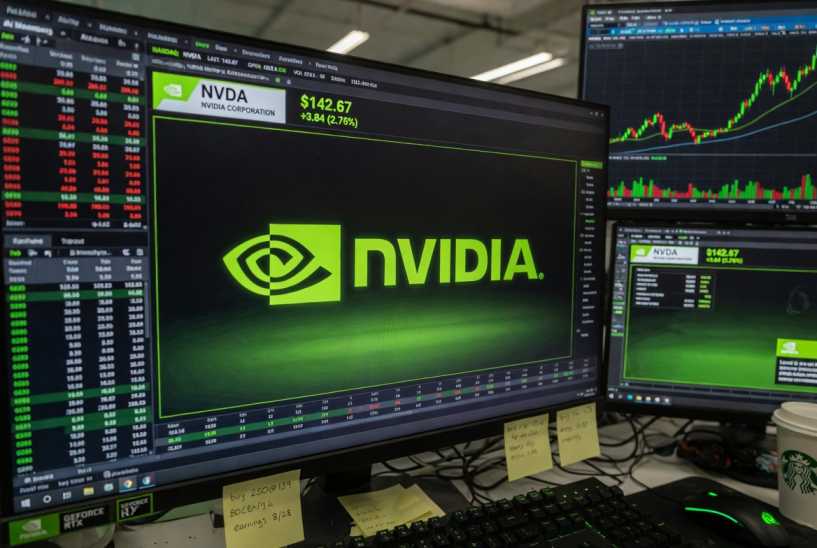
Ticker: NVDA | Exchange: NASDAQ | Sector: Semiconductors | Rating: BUY (Long-Term) Current Price (June 2026): ~$219 | 12-Month Consensus Target: $271 to $305 | 2030 Bull Case Market Cap: $10 to $20 Trillion
Executive Summary
NVIDIA Corporation has undergone the most rapid fundamental transformation of any large-cap company in market history. What was once a gaming graphics chip maker is now the undisputed infrastructure backbone of the global artificial intelligence economy. Consequently, the numbers are no longer just impressive: they are historically unprecedented.
In Q1 FY2027 (quarter ended April 2026), NVIDIA reported quarterly revenue of $81.6 billion and net income of $58.3 billion. To put that in perspective, this represents more profit in 90 days than Intel generated in total annual revenue for all of 2025. Furthermore, the company guided Q2 FY2027 revenue to $91 billion, signaling that the acceleration, far from plateauing, continues at warp speed.
This report provides a comprehensive equity research analysis of NVIDIA’s AI chip business: its competitive position, financial trajectory, valuation framework, and a structured scenario analysis for 2030. We examine both the extraordinary upside opportunity and the material risks that every investor must weigh before establishing or sizing a position.
Investment thesis in one sentence: NVIDIA is not just a chipmaker: it is the operating system of the AI economy, with compounding software lock-in, an annual hardware upgrade cycle with no peer, and a $1 trillion demand backlog that makes near-term revenue visibility exceptionally high by any historical standard.
The Business: From GPUs to AI Factories
NVIDIA’s product portfolio has evolved decisively. While the company still generates revenue from gaming, professional visualization, and automotive segments, these are now rounding errors by comparison. The Data Center segment, which sells AI training and inference chips, networking, and AI software, constituted 92% of total revenue in Q1 FY2027, generating $75.2 billion in that single quarter alone, up 92% year-over-year.
What NVIDIA Actually Sells
Understanding NVIDIA’s business requires recognizing that it sells systems, not individual components. Each product line plays a distinct and compounding role in the overall platform:
GPUs (Graphics Processing Units): The core product. The H100/H200 (Hopper generation), now succeeded by the Blackwell B200/GB200, are the world’s most sought-after compute accelerators. Blackwell’s two-die design delivers a 25x improvement in energy efficiency per AI operation versus Hopper: not merely a performance claim, but a direct response to the electricity constraint that limits AI factory scaling.
NVLink and Networking: NVIDIA’s NVLink fabric and Ethernet-for-AI solutions allow thousands of GPUs to communicate at near-memory speeds, turning a cluster of chips into a single coherent AI factory. Networking revenue alone reached $31.4 billion in FY2026, up 142% year-over-year. In other words, this sub-segment is growing faster than the already-explosive headline figure.
CUDA Ecosystem: CUDA (Compute Unified Device Architecture) is NVIDIA’s proprietary parallel computing platform and programming model. Over 5 million developers have built workflows, models, and codebases on CUDA. This is not just a software advantage: it is a structural switching cost that makes NVIDIA’s moat qualitatively different from traditional hardware manufacturers. Developers do not leave CUDA because their entire technical stack depends on it.
NIM Microservices and Enterprise AI Platforms: NVIDIA is executing a deliberate transition from hardware vendor to full-stack AI platform provider. NVIDIA Inference Microservices (NIM) allow enterprises to deploy AI models in production environments using optimized NVIDIA software, thereby creating a recurring revenue layer on top of hardware sales.
Rack-Scale AI Systems: The NVL72 and NVL576 are not individual GPUs. Rather, they are complete AI data center solutions sold to hyperscalers and sovereign AI programs. Jensen Huang explicitly frames these as “AI factories,” and the pricing and margin profile reflects this elevated positioning.
Financial Snapshot: The Numbers That Redefine “Growth”
FY2026 Full-Year Results
| Metric | FY2026 | FY2025 | YoY Growth |
|---|---|---|---|
| Total Revenue | $215.9B | $130.5B | +65.5% |
| Data Center Revenue | $193.7B | ~$115.2B | +68.1% |
| Net Income | $120.1B | ~$72.9B | +64.7% |
| Gross Margin (Non-GAAP) | ~74 to 75% | ~73% | Expanding |
| Free Cash Flow | ~$167B (est.) | ~$100B | ~+67% |
Most Recent Quarter (Q1 FY2027, April 2026)
| Metric | Q1 FY2027 | Q1 FY2026 | YoY Growth |
|---|---|---|---|
| Revenue | $81.6B | $44.1B | +85% |
| Net Income | $58.3B | ~$18.8B | +210% |
| Data Center Revenue | $75.2B | ~$39.1B | +92% |
| Non-GAAP EPS | ~$2.40 | $0.77 | +212% |
| Q2 FY2027 Guidance | $91.0B | N/A | N/A |
These are not the numbers of a company riding a temporary cycle. A 72% net profit margin, essentially printing $72 of profit for every $100 of revenue, reflects the pricing power of a company supplying a resource that the world’s largest technology firms desperately need and cannot easily source elsewhere.
Capital Returns and Balance Sheet
NVIDIA’s balance sheet discipline is equally impressive. The company carries minimal debt (Debt/Equity of just 0.07) and returns capital through buybacks, with shares outstanding falling 1.11% over the past year. Additionally, NVIDIA recently announced a dividend increase of 2,400% year-over-year. Its Return on Equity (ROE) stands at 114% and Return on Invested Capital (ROIC) at 104%: figures that place it in the top decile of every company in the S&P 500, not just semiconductors.
Competitive Position: The Moat Anatomy
Market Share
NVIDIA controls an estimated 80 to 92% of the AI data center chip market in 2026 by revenue, depending on methodology. IDC pegs it at 81%, while other analysts measuring only pure-play AI accelerators put the figure higher. AMD, the closest merchant competitor, holds approximately 10% with its MI300X series.
The relevant question is not whether this share will compress, because it likely will. Instead, the key question for investors is by how much and over what timeframe that compression occurs.
The CUDA Lock-In: Why Switching Is Hard
The software moat deserves standalone analysis. CUDA has been NVIDIA’s deliberate long-term strategy since its introduction in 2006, long before anyone predicted AI would become NVIDIA’s core market. Today, this early mover advantage has compounded into an ecosystem with formidable switching costs:
- Virtually every foundational AI model, including the GPT series, Llama, Gemini, and Claude, was trained primarily on NVIDIA hardware using CUDA.
- Enterprise AI teams have internal tooling, optimization pipelines, and infrastructure built around CUDA APIs.
- The ML research community defaults to CUDA-based frameworks, particularly PyTorch and TensorFlow with CUDA backends.
- CUDA 13.2, released in April 2026, extends compatibility while enabling performance gains on Blackwell, ensuring developers remain within the ecosystem across hardware generations.
Moreover, AMD’s ROCm (Radeon Open Compute) platform, though improved materially, still lags significantly in ecosystem maturity, library completeness, and developer familiarity. The switching cost is not just technical: it is organizational, as retraining engineering teams and rebuilding CI/CD pipelines for a new compute platform represents a genuine enterprise project, not a line-item decision.
Hardware Architecture Roadmap: Sustained Capability Inflation
NVIDIA’s multi-year hardware roadmap is a key element of the investment thesis because it gives hyperscalers and investors long-term visibility into procurement cycles. Each generation has delivered step-function improvements:
Hopper (H100/H200): The generation that triggered the global AI infrastructure boom. H100 became the most sought-after chip on earth in 2023 and 2024. Hopper established the baseline for what frontier AI compute requires.
Blackwell (B200/GB200, current generation): Two-die design, 130 trillion transistors, 576 memory chips, and 2,592 Grace CPU cores. Blackwell delivers a 25x energy efficiency improvement over Hopper per AI operation. The NVL72 and NVL576 rack configurations allow hyperscalers to deploy complete AI factory solutions. Production ramp delays in mid-2024 were resolved, and the architecture has since shipped at massive scale with demand consistently above supply.
Rubin (R100/R100X, 2026 to 2027): The next-generation architecture features approximately 1,300 trillion transistors, which is 10 times the transistor count of Blackwell, along with 2,304 memory chips and 12,672 Vera CPU cores. Rubin Ultra, confirmed for 2027, features approximately 500 billion transistors per GPU die, 384GB HBM4E memory, and 32 TB/s bandwidth. Furthermore, Rubin will introduce optical interconnects and the Kyber rack architecture supporting 144 GPUs in vertical configurations with NVLink 7.0. The performance-per-watt improvement over Hopper is projected at 97%, meaning Rubin compute will effectively cost 3% of the TCO equivalent of Hopper compute for the same AI output.
Feynman (2028 and beyond): NVIDIA has already named its next architecture after physicist Richard Feynman, expected to be at least 30 times more powerful than Blackwell Ultra. The consistent annual or bi-annual cadence of new architecture introductions creates a perpetual upgrade cycle. As a result, hyperscalers cannot afford to fall two generations behind in a market where inference cost determines competitive economics.
This roadmap visibility is a unique investment attribute. Customers can model multi-year capex on known NVIDIA architecture performance curves, which in turn creates both demand predictability and ecosystem lock-in. Enterprises that standardize on NVIDIA’s software stack will naturally upgrade to each new hardware generation rather than face the costly and disruptive process of migrating to a competitor’s platform.
The $1 Trillion Demand Signal
A Historic Order Backlog
Perhaps the most significant single data point in NVIDIA’s recent history is CEO Jensen Huang’s statement at GTC 2026: confirmed AI chip demand through 2027 amounts to at least $1 trillion, an upgrade from his prior estimate of $500 billion. Critically, this figure represents confirmed purchase orders from the world’s largest technology companies, not speculative projections.
To contextualise: NVIDIA’s FY2026 annual revenue was $216 billion. A $1 trillion order backlog therefore implies near-perfect revenue visibility for more than four years of current production. No other semiconductor company in history has possessed this degree of forward demand certainty.
What Is Driving Demand
The demand is being driven by an unprecedented capex supercycle across multiple buyer categories:
- Hyperscalers such as Microsoft, Meta, Amazon, and Google have announced combined AI infrastructure spending of $725 billion in 2026 alone.
- Sovereign AI programs, which are government-led national AI infrastructure initiatives across the Middle East, Europe, and Asia, represent a new and rapidly growing demand vertical that barely existed in 2023.
- Enterprise AI adoption is still in early innings. As a result, the ongoing shift from experimental to production AI deployments will require substantial additional inference infrastructure, a market NVIDIA is capturing through its NIM platform and cloud provider partnerships.
Why the Backlog Is Credible
It is worth addressing the credibility of this demand directly. Unlike speculative analyst projections, this backlog consists of purchase orders with contractual delivery commitments from companies whose own AI product roadmaps depend on receiving this compute. Microsoft, Meta, Amazon, and Google each have stated AI capital expenditure plans that are publicly committed and which require NVIDIA’s hardware to execute. Consequently, any shortfall in delivery would represent a supply problem, not a demand problem, for the foreseeable future.
Competitive Risks: Where Bears Have Valid Points
Intellectual honesty demands a rigorous treatment of the risks. NVIDIA’s position is strong but not unassailable, and several structural threats deserve serious consideration from any investor.
Custom Silicon From Hyperscalers
The most credible long-term threat to NVIDIA’s market share comes not from AMD or Intel, but from NVIDIA’s own customers. Each major hyperscaler is developing or deploying its own AI acceleration silicon:
- Google: TPU 8t and TPU 8i, launched at Cloud Next 2026, claiming up to 3x faster model training and 80% better performance per dollar versus prior generations. Google’s TPUs could theoretically offer total cost of ownership advantages of up to 80% at scale, though such figures depend heavily on workload characteristics.
- Amazon AWS: Trainium3 is already being used by frontier AI labs for training. Simultaneously, AWS is designing Trainium4 to integrate NVIDIA NVLink Fusion, a nuanced point that suggests these chips are complementary rather than purely substitutional.
- Meta: Plans to train next-generation models on its own MTIA hardware, though timelines for on-premise TPU integration extend to 2027 and beyond.
- Microsoft: Has deployed Maia 100 chips in U.S. data centers, though at scale well below its NVIDIA GPU deployments.
- OpenAI and Broadcom: A confirmed deal for custom ASIC chips has been announced, starting in 2026.
Custom silicon now represents approximately 20.9% of the AI chip market in 2025, expected to expand to 27.8% by 2026. This is a real and growing risk to NVIDIA’s pricing power in inference workloads, where the optimal performance-per-dollar trade-off differs from training.
However, several mitigating factors limit this threat in the near to medium term:
- Software friction remains real. Even Google continues investing in making TPUs compatible with mainstream PyTorch workflows, which is a tacit acknowledgment that CUDA’s developer mindshare is a structural advantage that custom silicon does not automatically inherit.
- Custom silicon is optimized for specific workloads. Google’s TPUs excel at certain inference patterns but lack the flexibility of CUDA GPUs for frontier model training, research, and rapid architectural iteration.
- Hyperscalers are still buying massive quantities of NVIDIA chips. Cloud providers represented just over 50% of NVIDIA’s data center revenue in Q4 FY2026. Therefore, custom silicon functions as a supplement and hedge, not a replacement strategy, at least in the current cycle.
- Interconnect standardization around NVIDIA. AWS designing Trainium4 to integrate NVIDIA NVLink Fusion is particularly revealing: even in-house silicon is being designed around NVIDIA’s networking fabric, reinforcing rather than displacing the broader NVIDIA ecosystem.
AMD and the MI400 Series
AMD’s MI300X captured roughly 10% of the AI accelerator market by 2026, up from approximately 5% in 2024. The upcoming MI400 series, expected by late 2026 with 432GB of HBM4 memory, represents AMD’s most credible challenge to Blackwell. AMD CEO Lisa Su has targeted double-digit market share gains and data center revenue scaling to tens of billions annually by 2027.
AMD’s ROCm software ecosystem has improved substantially and is now viable for many inference workloads. Cost-conscious cloud providers and enterprises scaling AI deployments beyond initial model training, where throughput per dollar matters more than raw training performance, represent AMD’s strongest market opportunity. Overall, AMD aims for 10 to 15% market share by 2027.
This is a meaningful competitive challenge. Nevertheless, it does not threaten NVIDIA’s core position at the top of the performance curve, where pricing power is greatest and where frontier model training is conducted exclusively on NVIDIA hardware.
Export Controls and the China Risk
The U.S.-China technology conflict has created direct revenue impact for NVIDIA. The company’s Q2 FY2027 guidance explicitly excludes any Data Center compute revenue from China, and NVIDIA has not assumed H20 chip shipments to China in its near-term outlook.
The Commerce Department’s Bureau of Industry and Security has imposed aggressive export controls on advanced AI accelerators destined for China, resulting in $420 million in combined penalties and forfeitures related to semiconductor smuggling enforcement in the past 12 months. The scale of enforcement actions highlights both the demand for restricted chips and the regulatory intensity of the control regime.
China represented a significant market for NVIDIA historically. The exclusion of this revenue creates a measurable near-term headwind. However, the investment thesis does not depend on China access, since U.S., European, Middle Eastern, and rest-of-world demand is sufficient to drive the growth trajectory described in this analysis. Moreover, a partial reopening of China access under any policy scenario represents genuine upside optionality that is not currently priced into consensus estimates.
Valuation and Multiple Compression Risk
NVIDIA’s valuation has historically commanded a significant premium. However, as earnings have grown explosively faster than the share price in recent periods, the multiple has compressed dramatically. As of June 2026:
- Trailing P/E: ~32x
- Forward P/E (NTM): ~21 to 25x
- PEG Ratio: 0.48 (a reading below 1.0 is conventionally considered undervalued relative to growth)
- EV/EBITDA: ~30.6x
- EV/FCF: ~42.6x
The forward P/E of roughly 21 to 25x is, by any reasonable measure, undemanding for a company with 85%+ revenue growth, 72% net margins, and a confirmed multi-year demand backlog. In addition, the PEG ratio of 0.48 would typically indicate undervaluation even for a modestly growing company, let alone one growing at NVIDIA’s current rate.
The bear case on valuation centers on multiple compression if AI infrastructure spending moderates or if NVIDIA fails to sustain current earnings beats. Even in a full AI-narrative failure scenario, NVIDIA at $38 would still trade at nearly a $1 trillion market cap, a floor that reflects its demonstrated ability to generate cash at scale in any reasonable business environment.
Valuation Framework: Scenarios to 2030
The following analysis presents three structured scenarios for NVIDIA’s position in 2030. These are analytical frameworks designed to illustrate how different assumptions about market share, margin trajectory, and earnings multiple drive radically different outcomes. They are not stock price predictions.
All scenarios assume NVIDIA shares outstanding remain roughly 24 billion, reflecting modest buyback activity partially offset by stock compensation.
Key Assumptions Common to All Scenarios
- Global AI data center market grows from roughly $514 billion (2026) toward $1 to 3.5 trillion by 2030 (IDC/Statista range)
- NVIDIA retains a leadership position in the AI accelerator market through at least the Rubin generation
- No catastrophic regulatory event such as a forced divestiture or complete export ban to all major markets
- TSMC successfully scales advanced packaging capacity to meet demand
Scenario A (Bull Case): Platform Dominance Through 2030
Assumptions:
- NVIDIA reaches $930 billion to $1 trillion in annual revenue by FY2031, consistent with management guidance and bullish analyst projections
- Data Center revenue reaches $850 to $900 billion, driven by continued Blackwell, Rubin, and Feynman upgrade cycles plus expanding software and NIM recurring revenue
- Gross margins hold at 73 to 76%; net margins at 65 to 70%
- Net income approaches $600 to $650 billion annually
- Shares trade at a price-to-sales ratio of 18 to 22x, below the 3-year median of approximately 28x
Implied market cap: $16.7 to $22 trillion Implied share price: approximately $690 to $910
This scenario is consistent with the I/O Fund’s “$20 trillion by 2030” thesis. It requires NVIDIA to execute on its stated trajectory, maintain its CUDA moat against intensifying custom silicon competition, and benefit from AI demand scaling as described by hyperscaler capex programs.
Scenario B (Base Case): Durable Leadership with Gradual Share Erosion
Assumptions:
- NVIDIA reaches $450 to $550 billion in annual revenue by FY2031
- Custom silicon erodes NVIDIA’s inference market share to 55 to 65% while training remains above 75%
- Revenue growth decelerates to 15 to 20% CAGR from current levels as the market matures
- Net margins compress modestly to 55 to 60% as software mix grows but hardware mix shifts
- Net income of $250 to $330 billion annually
- Multiple compresses to 20 to 25x net income
Implied market cap: $5 to $8.3 trillion Implied share price: approximately $205 to $340
This base case roughly aligns with the 24/7 Wall Street analysis projecting an $8.9 trillion market cap and $241 share price for 2030. It is achievable if the AI infrastructure buildout continues at a healthy but decelerating rate.
Scenario C (Bear Case): AI Capex Cycle Deceleration
Assumptions:
- AI infrastructure spending plateaus or declines materially after 2027 as hyperscalers complete initial buildouts
- Custom silicon captures 40%+ of inference workloads; AMD gains 20%+ of the training market
- NVIDIA revenue growth stalls in the $300 to $350 billion range by 2030
- Margins compress as competition intensifies; net margins fall to 40 to 45%
- Multiple compresses to 12 to 15x net income, analogous to a mature industrial company
Implied market cap: $1.5 to $2.4 trillion Implied share price: approximately $60 to $100
This scenario requires AI demand to disappoint materially relative to current hyperscaler capex commitments. Given $725 billion in announced 2026 spending alone, this would represent a significant and abrupt reversal of publicly committed capital plans from the world’s largest technology companies.
DCF-Based Intrinsic Value (Current)
Independent DCF analyses using NVIDIA’s free cash flow trajectory suggest a current intrinsic value range of approximately $308 to $372 per share, compared to a current market price of approximately $219. This implies meaningful undervaluation even on present earnings, not just forward growth, which is a relatively unusual situation for a market-leading technology company at this scale.
The Software Layer: NVIDIA’s Most Underappreciated Moat
Equity research on NVIDIA often focuses on GPU unit counts and average selling price. The more durable competitive advantage, and the one that will define whether the 2030 bull case materializes, is NVIDIA’s software ecosystem. This layer is frequently underappreciated by investors who view NVIDIA primarily as a hardware company.
CUDA and the Developer Ecosystem
CUDA remains the foundation. With 5+ million developers, an industry-standard programming model, and multi-generational backward compatibility (CUDA 13.2 supports Ampere through Blackwell), the platform reduces customer anxiety about upgrade cycles while continuously deepening lock-in. Moreover, the cuTile Python library, introduced in early 2026, has democratized tensor core access for data scientists who previously required deep systems programming expertise.
NIM, AI Enterprise, and DGX Cloud
NIM (NVIDIA Inference Microservices): Pre-optimized containers that allow enterprises to deploy NVIDIA-certified AI models in production with minimal configuration. This creates stickiness at the application layer, not just the infrastructure layer, which is significantly more valuable for long-term margin sustainability.
NVIDIA AI Enterprise: A software suite for deploying, managing, and securing AI in enterprise environments. As companies move from AI pilots to production deployments, this software stack becomes the recurring revenue bridge that transforms NVIDIA’s financial profile toward a more subscription-like model.
DGX Cloud: NVIDIA’s managed cloud service for AI training, available through major cloud providers. This allows NVIDIA to participate in cloud economics without owning data centers, a capital-light but strategically critical position that expands addressable market without proportional capex.
Physical AI and Omniverse
Jensen Huang’s next major thesis involves “physical AI”: AI systems that understand and interact with the physical world, including robotics, autonomous vehicles, and industrial simulation. NVIDIA’s Omniverse platform, designed for building and simulating physical environments, positions the company for a wave of AI applications beyond pure language and reasoning models. As a result, the transition from hardware vendor to full-stack platform provider is the key driver of why consensus analysts forecast 24% annual revenue growth over the next three years, even from an already enormous revenue base.
Emerging Growth Vectors Beyond Data Center
While Data Center dominates the current profit and loss statement, several adjacent markets provide NVIDIA with meaningful optionality for revenue diversification through 2030:
Automotive and Autonomous Driving
NVIDIA’s Drive platform is embedded in vehicles from major OEMs including Mercedes-Benz, Volvo, and Hyundai. Automotive revenue was $6.4 billion in Q1 FY2027 alone, up 29% year-over-year. As autonomous driving capabilities advance and in-vehicle AI compute requirements scale, this segment could contribute materially more to total revenue by 2028 to 2030.
Robotics and Physical AI
The humanoid robotics market, while still early-stage, is accelerating faster than most forecasters predicted two years ago. NVIDIA’s Isaac robotics platform and Jetson computing modules are already embedded in leading robotics programs. Physical AI deployment at scale will require inference compute at the edge, which is precisely NVIDIA’s natural domain.
Healthcare and Life Sciences
AI drug discovery, medical imaging, and genomics are emerging as significant enterprise verticals. NVIDIA’s Clara healthcare platform and its partnerships with pharmaceutical companies create a recurring enterprise revenue stream in a domain characterized by high switching costs and stringent regulatory barriers to entry.
Sovereign AI
Government-led national AI infrastructure programs represent a qualitatively new demand source. Countries in the Middle East, including through the UAE’s Stargate project and Saudi Arabia’s HUMAIN initiative, as well as programs across Europe and Southeast Asia, are funding national AI factories with significant NVIDIA hardware procurement. Importantly, this demand is driven by geopolitical imperatives rather than purely commercial ROI calculations, making it potentially more resilient to cyclical slowdowns in private sector AI spending.
Management and Capital Allocation
Jensen Huang, NVIDIA’s co-founder and CEO, has led the company since its founding in 1993, a 33-year tenure that has seen NVIDIA navigate multiple technology transitions without losing its leadership position. His long-term thinking, willingness to make decade-ahead architectural bets such as the CUDA investment in 2006, and ability to communicate a coherent strategic vision to both technical and investor audiences represent a qualitative management advantage that is difficult to quantify but materially important to the investment case.
Capital Allocation Priorities
NVIDIA’s capital allocation is disciplined across four areas:
- R&D intensity: NVIDIA spends significantly on research across GPU architecture teams, software development, and emerging market exploration. Sustaining the Rubin and Feynman roadmap requires this level of continued investment.
- Share buybacks: The company has reduced dilution through buyback programs despite the stock compensation inherent in a technology company’s hiring model, resulting in a net reduction in shares outstanding.
- Strategic investments: NVIDIA deployed $18.6 billion in private AI company investments during Q1 FY2027 alone, generating approximately $15.9 billion in investment gains. This venture-style portfolio provides both financial returns and strategic intelligence about where AI applications are evolving.
- Minimal debt: The near-zero leverage (D/E of 0.07) is conservative and intentional, preserving financial flexibility for future capex cycles and potential M&A.
Wall Street Consensus and Analyst Views
Consensus Rating: Strong Buy Number of Analysts: 71 Average 12-Month Price Target: $271 to $305 (range: $139 low to $454 high) Implied Upside from ~$219: 24 to 39%
Selected Analyst Perspectives
- DA Davidson (Gil Luria): Buy rating, $300 price target, added NVDA to the firm’s “Best-of-Breed Bison List”
- Multiple analysts revised targets upward following Q1 FY2027 results; consensus estimates for FY2027 revenue stand at approximately $369 billion
- FY2028 consensus revenue estimate: $479 billion
- FY2031 consensus revenue estimate: $757 billion, up sharply from $294 billion just one year ago
The Estimate Revision Pattern
The pattern of consistent upward estimate revision is itself a meaningful signal. Analysts who modeled NVIDIA’s growth trajectory conservatively have been repeatedly forced to revise upward. In fact, estimates for FY2028 have effectively doubled within a single year, suggesting that the consensus still may be underestimating the underlying demand curve. This dynamic of persistent estimate underrun followed by forced revision is a historically reliable indicator of fundamental outperformance in high-growth technology companies.
Key Risks Summary
| Risk | Probability | Impact | Mitigation |
|---|---|---|---|
| Custom silicon captures 30%+ of inference market | Medium to High | Medium | CUDA moat; NIM software layer; training dominance preserved |
| China export controls remain or tighten | High | Medium | Non-China demand sufficient; policy reopening represents upside |
| AI capex cycle peaks and reverses sharply | Low to Medium | High | $1T backlog; sovereign AI demand; enterprise still early |
| AMD gains 20%+ market share | Low to Medium | Medium | CUDA lock-in; Rubin/Feynman performance lead |
| Margin compression from competition | Medium | Medium | Software mix expanding; pricing power in frontier compute |
| Regulatory action (antitrust) | Low | Medium | No forced divestiture precedent in semiconductors |
| TSMC supply disruption | Low | High | Diversification underway; CoWoS expansion accelerating |
Investment Conclusion
The Core Thesis
NVIDIA is a once-in-a-generation company at a once-in-a-generation inflection point. The convergence of an unprecedented technological transition, in which AI is becoming foundational global infrastructure, an unmatched competitive position with 80 to 92% market share and the CUDA ecosystem, and explosive financial metrics including 85% revenue growth and 72% net margins, creates an investment profile with no clear historical peer.
Valuation at Current Prices
At roughly $219 per share as of June 2026, NVIDIA appears attractively priced relative to its earnings power:
- The forward P/E of approximately 21 to 25x is undemanding for a company with this growth profile
- A PEG ratio of 0.48 suggests the market is not fully pricing in earnings growth velocity
- DCF-based intrinsic value analyses suggest $308 to $372 per share on current cash flows, implying a 40 to 70% discount to fair value
- Analyst consensus targets of $271 to $305 imply 24 to 39% near-term upside
The 2030 Outlook
The 2030 base case, with a market cap of $5 to $8.3 trillion and an implied share price of $205 to $340, represents a reasonable scenario in which NVIDIA sustains leadership with some market share erosion and revenue growth deceleration. The bull case of $16 to $22 trillion requires continued execution on Jensen Huang’s stated trajectory. By contrast, the bear case of $1.5 to $2.4 trillion requires AI demand to disappoint significantly versus announced hyperscaler commitments, an outcome that appears unlikely given the structural forces driving AI adoption globally.
Position Sizing and Risk Management
NVIDIA carries a beta of 2.24, meaning it amplifies broad market moves in both directions. Therefore, investors with a 5-year-plus horizon and conviction in the AI infrastructure thesis should view volatility episodes as accumulation opportunities rather than exit signals. Dollar-cost averaging over multiple purchase points is prudent given the stock’s historical price swings.
Verdict: BUY on weakness; hold core position through 2030 for full realization of the AI infrastructure buildout thesis.
Appendix: Key Financial Metrics at a Glance
| Metric | Value (June 2026) |
|---|---|
| Market Capitalization | ~$5.3 trillion |
| Annual Revenue (FY2026) | $215.9 billion |
| Q1 FY2027 Revenue | $81.6 billion |
| Q2 FY2027 Guidance | $91.0 billion |
| Net Margin | ~72% |
| Return on Equity | 114% |
| ROIC | 104% |
| Forward P/E | ~21 to 25x |
| PEG Ratio | 0.48 |
| EV/EBITDA | 30.6x |
| Shares Outstanding | ~24.2 billion |
| 52-Week Price Change | +56.6% |
| Beta | 2.24 |
| Dividend Yield | ~0.1% |
| Data Center Share of Revenue | 92% |
| AI Accelerator Market Share | 80 to 92% |
This article is for informational and educational purposes only and does not constitute financial advice. Investing in individual stocks involves significant risk, including the possible loss of principal. Past performance is not indicative of future results. Always conduct your own due diligence or consult a qualified financial adviser before making investment decisions. Investments-Research.com has no position in any securities mentioned at the time of publication.