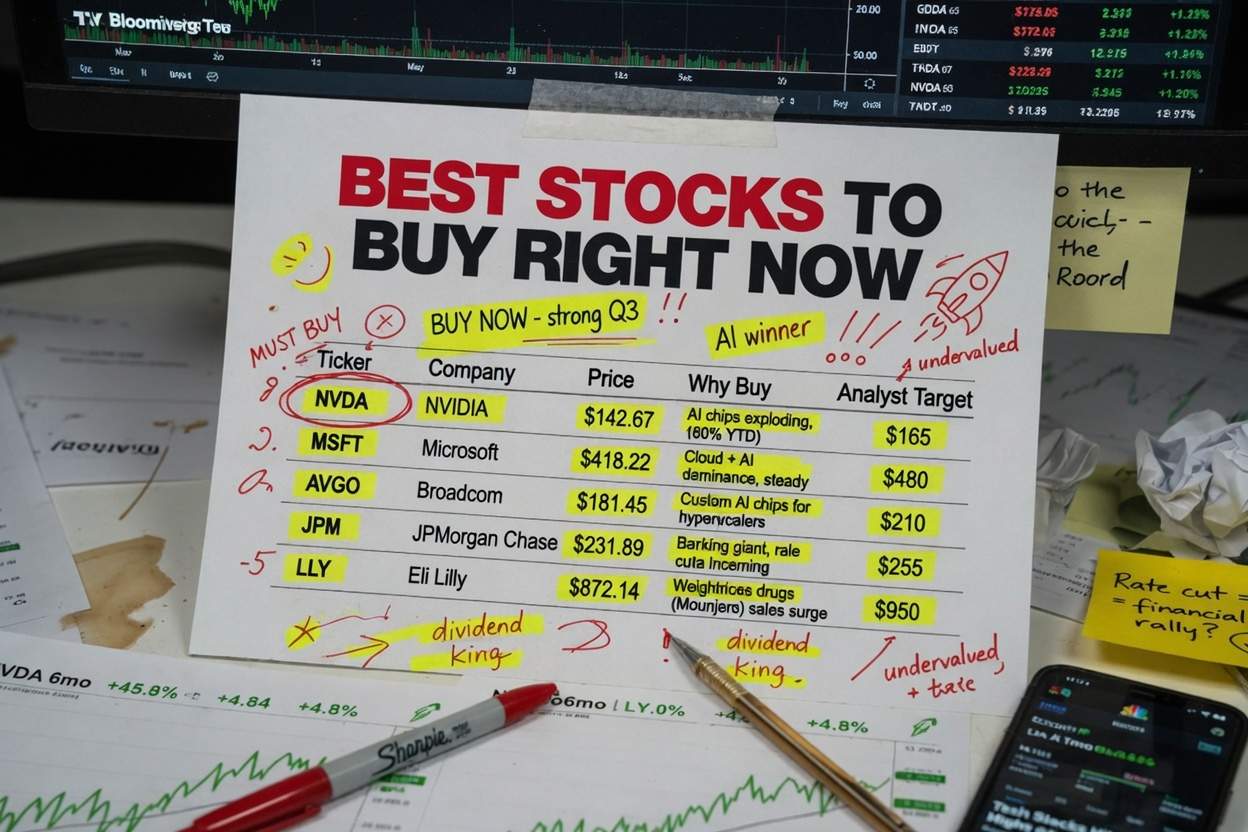
The stock market heading into June 2026 is, in a word, bifurcated. Five AI-oriented companies account for roughly half of the S&P 500’s year-to-date gains, while the broader market grinds forward on an uneven earnings recovery, a simmering Middle East energy shock, and a Federal Reserve that remains cautious about pivoting too aggressively on rates. Against that backdrop, investors face a deceptively hard question: where do you put capital right now, when the easy momentum trade is already crowded and the macro environment could turn on a single oil-price headline?
The answer, according to the most current analyst data and earnings signals as of June 2026, is nuanced. Some of the best opportunities still sit inside the AI infrastructure complex, but entry points now matter enormously. Furthermore, a cluster of names outside the Magnificent 7 offers compelling risk-reward for investors willing to look one layer deeper. This article identifies seven stocks that present the strongest fundamental cases for new or incremental capital in June 2026, grounded in recent earnings results, current analyst consensus, and the specific macro tailwinds shaping each sector.
Why the June 2026 Setup Is Unusual
Before turning to individual names, context is essential. S&P 500 earnings growth is tracking near 28% year over year in Q1 2026 according to Schwab’s market research, with beat rates above historical medians. Consequently, the bulls have clear ammunition: profits are genuinely accelerating, not just optically inflated. However, Schwab analysts also flag that revisions are heavily concentrated in Technology and Communication Services, with the Magnificent 7 still outpacing the rest of the S&P 500 by a wide margin.
The Macro Variables Investors Cannot Ignore
Two geopolitical and policy factors are reshaping sector allocations in real time. First, the Iran conflict and resulting energy shock have disrupted oil flows through the Strait of Hormuz, with tanker traffic collapsing from a weekly average of roughly 100 ships to just four ships during the week of May 8, 2026 per Fidelity’s midyear analysis. If oil prices stay elevated, inflation could reassert itself, putting rate-cut hopes back on the shelf. Second, the Fed’s posture remains uncertain. As noted by TheStreet, the next Fed chair, whoever succeeds Jerome Powell, is likely to face political pressure for rate cuts, which paradoxically creates both opportunity for interest-rate-sensitive assets and a credibility risk that could jolt bond markets.
Additionally, the S&P 500 is trading near all-time highs by cyclically adjusted metrics, and several strategists at firms like ACR and Alkeon have cautioned that valuations remain stretched. In aggregate, the setup rewards careful stock selection over passive index exposure. That is precisely what the following seven names are designed to provide.
The Seven Best Stocks to Buy in June 2026
1. NVIDIA Corporation (NVDA)
Current Price (June 2026): approximately $224 | Consensus Rating: Strong Buy (61 analysts) | 12-Month Consensus Target: approximately $297
NVIDIA remains the single most important infrastructure company in the artificial intelligence build-out, and the investment thesis has strengthened materially since April 2026. Specifically, the most recent earnings print showed quarterly revenue of $81.6B, beating the $78.9B estimate by a significant margin. Net income for that quarter came in at $58.3B. Furthermore, the company guided toward $91.6B in revenue for the next quarter, which would represent another step-change acceleration if achieved.
Why NVDA Still Belongs in Portfolios
Notably, multiple banks lifted NVDA price targets through May and June 2026 after the company guided to expanded Blackwell shipments in the second half. The catalyst is supply, not demand: foundry allocation freeing up means revenue that was previously capped by production constraints can now ship. Sell-side models are now pricing in a steeper revenue ramp into Q4 FY2026 than consensus carried just six weeks ago. Consequently, the stock deserves a fresh look even for investors who felt they missed the original entry.
The bear case centers on China restrictions on less-advanced chips, emerging Chinese alternatives in certain AI segments, and the risk that hyperscaler capex eventually plateaus. Those are legitimate concerns. Nevertheless, with fiscal year 2026 revenue reaching $215.9B, a 65% increase year over year, and earnings growing at 64.75% to $120.1B per stockanalysis.com data as of June 2026, the fundamental delivery has matched, and repeatedly exceeded, the narrative. At a trailing P/E of approximately 34.5x against that growth rate, the PEG ratio remains reasonable by large-cap technology standards.
Investment case in brief: NVDA is not a cheap stock. However, it is a stock where earnings acceleration has repeatedly proven skeptics wrong, supply constraints are easing, and 61 analysts maintain a Strong Buy consensus with a 33% upside target to $297.
2. Broadcom Inc. (AVGO)
Current Price (June 2026): approximately $481 | Consensus Rating: Strong Buy (47 analysts) | 12-Month Consensus Target: approximately $487
Broadcom is reporting its fiscal Q2 2026 results on June 3, and the pre-earnings setup is unusually constructive. Shares rose more than 7% in the session before the report, as investors positioned for what Susquehanna analyst Christopher Rolland described as continuing custom XPU momentum alongside TPU strength. In parallel, demand for Broadcom’s AI networking products is expected to grow. Rolland raised his price target to $490 before the print.
Custom Silicon as the Structural Differentiator
While NVIDIA dominates general-purpose GPU inference, Broadcom occupies a distinct and highly defensible position in custom AI silicon, specifically in the application-specific integrated circuits (ASICs) it co-designs with hyperscaler customers including Google (TPUs) and, until recently, Anthropic. Moreover, Broadcom’s infrastructure software division, anchored by the VMware acquisition, generates high-margin recurring revenue that cushions any near-term chip cycle volatility.
Gary Black, a prominent tech analyst, noted in early June 2026 that Broadcom and Marvell Technology “seem to be the big winners” as Wall Street’s focus shifts toward custom AI chips rather than general-purpose inference accelerators. In fact, Broadcom’s AI order book and switching chip cadence are both tracking ahead of competitor pace, according to recent analyst notes.
The risk here is concentration: Google remains the largest custom silicon customer, and any reduction in Google’s AI spending would disproportionately impact Broadcom’s ASIC segment. Nevertheless, with a 47-analyst Strong Buy consensus and a 52-week high of $496, the stock offers a compelling combination of AI exposure and software revenue durability.
Investment case in brief: Broadcom is the quieter, more defensible AI infrastructure play, with custom silicon momentum, a diversified software base, and Strong Buy consensus from nearly 50 analysts.
3. Meta Platforms Inc. (META)
Current Price (June 2026): approximately $635 | Consensus Rating: Strong Buy | 12-Month Price Target (24/7 Wall St.): $862, implying approximately 36% upside
Meta delivered 33% revenue growth in its most recent quarter, and the bull case rests on a straightforward AI monetization thesis: the company is converting its massive AI infrastructure spend into higher ad CPMs, more engaging content ranking, and new surfaces like Meta AI across WhatsApp, Instagram, and Facebook. Consequently, the return on that capex is becoming visible in the revenue line in a way that was still speculative twelve months ago.
The Tension Between Capex and Earnings
The bear case on Meta is real and should be acknowledged fully. Full-year 2026 expenses are guided at $162B to $169B, representing an enormous cost base. Reality Labs, the metaverse division, lost $4.03B in a single quarter. Youth-related litigation trials are heading to court in 2026, introducing headline and potential liability risk. Additionally, the Q1 earnings beat was partly flattered by an $8.03B tax benefit worth $3.13 per share, with normalized tax rates of 13% to 16% expected for the remainder of the year.
Nevertheless, free cash flow printed at $12.39B for Q1 alone. Furthermore, as 24/7 Wall St. analysis notes, the capex is funding the compute layer that drove 33% revenue growth. Bulls argue the spending creates a compounding moat, not a sinkhole. The bear case bottom in the 24/7 Wall St. model is $743, implying the stock looks attractive even in a pessimistic scenario.
Investment case in brief: META offers one of the cleanest AI monetization stories among mega-caps, with 33% revenue growth, massive free cash flow, and strong analyst support, provided investors can tolerate the capex overhang and litigation noise.
4. Amazon.com Inc. (AMZN)
Current Price (June 2026): approximately $226 | Consensus Rating: Strong Buy (45 Buys, 1 Hold) | JP Morgan Price Target: $305
Amazon is arguably the most mispriced of the mega-cap technology names heading into mid-2026, because it carries a cloud growth story that the market has not fully re-rated. RBC Capital analyst Brad Erickson called Amazon one of his top ideas for 2026 in a January research note, citing “best-in-class visibility on AI infrastructure ROIC with a compelling product cycle.” More concretely, Erickson projected AWS revenue growth of 23% in 2026 versus 19% in 2025, a meaningful acceleration driven by AI workload migrations and Project Rainier, Amazon’s partnership with Anthropic.
AWS as the Core Rerating Catalyst
In practice, the AWS rerating story is straightforward: as enterprises shift from AI experimentation to AI production workloads, the sustained infrastructure demand at AWS benefits from Amazon’s deep integrations with model providers, proprietary Trainium chips, and a distribution network that now reaches virtually every enterprise IT department globally. Moreover, JP Morgan analyst Douglas Anmuth projects free cash flow doubling to $59B in 2026 even against AI-driven capex growth, calling the valuation “attractive” at approximately 24x 2027E GAAP EPS.
Separately, the consumer retail segment continues to gain share, and international operating income margins have expanded. The primary risk is macro: if consumer spending slows sharply, the North America retail division would see pressure. However, the AWS anchor makes the sum-of-parts case compelling even under conservative retail assumptions.
Investment case in brief: Amazon’s AWS acceleration story is underappreciated relative to its mega-cap peers. With near-universal analyst Buy ratings and a 35% upside implied by JP Morgan’s target, it presents one of the better risk-reward setups in large-cap technology for June 2026.
5. Vistra Corp. (VST)
Current Price (June 2026): approximately $135 | Consensus Rating: Strong Buy | Morgan Stanley Price Target: $212
Vistra is not a technology company, but it may be one of the most direct beneficiaries of the AI infrastructure build-out in the entire U.S. equity market. Power generation is the binding constraint on data center expansion. Consequently, Vistra, as a major U.S. power producer with a growing clean energy and battery storage portfolio, finds itself at the intersection of two structural trends: surging AI-driven electricity demand and the energy transition.
The AI Power Demand Thesis
The regional grid operator PJM Interconnection’s admission that its capacity cannot meet data-center-driven demand is, as stockanalysis.com noted in recent commentary, a structural tailwind for incumbent power producers who can deliver firm capacity. Vistra reported Q1 2026 adjusted EBITDA of $1.49B, a record for the first quarter, driven by strong generation and retail performance. Moreover, the company has achieved investment-grade credit ratings, reducing its cost of capital and positioning it to fund new growth projects.
Jefferies analyst Julien Dumoulin Smith reiterated a Buy rating and $212 price target on VST, noting that the stock looks cheap following a roughly 35% pullback from late-2025 highs. That creates a potential mean-reversion opportunity on top of the structural demand thesis. Nevertheless, investors should note that Vistra does carry concentrated exposure to Texas power markets and carries regulatory risk tied to ERCOT pricing dynamics. Additionally, bearish options flow in VST has been notable, with a 3x elevated put-to-call ratio observed in recent trading sessions, signaling that not all institutional players are aligned on the bull case.
Investment case in brief: VST is the cleanest pure-play on AI power demand among publicly traded U.S. utilities, with record earnings, strong analyst conviction at $212, and a depressed price level that sets up an attractive entry for patient capital.
6. Uber Technologies Inc. (UBER)
Current Price (June 2026): approximately $85 | Consensus Rating: Strong Buy | Analyst Sentiment: Broadly constructive into H2 2026
Uber enters June 2026 with several converging catalysts. First, the company is expanding its autonomous vehicle footprint, launching robotaxi testing in Munich as it broadens its AV pipeline across Europe. Second, Uber is in active discussions to acquire Germany’s Delivery Hero for approximately $11.6B, a deal that would meaningfully expand its food and grocery delivery network across high-density European markets. Third, the upcoming 2026 FIFA World Cup is driving a specific near-term revenue catalyst, as Uber has developed new product offerings to capture tournament-related demand.
Platform Scale as the Competitive Moat
In practice, Uber’s moat rests on the same network effect that has always defined the business: more drivers attract more riders, which attract more drivers, and the same loop now applies to delivery. However, what is incrementally new in 2026 is that the cost structure of the platform is shifting. Autonomous vehicles, when deployed at scale, represent a structurally lower variable cost per ride, meaning Uber can either expand margins or reduce pricing to win market share. The company is positioning itself to benefit regardless of which AV partner scales fastest by maintaining agreements with multiple providers including Waymo and its own European program.
The key risk is the Delivery Hero acquisition, which introduces integration complexity and a large upfront capital allocation. Furthermore, Uber’s ride-hailing drivers in Massachusetts unionized in early 2026, establishing what state officials called the first officially recognized labor organization for app-based drivers, a development that could pressure driver economics in other states.
Investment case in brief: Uber’s AV roadmap, international expansion, and event-driven revenue catalysts make it one of the more compelling non-AI-infrastructure growth stories for the second half of 2026.
7. Berkshire Hathaway Inc. (BRK.B)
Current Price (June 2026): approximately $530 | Consensus Rating: Buy | Investment Style: Value / Defensive Quality
Berkshire Hathaway is the portfolio’s defensive anchor in an otherwise growth-heavy list. Under new CEO Greg Abel, who succeeded Warren Buffett at the start of 2026, the company holds nearly $400B in cash and short-term investments as of Q1 2026 per Motley Fool data, providing enormous strategic optionality. Its equity portfolio, worth approximately $310B at March 2026 values, includes concentrated positions in Apple, Bank of America, American Express, Chevron, and Coca-Cola.
Why New Leadership Does Not Break the Thesis
The transition from Buffett to Abel is legitimate cause for scrutiny. Specifically, the question for investors is whether Abel’s capital allocation instincts match the discipline that built Berkshire over five decades. The early evidence suggests continuity: the cash pile has grown, not shrunk, and no dramatic portfolio shifts have been publicly flagged. Moreover, Berkshire’s operating businesses, including GEICO, BNSF Railway, and Berkshire Hathaway Energy, provide a large and diversified base of real earnings that is essentially insulated from AI hype cycles and interest rate noise.
In a market where tech multiples are stretched and macro uncertainty is elevated, Berkshire functions as a hedge: it typically underperforms in raging bull markets and outperforms in corrections and sideways chop. For investors who want equity exposure but are uncomfortable with 30x to 40x multiples on growth names, BRK.B offers a genuinely differentiated risk profile.
Investment case in brief: Berkshire is the portfolio construction tool for June 2026, balancing AI and growth concentration with a $400B cash-backed value engine under proven institutional leadership.
What Ordinary Investors Should Do With This Information
The seven names above are not a buy-everything list. Rather, they reflect different risk exposures, time horizons, and investment objectives. Consequently, how an investor deploys them depends on their current portfolio composition and tolerance for volatility.
Building a Balanced Allocation
For investors already holding index funds, NVIDIA and Broadcom add concentrated AI infrastructure exposure beyond what the S&P 500 passively provides. Meta and Amazon offer AI monetization exposure with stronger near-term earnings visibility than pure-play hardware names. Vistra and Uber represent two distinct forms of “picks and shovels” exposure: energy infrastructure and mobility logistics respectively. Berkshire functions as the stabilizer.
In practice, sizing matters more than selection. A position that represents 2% to 5% of a portfolio in any single name allows meaningful participation in upside without catastrophic exposure to a single-company earnings miss. Furthermore, investors should note that all seven of these names carry above-average volatility relative to the broader index, meaning drawdowns of 20% to 40% in any given name over a 12-month horizon are entirely consistent with ultimately positive thesis outcomes.
The Risks That Could Invalidate This Entire Framework
Two macro risks in particular could undermine the bullish case across most of these names simultaneously. First, if the Iran conflict escalates sharply and oil prices spike above $120 to $130 per barrel, inflation re-acceleration would force the Fed to hold or raise rates, compressing equity multiples and hitting growth names hardest. Second, any meaningful rollback of AI capex commitments from hyperscalers, such as Amazon, Microsoft, or Google reducing their data center spending plans, would ripple immediately through NVIDIA, Broadcom, and indirectly Vistra’s power demand thesis.
Neither scenario is the base case as of June 2026. Nevertheless, investors who ignore these tail risks are not engaging in analysis but in storytelling.
Forward Outlook: The Themes That Will Dominate H2 2026
AI Infrastructure: From Build-Out to Bill Arrival
The dominant question for H2 2026 is whether the AI capex super-cycle generates sufficient return to justify its cost. Fidelity’s midyear analysis notes that capital expenditures as a percentage of S&P 500 revenue have doubled to 9% since the ChatGPT launch in late 2022, even as revenue itself has grown. In short, the spending is enormous, and the bill is arriving. Companies that can demonstrate clear AI revenue contribution, including Meta through advertising and Amazon through AWS, will likely outperform those still in the “trust us” phase of the story.
Energy as the New Semiconductor Shortage
Power generation is now the binding constraint on AI scale in a way that few investors anticipated twelve months ago. Consequently, utilities and independent power producers with firm dispatchable capacity, like Vistra, are well-positioned to negotiate long-term power purchase agreements with hyperscalers. This is a multi-year theme, not a quarter-to-quarter trade.
Autonomous Vehicles: The 2026 Inflection
Uber’s robotaxi expansion into Munich and its ongoing partnership negotiations represent a practical inflection in the AV deployment story. Unlike previous years when AV remained a prototype narrative, commercial robotaxi deployments are now operating in multiple U.S. and European cities simultaneously. This changes the financial modeling for mobility platforms: the marginal cost of a ride, over time, is approaching the variable cost of the vehicle depreciation plus software licensing, not human labor.
Investment Conclusion
June 2026 presents a market where the macro backdrop is uncertain but the earnings foundation is, at this moment, genuinely strong. The seven stocks outlined above offer a range of exposures: AI infrastructure through NVDA and AVGO; AI monetization through META and AMZN; power infrastructure through VST; mobility and logistics through UBER; and defensive quality through BRK.B. Together, they reflect a market environment where selectivity and diversification across sub-themes are more important than simply buying the index.
Verdict: The best setup in June 2026 is not a momentum bet but a structured allocation across AI infrastructure, AI monetization, enabling infrastructure (power), and one defensive anchor. Investors willing to size positions appropriately and maintain a 12-month-plus time horizon have a compelling menu of opportunities at current entry points.
| Stock | Ticker | Theme | Consensus Rating | 12-Month Target (approx.) |
|---|---|---|---|---|
| NVIDIA | NVDA | AI Chips / Infrastructure | Strong Buy | $297 |
| Broadcom | AVGO | Custom Silicon / Software | Strong Buy | $487 |
| Meta Platforms | META | AI Monetization / Advertising | Strong Buy | $862 |
| Amazon | AMZN | AWS / Cloud / AI ROIC | Strong Buy | $305 |
| Vistra Corp. | VST | AI Power Demand / Energy | Strong Buy | $212 |
| Uber Technologies | UBER | Mobility / AV Optionality | Strong Buy | N/A (broadly bullish) |
| Berkshire Hathaway | BRK.B | Defensive Quality / Value | Buy | N/A (intrinsic value play) |
Analyst price targets and consensus ratings sourced from MarketBeat, TipRanks, StockAnalysis.com, and individual firm research notes as of June 2026. All data is provided for informational purposes only and reflects publicly available analyst estimates at the time of publication. This article does not constitute investment advice. Investments-research.com does not hold positions in any of the securities mentioned. Past performance is no guarantee of future results. All investing involves risk, including the possible loss of principal. Readers should conduct their own due diligence or consult a licensed financial advisor before making any investment decisions.