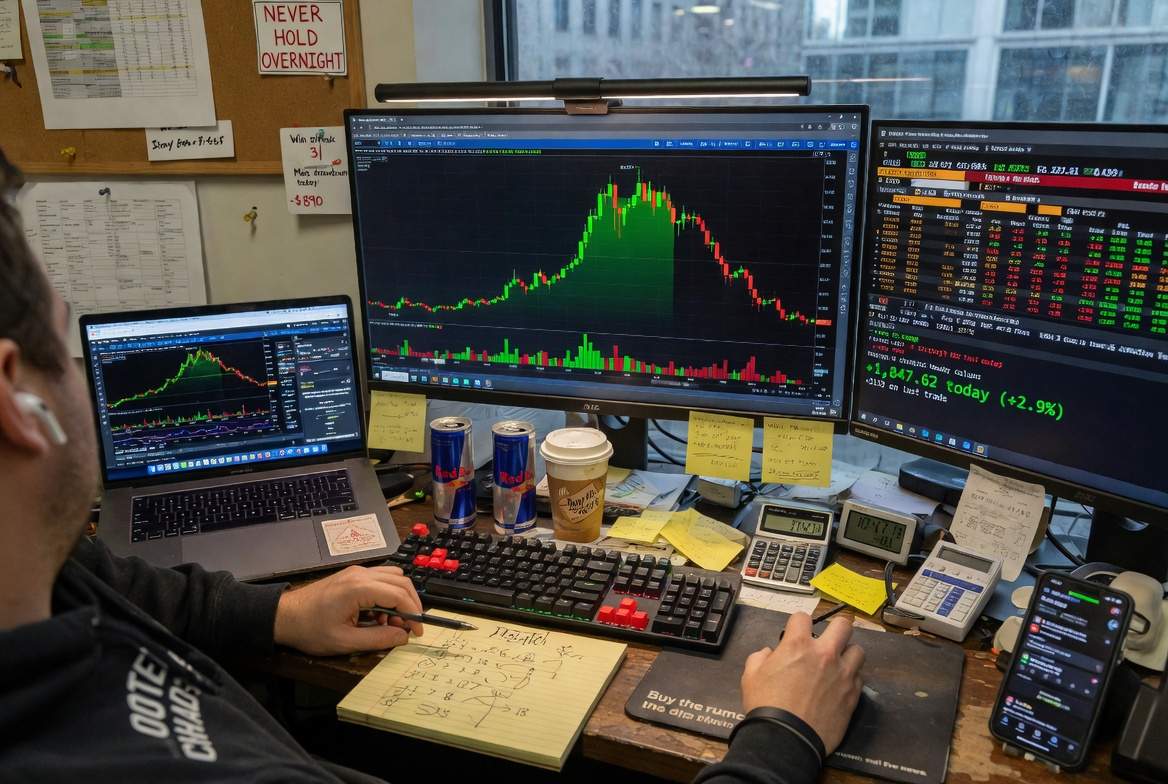
The $25,000 barrier that kept millions of retail investors out of day trading for 25 years was officially erased on June 4, 2026. The SEC’s approval of FINRA Rule 4210 amendments removed the Pattern Day Trader designation entirely, along with the minimum equity requirement that had defined who could and could not trade intraday in U.S. markets since 2001. For a generation of retail traders who had stared at that $25,000 wall and walked away, the landscape has fundamentally changed. The question now is not whether you can day trade, but whether you should, and if so, how to approach it without becoming a statistic.
The statistics are sobering. As of June 2026, only 1% to 4% of day traders maintain consistent profitability over a five-year period. Approximately 40% quit within the first month. Around 72% end a given year with a net loss. These are not numbers designed to discourage; they are numbers designed to inform. The traders who survive long enough to build a consistent edge share a common trait: they treated the learning process like a professional discipline, not a side hustle or a shortcut to income.
This guide covers what day trading actually is, what the new regulatory environment means for beginners, the five core strategies worth studying, the psychological framework that separates winners from the majority, and a structured roadmap for getting started without blowing up your account in the first 90 days.
What Day Trading Actually Is
Day trading is the practice of buying and selling a financial instrument, such as stocks, options, futures, or forex, within the same trading session, closing all positions before the market closes. Unlike long-term investors who hold positions for years and accept short-term volatility as noise, day traders attempt to profit from that noise directly. Every price move, every volume spike, every piece of breaking news is a potential trade signal.
How a Day Trade Works in Practice
Consider a straightforward example. A trader opens a position in a mid-cap technology stock at 9:45 AM EST, shortly after the opening volatility settles. The stock broke above a key resistance level on above-average volume. By 11:30 AM, the move has played out, momentum has faded, and the trader exits the position for a 1.8% gain. No overnight exposure, no weekend risk, no waiting for an earnings report three months away. The position lasted roughly 105 minutes.
That sounds clean. In practice, the same setup fails a meaningful percentage of the time. Resistance breaks that look convincing on a five-minute chart reverse sharply when broader market conditions shift. Moreover, commissions, the bid-ask spread, and slippage (the difference between the price you wanted and the price you got) all chip away at gross returns. Consequently, a gross return of 1.8% can become a net return of 0.9% to 1.3% depending on position size and execution quality.
What Day Trading Is Not
Day trading is frequently confused with two other activities: swing trading and algorithmic trading. Swing trading involves holding positions for several days to several weeks, accepting overnight risk in exchange for larger potential moves. By contrast, day trading explicitly eliminates overnight risk by requiring all positions to close before the session ends. Algorithmic trading, meanwhile, uses computer programs to execute strategies at speeds impossible for a human, often capturing fractions of a cent across millions of transactions. Human day traders compete in a different space, targeting larger intraday moves that algorithms do not fully arbitrage away.
Additionally, day trading is not gambling, though the line blurs for those who approach it without a defined edge, systematic risk management, or a trading journal. The distinction matters because professional traders with documented edges can and do generate consistent returns. However, those traders represent a small minority.
The New Regulatory Environment: What Changed in June 2026
For 25 years, a single rule defined who could participate in U.S. day trading: the Pattern Day Trader rule. Understanding what it was, why it existed, and what replaced it is essential context for any beginner entering the market in 2026.
The Old PDT Rule and Its Legacy
FINRA introduced the PDT rule in 2001 under Rule 4210. Any margin account holder who executed four or more day trades within a rolling five-business-day window was classified as a “pattern day trader.” That classification triggered a mandatory minimum equity requirement of $25,000, maintained at every market close. Accounts falling below the threshold faced restrictions limiting them to closing positions only.
The rule reflected the technology and market structure of 2001: volatile markets, slower executions, and limited retail access to real-time data. Regulators worried that undercapitalized retail traders were taking on excessive intraday leverage without understanding the risks.
What the June 2026 Change Means
On April 14, 2026, the SEC approved FINRA’s amendments to Rule 4210, formally eliminating the PDT designation and the $25,000 minimum equity requirement in their entirety. The effective date was June 4, 2026. A risk-based intraday margin framework replaced the old system, calculating buying power dynamically based on actual position risk and account volatility, rather than a static trade count.
In practice, this means several things for beginners. You can now day trade a margin account with as little as $2,000, the pre-existing FINRA minimum for trading on margin at all. The four-trades-in-five-days counter no longer exists. Brokers with system upgrade needs have until October 20, 2027 to fully phase in the new framework, so rollout will be staggered across platforms.
However, one risk has actually increased. Under the old system, a trader with $5,000 could lose, at most, $5,000 in a session. Under the new risk-based margin framework, that same trader can borrow against open positions intraday and potentially lose more than their account balance on a single badly managed trade. Therefore, the elimination of the PDT rule is not simply a liberalization; it is a shift of responsibility from a blunt regulatory guardrail to the individual trader’s risk management discipline.
PDT RULE: BEFORE vs. AFTER
Effective June 4, 2026 (FINRA Rule 4210 Amendment)
- $25,000 minimum equity required
- Max 3 day trades per rolling 5 days
- PDT flag restricts account on breach
- 4:1 fixed intraday leverage formula
- 90-day account freeze possible
- No minimum equity for day trading frequency
- Unlimited day trades in margin account
- No PDT designation or trade counting
- Dynamic intraday margin based on real risk
- $2,000 base margin minimum still applies
The Five Core Day Trading Strategies
No single strategy works for every trader. Successful day traders tend to specialize deeply in one approach, master it through repetition, and resist the temptation to trade every setup they see. The five strategies below represent the most widely used and documented approaches in current retail markets.
Strategy 1: Momentum Trading
Momentum trading is the practice of entering a stock or instrument already moving strongly in one direction, typically triggered by a catalyst: an earnings surprise, a breaking news event, an analyst upgrade, or a significant sector development. The premise is straightforward. When institutional and retail participants pile into a move simultaneously, short-term price momentum tends to persist for minutes to hours, offering a tradeable window.
Notably, momentum trading is the strategy most commonly associated with day trading in financial media, and for good reason. It aligns with how markets actually behave during high-volume sessions. Volume confirmation is essential; a price move without volume backing is far more likely to reverse sharply than one accompanied by three to five times average daily volume.
Furthermore, momentum strategies require a reliable real-time news source. In 2026, AI-powered news aggregators have made this easier and simultaneously more competitive, as the same tools available to retail traders are available to thousands of others, compressing the edge window on news-driven moves. Consequently, execution speed and pre-planned entry criteria matter more than they did five years ago.
Strategy 2: Breakout Trading
Breakout trading involves identifying a key resistance level that a stock has failed to break through multiple times, then entering when price finally pushes through that level on strong volume. The underlying logic is that resistance levels, once breached, often become support, and the supply of sell orders that had accumulated at that price level gets absorbed, creating a short-term vacuum of resistance above.
In practice, many breakouts fail. False breakouts, where price briefly exceeds a resistance level before reversing, are common, particularly in low-liquidity environments or when the broader market is trending against the individual stock’s direction. Consequently, experienced breakout traders typically use tight stop-losses placed just below the breakout level and accept a lower win rate in exchange for larger average wins on successful trades.
Strategy 3: Scalping
Scalping targets very small price moves, often capturing two to eight ticks on futures instruments or fractions of a percent on equities, through a high volume of trades over the course of a session. It is the highest-intensity strategy on this list, requiring near-constant focus, low-latency execution infrastructure, and the psychological capacity to take dozens of small losses without deviating from the system.
The financial profile of scalping is unusual. Earnings potential ranges from approximately $30 to $500 per day depending on capital and trade volume, but commission costs, bid-ask spread friction, and slippage can erode a substantial portion of gross profits. Moreover, scalping is mentally exhausting in a way that most beginners underestimate. Many traders who begin with scalping migrate toward momentum or breakout strategies within six to twelve months, simply because the cognitive load is unsustainable over long trading careers.
Strategy 4: Reversal (Mean Reversion) Trading
Reversal trading, sometimes called mean reversion, operates on the premise that extreme short-term price moves tend to correct back toward an equilibrium level. When a stock drops 5% in 20 minutes on no material news, a reversal trader sees a potential entry on the long side, anticipating that the initial selling was an overreaction that will partially unwind.
This strategy carries a distinct risk profile. By definition, reversal traders are buying into weakness or selling into strength, which means the position is briefly in the red before the anticipated correction materializes. Consequently, precise stop-loss placement is critical: too tight, and normal intraday volatility triggers the exit before the move plays out; too wide, and a single losing trade can exceed multiple winning trades in dollar terms.
Strategy 5: News-Based Trading
News-based trading involves monitoring real-time news feeds for catalysts, such as FDA approvals, mergers and acquisitions announcements, unexpected earnings guidance changes, or macro data releases, and positioning in the affected instrument before broader market participants have fully priced in the information.
Speed is the defining constraint of this strategy. In 2026, the window between a news event and full market pricing has compressed from minutes to seconds in many cases, particularly for large-cap equities covered by institutional desks. Nevertheless, opportunities persist in mid-cap and small-cap names where analyst and media coverage is thinner, and in the interpretation and second-order effects of macro announcements that take time for the market to process.
STRATEGY COMPARISON
Key characteristics at a glance (June 2026)
| Strategy | Trades per Day | Intensity | Win Rate Needed | Best For |
|---|---|---|---|---|
| Momentum | 3 to 8 | Medium | 45% to 55% | Catalyst-driven sessions |
| Breakout | 2 to 5 | Medium | 35% to 45% | Trending markets |
| Scalping | 20 to 100+ | Very High | 55% to 65% | High-liquidity instruments |
| Reversal | 2 to 6 | Medium to High | 50% to 60% | Range-bound markets |
| News-Based | 1 to 4 | High (bursts) | 40% to 50% | High catalyst days |
Risk Management: The Only Variable You Control
Strategy selection matters less than risk management over the long term. Professional traders consistently point to position sizing and stop-loss discipline as the primary variables that separate the 4% who survive from the 96% who do not. The market does not care about your analysis. Moreover, it does not care about your thesis, your conviction level, or your account balance. What you can control is how much capital you expose on any single trade.
The 1% Rule
The most widely cited professional risk management standard is the 1% rule: never risk more than 1% of total trading capital on a single trade. For a $10,000 account, that means a maximum loss of $100 per trade. For a $5,000 account, the cap is $50. This is not a suggestion; it is structural protection against the inevitable losing streaks that every trader experiences, including profitable ones.
The logic becomes clear when modeled against a losing streak. A trader risking 5% per trade who experiences ten consecutive losses, which is statistically common in strategies with 45% win rates, loses 40% of capital. By contrast, the same losing streak with 1% risk reduces capital by only 9.6%. Furthermore, the psychological impact differs enormously: a 40% drawdown forces many traders into revenge-trading behavior that accelerates losses, while a 10% drawdown is manageable and recoverable without emotional decision-making.
Stop-Loss Discipline
A stop-loss is a pre-defined price level at which you exit a losing position, converting an open loss into a realized one. Experienced traders set their stop-loss before entering a trade, not after. Specifically, they decide in advance: “If this stock moves against me by X amount, I am wrong about this trade and I exit.” That decision, made before the emotional investment of an open position, is consistently superior to trying to decide when to exit while watching real-time losses accumulate.
As of June 2026, approximately 88% of active day traders use stop-loss orders as part of their strategy, according to industry survey data. However, the quality of that usage varies widely. Setting a stop-loss too tight produces unnecessary exits on normal intraday volatility. Consequently, effective stop placement requires understanding the Average True Range (ATR) of the instrument being traded, placing stops outside the normal noise level of that particular security.
The Risk-to-Reward Minimum
Professional traders typically target a minimum reward-to-risk ratio of 2:1 on any given trade. This means that if you are risking $100 on a trade, the potential profit target should be at least $200. Over a large sample of trades, this ratio allows a trader to be profitable even with a win rate below 50%. Notably, a 40% win rate with a 2:1 reward-to-risk ratio produces a positive expected value, meaning the strategy generates profit in aggregate despite losing more trades than it wins.
The Psychology Framework Most Beginners Ignore
Technical knowledge is necessary but insufficient. Consider one striking data point: as of 2025, approximately 65% of day traders win more trades than they lose on a count basis. However, close to 82% of those traders still end the year with a net loss. The explanation is almost entirely psychological: traders let losses run and cut winners short, the precise opposite of what a profitable risk-to-reward framework requires.
The Emotional Cycle of a New Trader
The emotional arc of most new traders follows a predictable pattern. Initially, a few early wins create overconfidence. Subsequently, a larger loss triggers the instinct to “make it back” on the next trade, prompting oversizing or deviation from the established strategy. That revenge trade often produces a second loss. Consequently, emotional recovery takes longer than capital recovery, and many traders make their worst decisions in the two to four weeks following a significant drawdown.
Journaling as Professional Practice
Every serious trading educator and profitable practitioner emphasizes the same tool: the trading journal. A journal documents every trade, including the setup rationale, entry price, stop-loss level, profit target, actual exit, and a post-trade review noting what was done correctly and what was not. In practice, the journal serves a function that no indicator or strategy can replicate: it creates an honest, time-stamped record of patterns in your own decision-making, both good and bad.
Without a journal, improvement is largely accidental. With one, a trader can identify specific setups where their win rate is significantly above average, specific market conditions where they consistently lose, and recurring psychological patterns, such as exiting winning trades too early when a predetermined target has not been reached.
Your Step-by-Step Roadmap to Getting Started
The following roadmap reflects the sequence that professional traders and trading educators consistently recommend for beginners. Each phase has a clear milestone before proceeding to the next. Rushing through any phase is one of the most reliable ways to ensure early failure.
YOUR 6-PHASE GETTING STARTED ROADMAP
Complete each phase before advancing. Do not skip Phase 2.
Essential Tools and Technology in 2026
Day trading in 2026 does not require an expensive multi-monitor setup. However, certain tools are non-negotiable for consistent, disciplined execution.
The Core Toolkit
A real-time charting platform is the most critical tool. Thinkorswim (now part of Charles Schwab) remains the most feature-rich free option available to retail traders, offering level 2 data, customizable scanning, and paper trading integration. Interactive Brokers’ Trader Workstation is the professional standard for traders who prioritize order routing control and margin efficiency. Webull provides a clean, commission-free interface that is appropriate for beginners who are not yet paying close attention to execution quality.
A real-time news aggregator is the second essential tool, particularly for momentum and news-based strategies. Benzinga Pro, Market Chameleon, and TradeXchange each offer varying levels of speed and filtering capability. Furthermore, a trading journal application, such as TraderSync or Tradervue, dramatically simplifies the process of maintaining the performance records that drive improvement.
What You Do Not Need
Beginners are frequently upsold on signal services, chat rooms with “guaranteed” trade alerts, and multi-thousand-dollar educational courses. In practice, the most reliable evidence suggests that paid signal services produce worse outcomes for subscribers than systematic self-study combined with paper trading. Specifically, following someone else’s entries without internalizing the rationale does not build the pattern recognition required for independent profitable trading. Additionally, the subscription cost directly reduces net returns.
What the Real Numbers Say About Your Odds
Intellectual honesty requires presenting the failure rate data clearly. As of June 2026, the probability distribution of day trading outcomes is approximately as follows: roughly 40% of new traders quit within the first month, typically after early losses they had not mentally prepared for. Another 47% remain active for varying periods but do not achieve consistent net profitability. Approximately 13% remain active after three years, and of those, a meaningful fraction is profitable on an ongoing basis.
However, the composition of that 13% is instructive. Traders who paper-traded for at least 30 days before going live show significantly better three-year survival rates than those who skipped simulation. Traders who journaled consistently outperform those who did not. Moreover, traders who capped risk per trade at 1% or below showed materially lower account-blowup rates than those who used larger position sizing. In other words, the process described in this guide is not theoretical; it reflects the documented habits of the minority who actually build sustainable trading operations.
Common Beginner Mistakes Worth Cataloguing
The failure literature on day trading is extensive and consistent. Certain mistakes appear so reliably in the early trading histories of unsuccessful traders that they deserve explicit documentation.
Overtrading
More trades do not produce more profit. In fact, studies consistently show that average profit per trade falls as trade frequency increases beyond an optimal threshold for a given strategy. Overtrading typically stems from boredom during flat markets, fear of missing out on moves, or the psychological compulsion to “make back” a recent loss. Consequently, successful traders often predefine a maximum number of trades per day and stick to it regardless of perceived opportunity.
Ignoring the Broader Market
Individual stock behavior is strongly correlated with the broader market, particularly on high-volatility days. A breakout setup in a single stock has substantially higher failure rates when the S&P 500 is falling sharply. Conversely, mean reversion setups in weak stocks perform better in rising markets where sector rotation creates genuine selling pressure in specific names. Beginners who ignore the macro context of their intraday trades consistently underperform those who use it as a filter.
Averaging Down
Averaging down means buying more of a losing position in an attempt to reduce the average entry price. In long-term investing, this is sometimes a valid strategy. In day trading, it is almost invariably a mistake. It directly violates stop-loss discipline, increases exposure to a position that the market is telling you is wrong, and is the single most common factor in the accounts that experience catastrophic single-day losses. A losing position should be closed according to the predetermined stop-loss, not expanded.
What This Regulatory Moment Means Going Forward
The elimination of the PDT rule represents the most significant structural change to retail day trading access since zero-commission trading arrived in 2019. Furthermore, it arrives simultaneously with the proliferation of AI-assisted trading tools, commission-free platforms with institutional-grade analytics, and real-time data feeds that were inaccessible to retail traders a decade ago.
The democratization is genuine. Nevertheless, access without education creates casualties, and the data on retail trading outcomes suggests that the influx of new day traders who enter markets following the PDT rule removal will follow the same statistical distribution as prior cohorts unless they approach the practice with the same discipline the small minority of successful traders have always applied.
Day trading in 2026 has never been more accessible. In that sense, it has also never been more important to treat it as a profession rather than a pastime. The market does not accommodate learning curves with patience. The roadmap above is designed to create that cushion artificially, through simulation, micro-sizing, and journaling, until competence earns the right to take larger risks.
Ultimately, the traders who will benefit from this regulatory shift are not those who open a $2,000 account and begin trading immediately. They are the ones who use the newfound access as motivation to build the knowledge base, risk framework, and emotional discipline that have always defined the small percentage who make this work.
This article is for informational and educational purposes only. Nothing in this piece constitutes financial advice, investment recommendations, or an offer to buy or sell any security. Day trading involves substantial risk of loss. Past performance of any strategy is not indicative of future results. Always consult a qualified financial professional before making investment decisions. Investments-research.com does not provide individualized investment advice.